
 |
 |
 |
 |
 |
 |
|
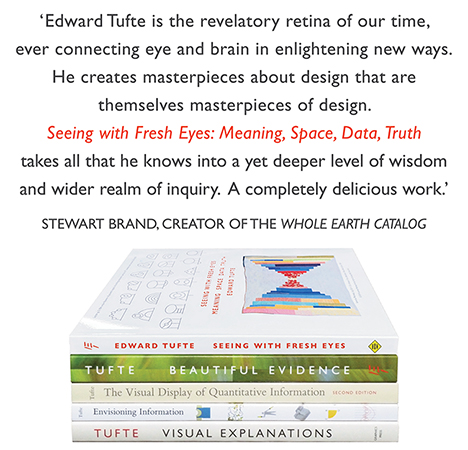
All 5 books, Edward Tufte paperback $180
All 5 clothbound books, autographed by ET $280
Visual Display of Quantitative Information
Envisioning Information
Visual Explanations
Beautiful Evidence
Seeing With Fresh Eyes
catalog + shopping cart
|
Edward Tufte e-books Immediate download to any computer: Visual and Statistical Thinking $5
The Cognitive Style of Powerpoint $5
Seeing Around + Feynman Diagrams $5
Data Analysis for Politics and Policy $9
catalog + shopping cart
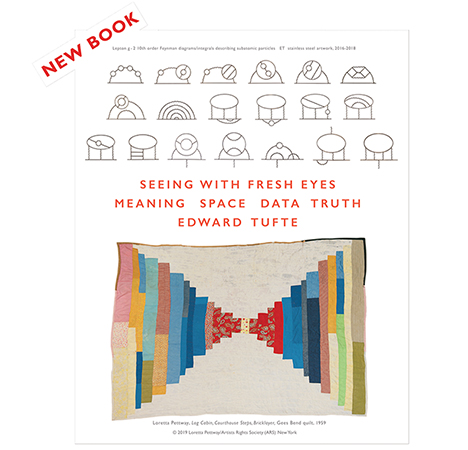
New ET Book
Seeing with Fresh Eyes:
catalog + shopping cart
Meaning, Space, Data, Truth |
Analyzing/Presenting Data/Information All 5 books + 4-hour ET online video course, keyed to the 5 books. |
What do you think of nomographs as a way to show data? Are there any good software packages or books on the topic?
-- Joe Iannucci (email)
I have not seen any current books on nomography, but I have an old one which you may be able to find at used book sources:
Levens, Alexander S. _Nomography_, 2nd ed. New York: John Wiley & Sons, Inc.; 1959.
Levens was a professor of mechanical engineering at Berkeley. The book has 296 pages. HTH.
Regards,
Mike
-- Michael Rosenborg (email)
According to the dictionary at Wolfram research's web site, a nomograph (nomogram) is a graph that is useful for solving an equation. An example is available on-line at Rice University's flood alert center:
http://www.floodalert.org/BraysFAS/index.php?sPageID=Nomograph&sRadar=KHGX
It relates the intensity of rainfall to rainfall duration and expected waterflow in Brays Bayou, with color coding (yellow to orange to bright red) indicating the level of danger of flooding at the Bayou. A good narrative explains how to use the chart to solve the problem -- if it rains x inches in y hours, how bad will the flooding be?
[link updated February 2005]
-- Scott Zetlan (email)
I liked to see nomographs (nomograms) when they were still being used, but I did not always gain a complete understanding of the relationships among the variables from the nomograms. There is a nice orderly contour-line type aesthetic pattern to some nomograms. But the equation behind the nomogram usually gives a better theoretical sense of what was going on; that is, Y varies as log X, taken at various levels of Z, for example. Still, to see the systematic contours--the shape of the equations--is quite helpful.
A great virtue of nomograms is that they are usually multivariate, showing relationships among variables in quite complex systems.
It is surely helpful to have both an analysis of the underlying equation along with nomogram visualization of the curves generated by the equation. Nomograms show how equations perform.
Nomograms remain useful for understanding; their computational use has passed. Computational power is so cheap now, we don't need look-up tables or nomograms; we can just plug the numbers into the equations and solve.
Recently nomograms appear to be used mainly as practical workaday graphics in local applications and particular trades. Nomograms don't appear often enough in scientific textbooks. Nomograms are routinely used in engineering statistics books in order to show operating characteristic curves. The original graphic of Moore's Law is a nice nomogram.
The article by Thomas L. Hankins, "Blood, Dirt, and Nomograms: A Particular History of Graphs," Isis, 90 (1999), 50-80 is excellent, a helpful history and depiction of nomograms. It can be seen at http://www.journals.uchicago.edu/Isis/journal/demo/v000n000/000000/000000.text.html . Hankins' article at this link shows spectacular high-resolution images of many great nomograms.
-- Edward Tufte
See an excellent website: http://www.projectrho.com/nomogram/index.html with extensive literature references: http://www.projectrho.com/nomogram/reading.html
-- Zenon Kulpa
-- Zenon Kulpa (email)
I have written a three-part article on nomography that might be of interest. It includes some references as well as links to online examples and programs. It starts here with the first part:
http://myreckonings.com/wordpress/2008/01/09/the-art-of-nomography-i-geometric-design
-- Ron Doerfler (email)
 |
|
|||||||
