

 |
 |
 |
 |
 |
 |
|
All 5 books, Edward Tufte paperback $180
All 5 clothbound books, autographed by ET $280
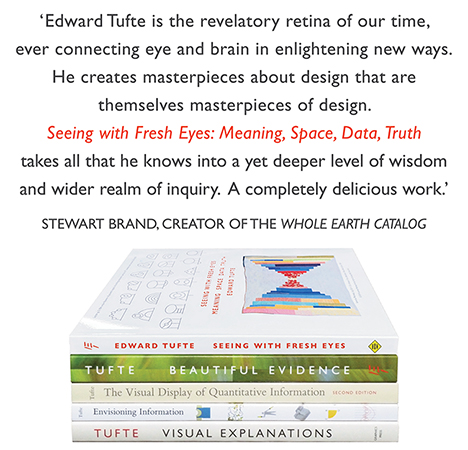
Visual Display of Quantitative Information
Envisioning Information
Visual Explanations
Beautiful Evidence
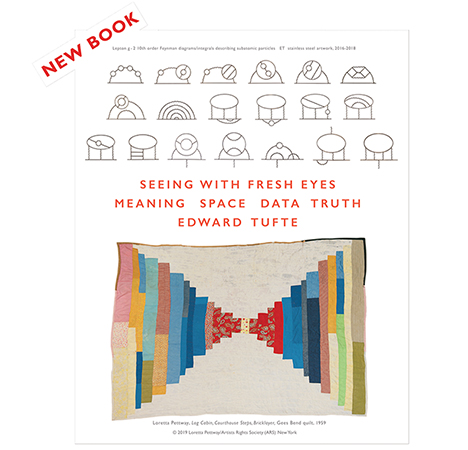
Seeing With Fresh Eyes
catalog + shopping cart
|
Edward Tufte e-books Immediate download to any computer: Visual and Statistical Thinking $5
The Cognitive Style of Powerpoint $5
Seeing Around + Feynman Diagrams $5
Data Analysis for Politics and Policy $9
catalog + shopping cart
New ET Book
Seeing with Fresh Eyes:
catalog + shopping cart
Meaning, Space, Data, Truth |
Analyzing/Presenting Data/Information All 5 books + 4-hour ET online video course, keyed to the 5 books. |
Hello,
I don't know much about the stock market, but I like this site's innovative way of compressing the hard-to-read stock page of the morning paper into a simple snapshot. It also has a seasonal colour scheme...
http://activequote.fidelity.com/rtrnews/market_map.phtml
I would be interested if others know of other good visualizations on the internet.
Cheers,
Matt
[link updated February 2005]
-- Matt (email)
Several people have mentioned these sorts of displays. Here are some issues:
The use of two-dimensional areas to show one-dimensional numbers is always a problem. See The Visual Display of Quantitative Information, chapter 2.
It would be very helpful to show the same data in a well-designed table of numbers; then we could compare the graphic with the table.
Would expert stock analysts use this device? The display is certainly charming, but probably too thin for serious data analysis.
The lack of specific labels for stocks is a problem. There is insufficient text in the graphic. For nearly all data analysis involving nouns (for example, names of sectors) and numbers, a supertable is the preferred display. See VDQI, chapter 9. Another alternative is the semi-graphic / semi-table method of spark lines.
A chronic problem with most stock market displays is to encourage over-weighting of the most recent results--what is called appropriately the recency bias. Human beings, perhaps for evolutionary reasons, give too much weight to the most recent event in making decisions. That intense responsiveness to the most recent data, that paranoid alertness, might have served well thousands of years ago to defuse the threat of snakes coming into the cave-house, but today we need more contextual long-term analysis. One of the useful characteristics of spark lines is that they allow us to compare today's change with the changes for, say, every day for the entire last year.
-- Edward Tufte
In addition to Mr. Tufte's comments, I would also be interested in knowing the specific actionable use of this chart. With any 'report' there should be an action(s) associated with the information it presents.
-- Wiley Vasquez (email)
Smaller organisations, especially not-for profits, often like to have a proportion of their treasury monies in something wider than AAA bonds, but cannot justify outsourcing a whole portfolio. Such a display could be use to "semi- amateurs" who have some professional knowledge. You get a feel of what's going on from the graphic, and even if you didn't use it directly to invest it would help in amassing a store of knowledge at least large enough for a broker to treat you with some respect.
It is an adjunct to the information base of someone whose main business it isn't, but who needs some idea of what's going out just outside the immediate management focus.
-- Martin Ternouth (email)
I was the lead designer of the market map display (for SmartMoney, which licensed it to the cited site) and am also a Tufte admirer, so this thread is fascinating to me. Here are a couple of comments.
All kinds of experts do indeed use this device to analyze data, but not necessarily in an unhurried, methodical style.
Let me describe one expert I observed. Her job is to execute large trades for institutional investors. She can't simply announce she wants to buy $1,000,000 of Ford, since the price would instantly skyrocket. So instead she arranges many small carefully timed trades to keep prices steady. (Her activities are nothing like classic long-term investing but she is serving a critical social goal by maintaining market liquidity.)
To time her trades she must continually make guesses about near-term market activity, based on data from three computer screens, a TV, and a large overhead board. She told me the SmartMoney map gives her a sense of the overall "market weather" far faster than a table-based display, and she generally devotes one of her three screens to the map.
Her case is typical of expert users of the map. They are usually in a hurry and must absorb data from multiple sources. They often keep the map in view all day and monitor it with frequent glances, occasionally "drilling down" into it with the mouse for more data.
Given that context, I can describe why we made some of the design decisions we did.
First, the goal of using area to represent market capitalization is to direct attention and give an effective macro/micro reading. Bigger companies and sectors get more visual emphasis than smaller ones. The macro/micro reading comes from combining colors and areas: e.g. if you look at the map across the room you get an instant sense of a key stock market summary statistic, the overall market-cap weighted performance. This kind of "glanceability" and attention management is critical for viewers in a hurry. On the other hand, precise market cap comparisons--problematic due to the area encoding--are generally not important to traders.
Second, the original version of the map had more text, including a ticker symbol inside each company's rectangle. But the more we used and tested the map, the more text we removed. We discovered the company labels interfered with a quick reading of the display. And, surprisingly to us, test users rapidly learned which rectangles corresponded to which sectors and industries, and even the location of many of the companies--for habitual users, the display becomes like a geographic map of a familiar region where labels are redundant. Compare the maps on pp. 17-19 of VDQI or pp. 40-41 of Envisioning Information. Even so, given the needs of first-time users I'm still not sure we made the right decision, and there may well be a way to put more text on the screen without hurting the overall legibility.
Finally, to compare with a well-designed table, I recommend looking at page C2 of the Wall Street Journal. The data is not quite the same, but the goal--providing an overview of market activity--is parallel. I think the table and map are each useful but vastly different in what they convey best. To compare, look at both the table and the map before the market opens on a couple of successive days and see for yourself the difference in perspective.
-- Martin Wattenberg (email)
The Map of the Market was mentioned in Bloomberg (January 20, 2003), along with other examples of "a technique known as information visualization that is making its way into the mainstream after a long gestation in computer science labs."
Does anyone have comments about Grokker, from Groxis? The other tool mentioned -- MindManager (MindJet) -- has come up in another thread.
-- Scott Zetlan (email)
The URL for the map has apparently been changed to: http://activequote.fidelity.com/rtrnews/market_map.phtml
-- Peter Harkins (email)
I recently was doing some research on Google stock on the Fidelity website.
I decided to chart daily activity using the "Draw Chart" functionality available via this link:
http://eresearch.fidelity.com/eresearch/goto/evaluate/chart.jhtml?symbols=GOOG
I found the resulting chart to be mostly meaningless.
It does seem to be apparent that there is some movement up and down between a high of approximately 222 and a low of approximately 218.
The horizontal bars should be labeled. I still am not certain what they mean. I assume either a high/low at that 15 minute mark or a bid/ask at that 15 minute mark??
Iterestingly, if you try to draw a chart of 1-day/Daily, the chart is even more meaningless. Not that I think I would draw a chart of 1-day/Daily? What exactly would I be comparing and analyzing if I did so?
-- Jennifer Wilmer (email)
This is 3D visualization of multiple charts in stock market.
http://www.sciencegl.com/Stock_market/Stock_market.htm
-- igor (email)
These provide a useful stacking of sparklines, although such arrangements may hide the ups and downs of divergently trending stocks. The labels are not so good in the plots and the color code has no legend. The ribbon quality of the sparklines is an interesting variation although its only purpose is to allow the aerial overview. The skewed baseplane leaves a lot of empty, content-free space on the rectangular 2D plane of the interface; thus in some of the plots more than half the visual field is simply a content-free color background.
The idea of bringing scientific quality graphics to financial data is excellent.
Sometimes similar sparklines can be piled directly on top of one another, with divergent lines highlighted, as in the case of the top 10 mutual funds in the sparklines chapter elsewhere on board.
-- Edward Tufte (email)
NYXTrac is a stock heat map, representing the performance of all common stocks listed on the NYSE Euronext. The heat map renders the individual percent changes in market value for more than 1800 U.S. and non-U.S. stocks utilizing Yahoo's market data, providing a "at a glance" view of the market.
A simple interface allows to filter the stocks by logical groupings such as geographic region, industries and major indices. The heat map can also be sorted by ticker symbol, price change, volume or market capitalization. The filter and sorting buttons located on the top of the map are color coded according to the performance of the group. You can "mouse-over" any button to get the trading volume of the group.
The project is featured in this years Communication Arts Interactive Annual. Have a look at" http://www.commarts.com/interactive/cai10/nyxtrac.html
Or go to http://stockmapper.com/
Would love to get your comments...
Best, Hermann Zschiegner
-- Hermann Zschiegner (email)
 |
|
||||||||||