

 |
 |
 |
 |
 |
 |
|
All 5 books, Edward Tufte paperback $180
All 5 clothbound books, autographed by ET $280
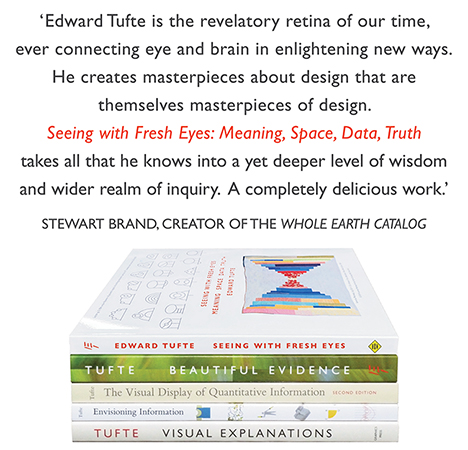
Visual Display of Quantitative Information
Envisioning Information
Visual Explanations
Beautiful Evidence
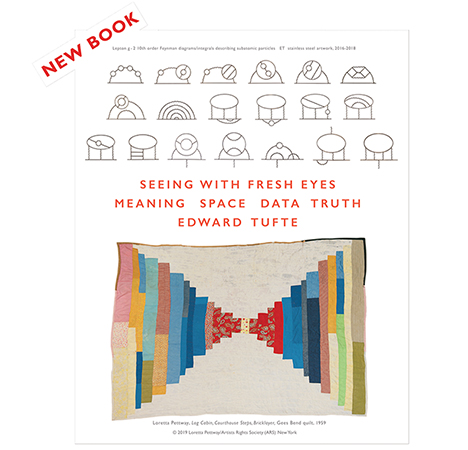
Seeing With Fresh Eyes
catalog + shopping cart
|
Edward Tufte e-books Immediate download to any computer: Visual and Statistical Thinking $5
The Cognitive Style of Powerpoint $5
Seeing Around + Feynman Diagrams $5
Data Analysis for Politics and Policy $9
catalog + shopping cart
New ET Book
Seeing with Fresh Eyes:
catalog + shopping cart
Meaning, Space, Data, Truth |
Analyzing/Presenting Data/Information All 5 books + 4-hour ET online video course, keyed to the 5 books. |
I'm developing a training module for epidemiologists on questionnaire design. I'm looking for information on how to develop questionnaires for activities in the four fundamental functions of epidemiology: surveillance, disease investigation, analytic studies, and program evaluation. Thanks
-- Diane Lowry (email)
Search this forum using the word "questionnaire" for some thoughts.
Read Chapter 2 of Visual Explantions to see John Snow's streetcorner detective work combining statistical data and interviews to figure out a cholera epidemic.
Sometimes a helpful question is of the form: (1) state a fact, and (2) then ask people what they think this might be the case. For example: "250 people on this cruise ship have the Norwalk virus. Wy do you think this happened?" This allows you to see how people reason about a problem in their own words. Maybe this open-ended question will give some insights into how people reason about causes, prevention in their own lives. Such a question might even generate a clue about what happened.
Question-asking in epidemiological research has a long history; you should find the classics in the field and see what was done.
It is often valuable to ask questions that have been asked on other surveys; now you have some baseline comparisons. Also you might ask questions that appeared on the U.S. census; now you can compare census results for the relevant area with the results of your survey. It also a way to detect biases in your sample. Generate external comparisons with your data, both for validation of your survey and to learn more about your respondents compared to the local population. Good questions generate comparisons.
Anything that can be done to reduce the enormous problem (and resulting bias) of nonresponse and refusals is helpful.
-- Edward Tufte
Having completed graduate modules in this area recently I thought the following information may be useful.
Reference
1. Questionnaire Design, Interviewing and Attitude Measurement - A.N.Oppenheim ISBN 1 85567 044 5
2.Measuring Health and Medical Outcomes - Crispin Jenkinson ISBN 1-85728-084-9
Practical aspects
3. Pilot, pilot, pilot - the truth of any questionnaires or forms are revealed as they are filled out. Practical sessions where forms are constructed and ideally tested, are often more useful than reams of theory.
-- Patrick Sequeira (email)
I have recently been instructed that Dr. Don Dillman at Washington State University is the guru in all things questionaire. I can't say anything more, as I'm just beginning to read his stuff.
For more, his website is here http://www.sesrc.wsu.edu/dillman and he has a couple of books including a new edition to the classic, "Mail and Internet Surveys: The Tailored Design Method."
-- Kent Karnofski (email)
 |
|
|||||||
