

 |
 |
 |
 |
 |
 |
|
All 5 books, Edward Tufte paperback $180
All 5 clothbound books, autographed by ET $280
Visual Display of Quantitative Information
Envisioning Information
Visual Explanations
Beautiful Evidence
Seeing With Fresh Eyes
catalog + shopping cart
|
Edward Tufte e-books Immediate download to any computer: Visual and Statistical Thinking $5
The Cognitive Style of Powerpoint $5
Seeing Around + Feynman Diagrams $5
Data Analysis for Politics and Policy $9
catalog + shopping cart
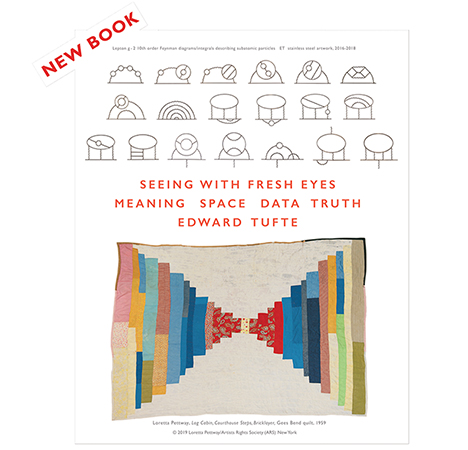
New ET Book
Seeing with Fresh Eyes:
catalog + shopping cart
Meaning, Space, Data, Truth |
Analyzing/Presenting Data/Information All 5 books + 4-hour ET online video course, keyed to the 5 books. |



A timely "Word of the Day" arrived in my inbox this morning:
objet trouve \AWB-zhay-troo-VAY\ noun
: a natural or discarded object found by chance and held to have aesthetic value
Example sentence: The museum's latest show, which features objets trouves, is a dramatic change from last year's exhibition of medieval religious art.
-- Doug Allen (email)
From my previous post, I should have included the rest of the Word of the Day entry:
"Objet trouve" comes from French, where it literally means "found object." The term entered English during the early 20th century, a time when many artists challenged traditional ideas about the nature of true art. Surrealists and other artists, for instance, held that any object could be a work of art if a person recognized its aesthetic merit. "Objet trouve" can refer to naturally formed objects whose beauty is the result of natural forces as well as to man-made artifacts (such as bathtubs, wrecked cars, or scrap metal) that were not originally created as art but are displayed as such.
Source: Merriam-Webster "Word of the Day" for August 27, 2007.
-- Doug Allen (email)
Skewed Machine fascinates me.
Did you do anything special to get the uniform rusty appearance?
Three other pieces come to mind. The first is Carhenge, the Stonehenge parody made with junked cars in western Nebraska.
The second is Cadillac Ranch, a collection of various junked Cadillacs half-buried in Texas.
The third is Spindle, made with eight junked cars skewered on a tall spindle in Berwyn, a western suburb of Chicago. The red VW Beetle topping Spindle is a metaphorical cherry.
Sadly, the future of Spindle is uncertain, according to a Chicago Sun Times article. It stands in the way of a major retail pharmacy development in a parking lot at the southeast corner of Cermak and Harlem. Either a move or demolition will happen. Surely there's a home somewhere for Spindle.
What's wrong with a little whimsy?
-- Jon Gross (email)
Jon Gross' post reminds me of the old Ghost Parking Lot, in Hamden, CT. It was demolished a few years ago. http://www.roadsideamerica.com/attract/CTHAMparking.html
-- Miklos Z. Kiss (email)
Skewed Machine: responses to recent questions
Most of the uniform rusty appearance was achieved as the broken-down Caterpillar bulldozer sat in a farmer's field, largely undisturbed, for 25 years. After obtaining the Cat from a scrap dealer, we removed a lot of rusted-out and unbeautiful parts to make it more sculptural, followed by a power washing and hand scrubbing. All this took about 18 months of on-and-off meditation, design, cleaning, and welding. Andy Conklin did the amazing base; my friends at United Concrete did the installation, as shown in above time-lapse movie. Sometimes, although not here, we've experimented with salt water or just outdoor exposure for a few months to improve the rust patina.
A natural rust patina is very soft, nearly powdery, and easily damaged. Richard Serra sometimes uses "weatherproof steel," which is probably steel made with some copper added. Such steel achieves a much harder rust patina than the usual powdery rusty steel. In some other pieces (yet unpublished at this board) I have used tool steel with a caked oily rust patina that is less sensitive to bruising. The 8 Millstone pieces (see elsewhere on this board) have rust mixed with what appears to be a thin tar-like surface preservative that was slowly eroded by natural rusting outdoors.
Yes, I've often admired Carhenge and Cadillac Ranch, which Skewed Machine parallels (although SM is only a single machine in the air and earth--maybe there should be a series of embedded bulldozers!).
How good to be reminded (by M. Z. Kiss) of the Ghost Parking Lot in Hamden, about 6 miles from our other sculpture field in Cheshire, CT. The sunken asphalt ghost VW beetle was a special favorite of mine. Not everyone in our household was a fan of the asphalt ghost cars but I would make a special trip by the dreary mall in Hamden to see the black ghost cars, which were particuarly enchanting at night. (Also nearby were a good Chinese restaurant and an excellent bagel place.)
Skewed Machine is located up a 0.7 mile dirt road leading to our sculputure fields at Hogpen Hill Farms and is the first sculpture that appears after driving up the road. The piece has received particular admiration and commentary from truck drivers bringing up tri-axle truck loads of sand and top soil. The drivers know about Cat bulldozers but have never seen something like this. At times the piece provokes sculptural seeing--viewing in terms of shape, negative space, skewness, and color--on the part of people new to abstract sculpture ("What the hell is this?" "I must have my ten year-old daughter come up and take a picture for school." "How did this happen?" "My father had a Cat like that." ). I then show our visitors my more abstract and analytical pieces to explain (in surely an over-didactic way) what my landscape sculptures are up to. I located Skewed Machine so as to have a happy introduction to Hogpen Hill Farms but did not expect such a generous response by those who don't quite match the typical demographics of most of our visitors (who are curators on scouting visits, friends, and town regulatory officials).
-- Edward Tufte
Skewed Machine, seeing it for the first time today, reminded me for a moment of Wall-E it could be a cousin of the forlorn little machine with tracks. Resting at such a jaunty angle it clearly has a sense of humor.
Presenting a found object can be challenging; something has to be done to it separate it from it's original use, to frame it. Too often the framing device undermines the original interesting object. Your solution is perfect in that it re- presents the object for us to appreciate and consider while not falling into visual trickery. Your pedestal is clearly visible and has a high degree of intention all of which allows the machine to breath a new life.
I wonder if you have seen the amazing sculpture: Big Rig Jig? http://bigrigjig.com/
-- Jody Rhone (email)
The installation of Edward Tufte's Skewed Machine at the Aldrich Contemporary Art Museum was completed
on May 29, 2009. The piece is part of ET's exhibit Seeing Around from June 21, 2009 - January 17, 2010.
This video is also available on YouTube and Vimeo
-- Edward Tufte
 |
|
|||||||||||||||||||||||||||||||||||||||||||||||||||||||||||||||||||||||||||||||||||||||||


