

 |
 |
 |
 |
 |
 |
|
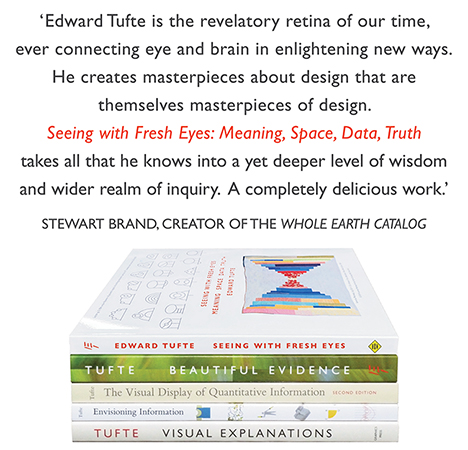
All 5 books, Edward Tufte paperback $180
All 5 clothbound books, autographed by ET $280
Visual Display of Quantitative Information
Envisioning Information
Visual Explanations
Beautiful Evidence
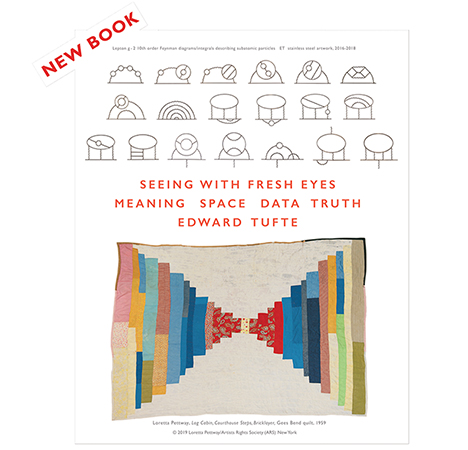
Seeing With Fresh Eyes
catalog + shopping cart
|
Edward Tufte e-books Immediate download to any computer: Visual and Statistical Thinking $5
The Cognitive Style of Powerpoint $5
Seeing Around + Feynman Diagrams $5
Data Analysis for Politics and Policy $9
catalog + shopping cart
New ET Book
Seeing with Fresh Eyes:
catalog + shopping cart
Meaning, Space, Data, Truth |
Analyzing/Presenting Data/Information All 5 books + 4-hour ET online video course, keyed to the 5 books. |
Ways of seeing
Landscape sculpture installation art is obviously best seen in person in real spaceland--an experience limited to
those who show up.
The dynamic range of human eyes exceeds that of video and still photography. Those
eyes see in
three-space, those eyes can walk around, those eyes reside in the same 3D+time space of the artwork.
However, video and still photography provide
different experiences of artwork.
Time-lapse video (as in all 3 segments of ZZ Smile) provide a new
experience of the artwork by compressing
hours
of slow and subtle color changes into an intense and perceptive few minutes. And still photographs, particularly from
diverse
viewpoints, provide high-resolution contemplative detail. (I always photograph the pre-construction models for larger
pieces to see the pieces better.) Stills also decontextualize artworks.
Part of project 5 (my new book/film/whatever) is to show how a pluralism of methods reveals different aspects of
real-land
objects. The general philosophy is "To see, do whatever it takes." Various methods for obtaining visual
experiences are not competitors, or necessarily to be judged as better or worse--but rather as colleagues in
providing diverse visual readings of real-world objects and events.
I also think of my artworks as
image generators that provide a multiplicity of visual
experiences under varying light, observer positions, contexts. Thus my remark at the end of the video about the
resemblance of ZZ Smile images to beautiful pencil outline drawing filled in soft and subtle water-color tones.
The paradox of Project 5 (and the universal problem of representation) is that it must describe real-land seeing experiences using the flatlands of movies, paper, computer screens--except for those who show up at the artworks.
-- Edward Tufte
Response to ZZ Smile
 |
-- Edward Tufte
 |
 |
 |
-- Edward Tufte
I first saw a photo of Zerlina's Smile at the end of the seminar in Seattle. My first impression was of water droplets hanging from a blade of grass. These additional photos convince me that this way of seeing the sculpture is likely reinforced by the play of color and reflections on the piece as the lighting changes throughout the day. Lovely. Probably my favorite piece next to Spring Arcs.
-- Debbie McGlenn (email)
 |
|
|||||||||||||||||||||||||||||||||||||||||||||||||||||||||||||||||||||||||||||||||||||||||


