

 |
 |
 |
 |
 |
 |
|
All 5 books, Edward Tufte paperback $180
All 5 clothbound books, autographed by ET $280
Visual Display of Quantitative Information
Envisioning Information
Visual Explanations
Beautiful Evidence
Seeing With Fresh Eyes
catalog + shopping cart
|
Edward Tufte e-books Immediate download to any computer: Visual and Statistical Thinking $5
The Cognitive Style of Powerpoint $5
Seeing Around + Feynman Diagrams $5
Data Analysis for Politics and Policy $9
catalog + shopping cart
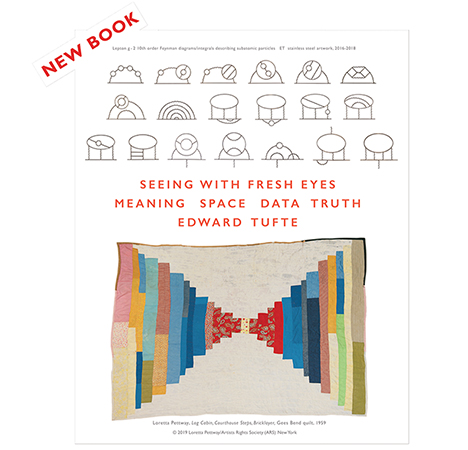
New ET Book
Seeing with Fresh Eyes:
catalog + shopping cart
Meaning, Space, Data, Truth |
Analyzing/Presenting Data/Information All 5 books + 4-hour ET online video course, keyed to the 5 books. |

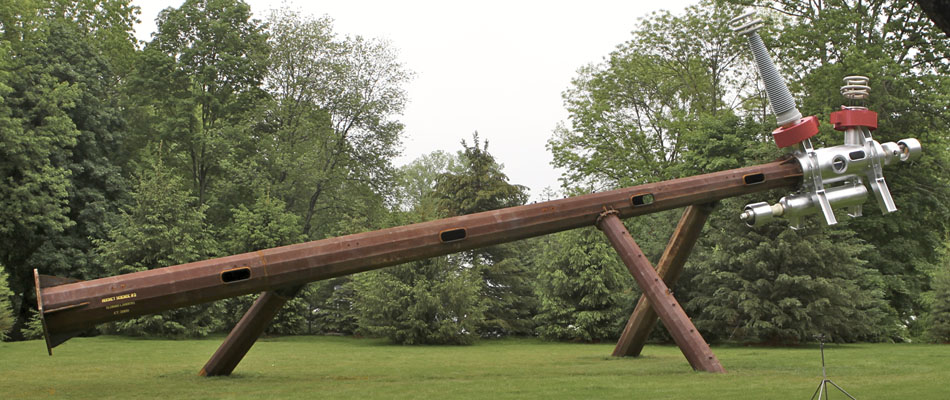
We recently installed my new sculpture Rocket Science #2 (Lunar Lander) at the
Aldrich Contemporary Art Museum in Ridgefield, Connecticut in preparation for my
show, Seeing Around, June 13, 2009 to January 17, 2010. The piece is in the style of
Home-Brew High Industrial Fruitcake. It is 70 feet or 21 meters long, and 35 feet or
11 meters high. The installation was carried out by my staff and by United Concrete
(Yalesville, CT), who also constructed the piece.
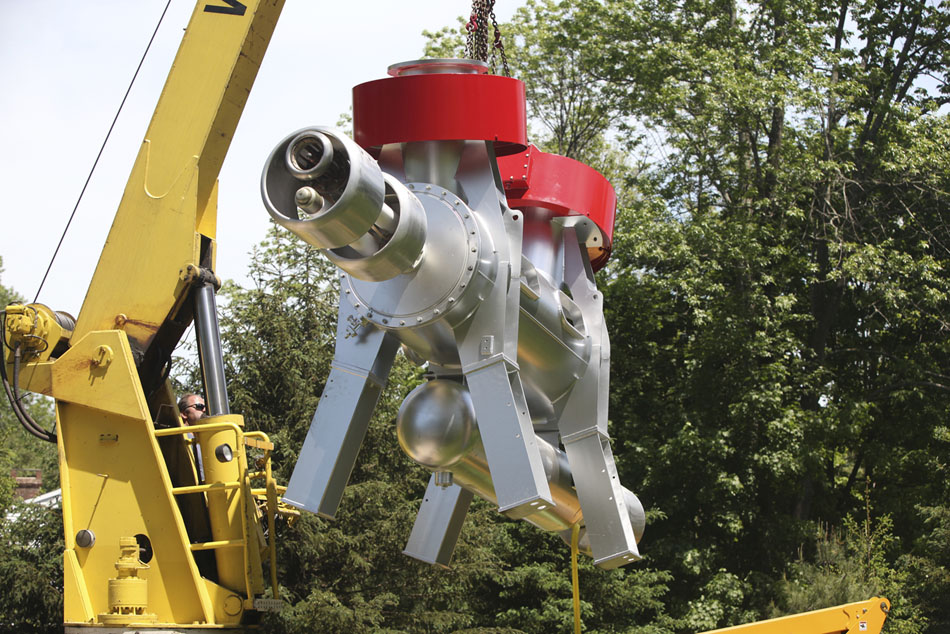
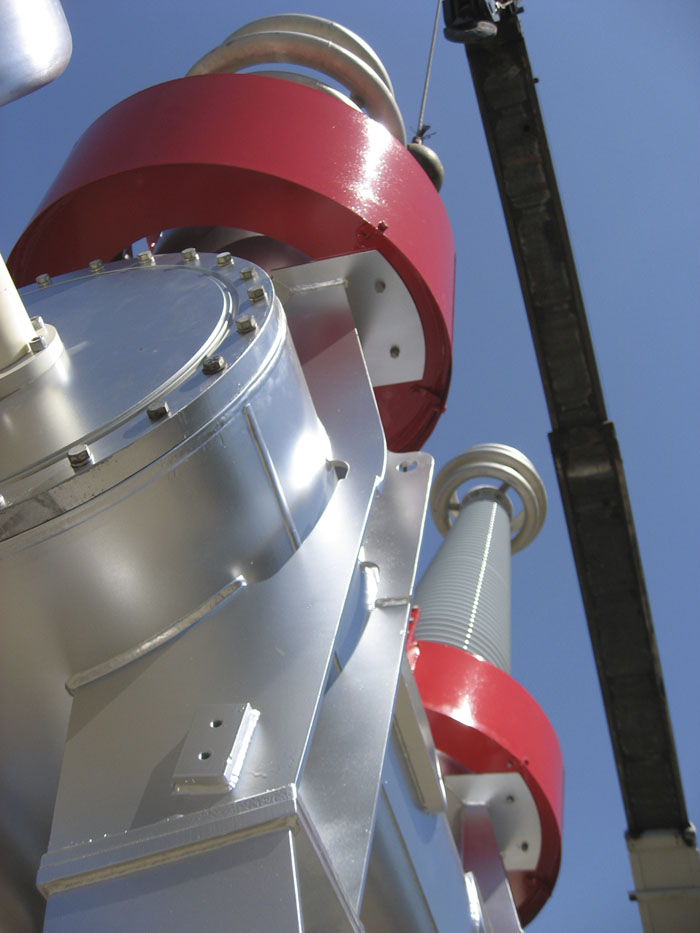
Below, Rocket Science #2 (Lunar Lander) during construction and installation.
 |
 |
 |
 |
 |
This video is also available on YouTube and Vimeo
-- Edward Tufte
Response to Rocket Science II (Lunar Lander)
Having been involved in the relocation of a fragile but bulky scientific apparatus, I've been paying more attention to the work that riggers do. The job of getting the piece in place looks like it was a fascinating story in itself.
Did you choose a rigging crew with experience installing large sculpture, or is the installation work sufficiently straightforward for professional riggers that they wouldn't need special experience?
-- Tom Metcalf (email)
Rigging
We use both generalist riggers and sculpture specialists. Both types do fine. Rigging large complex objects is rigging large complex objects, whether septic tanks or sculpture.
Sculpture specialists are more expensive. To have sufficient business, they need to serve several states (Connecticut, New York, New Jersey, Massachusetts). Because some of these states are strong union states, the workers must be union members and bill at union rates in all the states.
Lots of riggers are looking for work these days, thus reducing the rates of non-union generalist riggers. The result is that the fees of unionized sculpture specialists run about twice those of non-union generalists. There are also sometimes significant attitudinal differences between the two types.
Nonetheless, for particularly difficult local jobs in Connecticut, such as installing and de-installing a piece hung from a museum ceiling, we rely on sculpture specialists. Otherwise we prefer the cheerier generalists, who might do a one-day outdoor installation of a single artwork for $2000 compared to a specialist price of $4000.
In the worlds of museums and of landscape sculpture, that $2000 differential for one day for one piece is a large amount. That's because museums have little money. And because, as Richard Serra may have said, "the market for large abstract outdoor sculpture is like the market for Canadian experimental poetry."
On installation and rigging (from my essay Seeing Around):
Big artworks are big deals to install; outdoor pieces often outweigh humans by hundreds-fold. Steelworkers, riggers, operators--who do the heavy lifting and putting together--engage in a complex and sometimes dangerous craft. Like sculptors, they move big metal to precise 3D locations, work against gravity, closely attend to rigging operations, and appreciate the sheer physicality of large artworks. Landscape installations are challenging and notable, and everyone involved usually comes away with a good story.
-- Edward Tufte
 |
|
|||||||||||||||||||||||||||||||||||||||||||||||||||||||||||||||||||||||||||||||||||||||||


