Warning: Trying to access array offset on value of type bool in /nas/content/live/graphicspress/wp-content/themes/edwardtufte/archive.php on line 21
Porta and the Birds (at 300 frames/second)
Slow-motion movies of animals reveal previously unavailable information about the complexity and dynamics of motion that we have seen only in fast-paced real time. High-speed cameras (now relatively inexpensive) provide all sorts of fresh and interesting slow-motion views of sports, dogs, cats, birds, dance, water--as well as the usual explosions, bullets through apples, and breaking eggs.
Andrei Severny and I made this video of animals in slow motion with a new Casio Exlim EX-F1, which provides video at 300, 600, and 1200 fps (frames per second). We first took movies of Porta, the dog, at 300 fps, which means that motion is slowed tenfold.
Later that afternoon, we did bird movies also at 300 fps. In the video, the birds move rather fast at 1/10 speed! About 32 minutes of video were edited down in FinalCut to 2:26. A special effect in the second segment was created in the edit.
This video is also available on YouTube and Vimeo
Spatial resolution per frame decreases as temporal resolution increases, as shown by the specs for the EX-F1:
Hi-Speed Movies (HS):
512 x 384 (300 fps, 30-300 fps)
432 x 192 (600 fps)
336 x 96 (1200 fps)
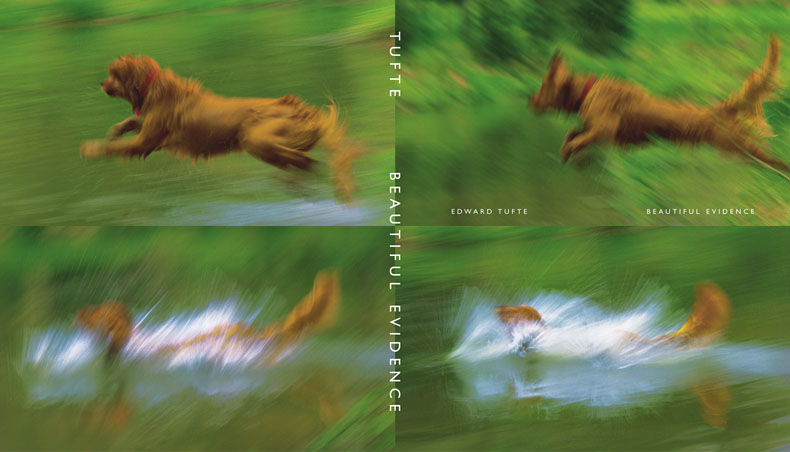
It would be wonderful to see Max Diving in slow motion as well as in the sequential stills in Beautiful Evidence
Warning: Undefined variable $count in /nas/content/live/graphicspress/wp-content/themes/edwardtufte/archive.php on line 24
Warning: Trying to access array offset on value of type bool in /nas/content/live/graphicspress/wp-content/themes/edwardtufte/archive.php on line 21
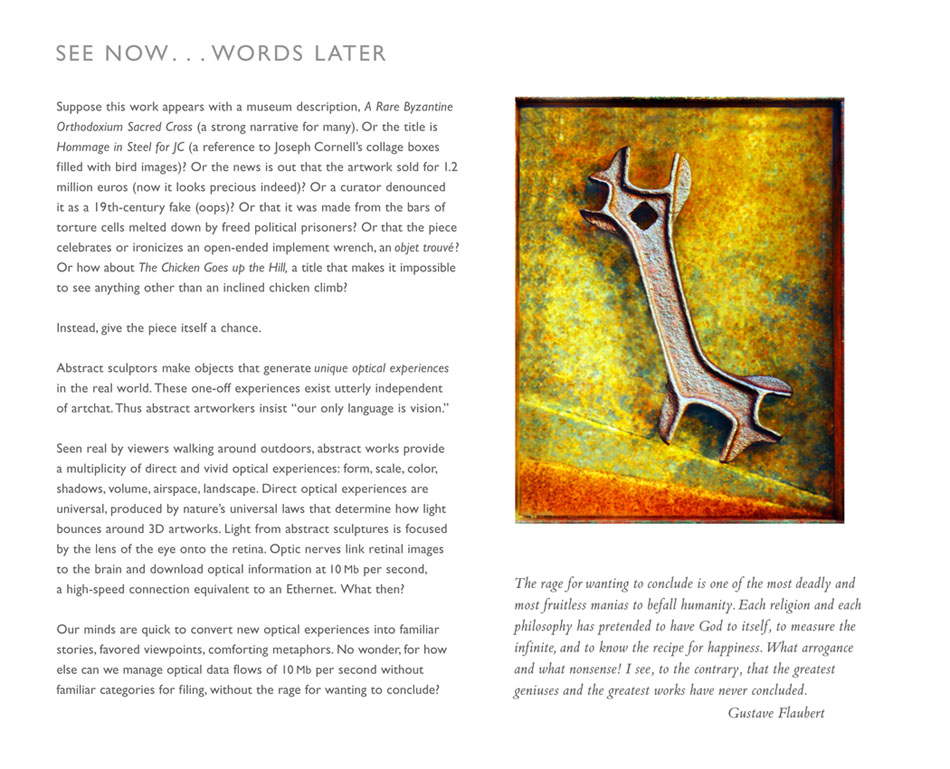
See now . . . Words later
Here are 2 pages from my new short book (or long essay) Seeing Around:
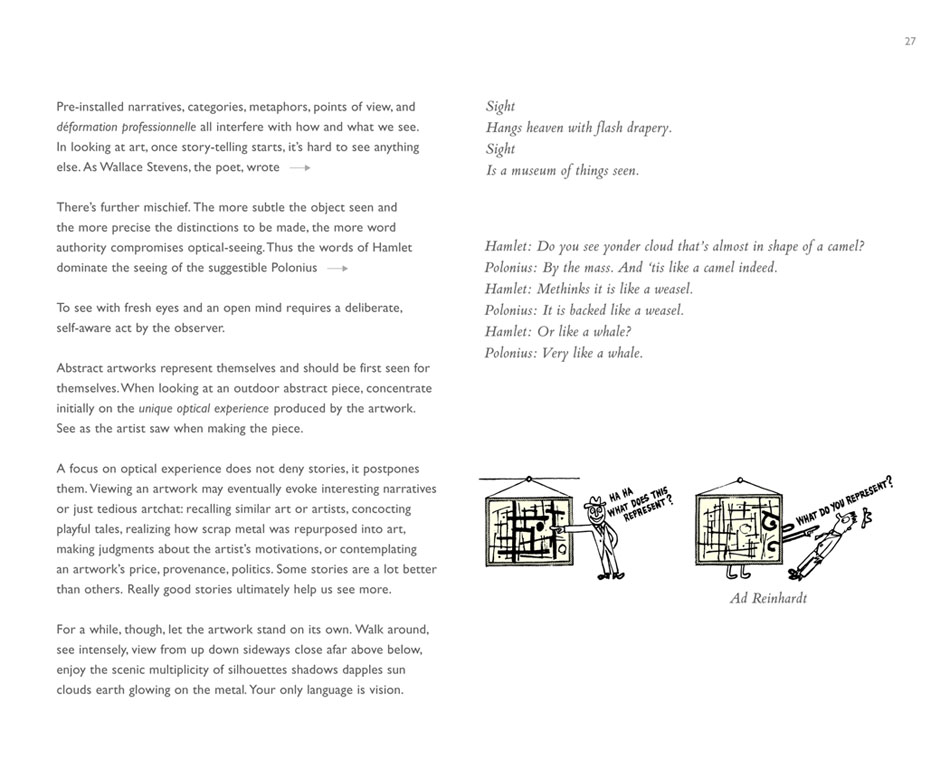
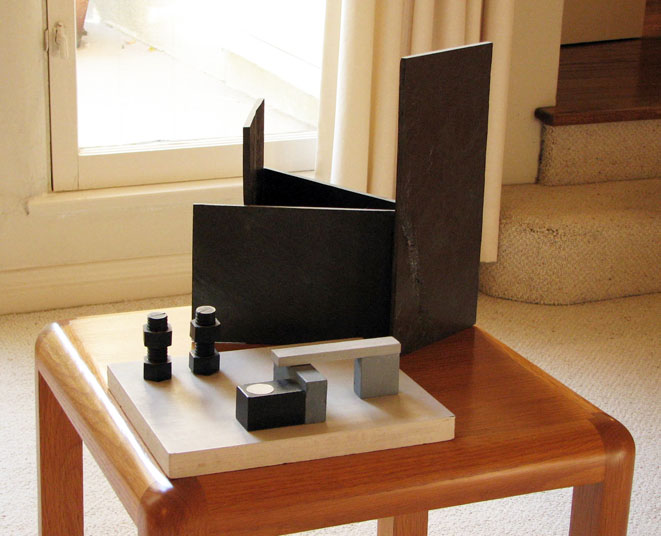
Early ET works: paintings, constructions
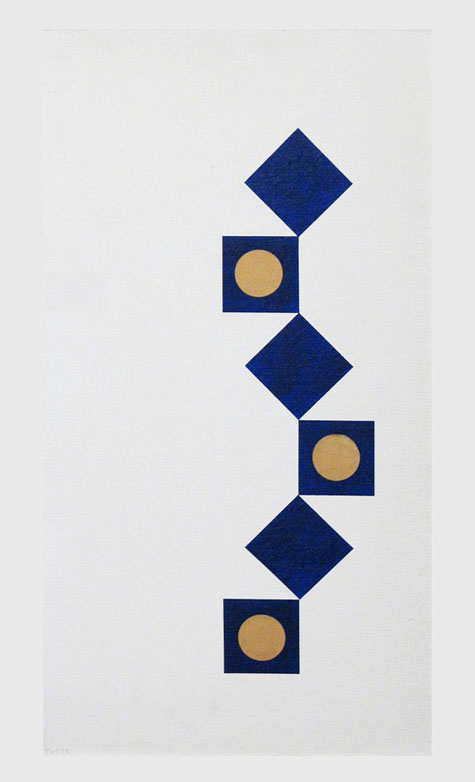
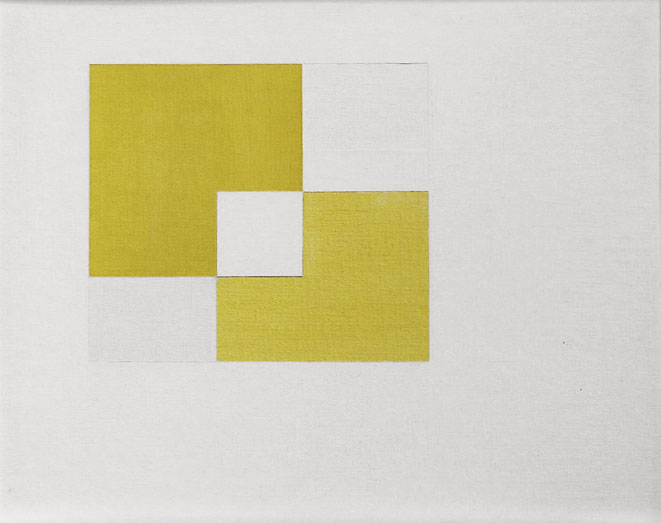
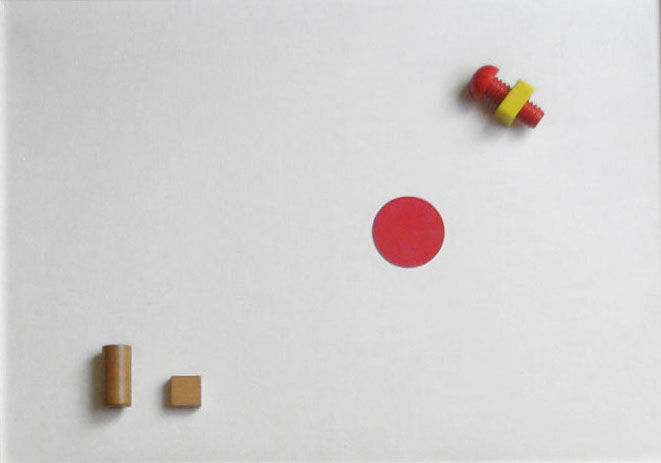
Here are some paintings and constructions done around 1970, except for a slate maquette for Escaping Flatland made in the early 1990s.
These pieces are now in a private collection in Beverly Hills.

Resolution and dimensional compression
A profound discussion of resolution and frame rate by James Cameron here
My work revolves around the routinely spectacular resolution of the human eye-brain system, and, in turn, that our displays of evidence should be worthy of the routine functioning human eye-brain system.
This is, for example, the conclusion of sparkline analysis in Beautiful Evidence, where the idea is to make our data graphics at least operate at the resolution of good typography (say 2400 dpi).
Below is a link to an article in Current Biology (July 2006) by Judith McLean and Michael A. Freed, from the University of Pennsylvania School of Medicine, and Ronen Segev and Michael J. Berry III, from Princeton University. The research suggests that the human retina transmits data to the brain at the rate of 10 million bits per second, which is close to an Ethernet connection! See Kristin Koch, Judith McLean, Ronen Segev, Michael A. Freed, Michael J. Berry, Vijay Balasubramanian, Peter Sterling, "How Much the Eye Tells the Brain," Current Biology 16 (July 25, 2006), 1428-1434.
PDF file
here
Looking around the world is easier than analyzing evidence displays, and there may also be within-brain impediments to handling vast amounts of abstract data, but at least the narrow-band choke point for information resolution should not be the display itself.
The average PP slide contains 40 words, which take less 10 seconds to read. Call that 1000 bits per second, which comes to 1/10,000 of the routine human retina-brain data capacity.
Memory problems can be partly handled by high-resolution displays, so that key comparisons are made adjacent in space within the common eyespan. Spatial adjacency greatly reduces the memory problems associated with making comparisons of small amounts of information stacked in time.
Flame Theater
Andrei Severny and I made a new movie, Flame Theater.
It is helpful to watch at full screen and listen on a reasonably competent set of speakers.
This video is also available on YouTube and Vimeo
714,032 pageviews by Microsoft IP number to our shopping cart in 3 days: what's going on?
Our website ecommerce/shopping cart link received
from bl1sch4081711.phx.gbl (65.55.107.116) the following:
March 13, 2008: 100,505 pageviews
March 14, 2008: 375,080 pageviews
Normally we receive a few hundred pageviews each day to the ecommerce/shopping cart link.
The tying up of our ecommerce/shopping cart raises special concerns.
A DNS lookup leads a Microsoft IP number, but with this note:
"Could be forged: hostname bl1sch4081711.phx.gbl. does not exist."
Any suggestions, ideas?
Thanks,
ET
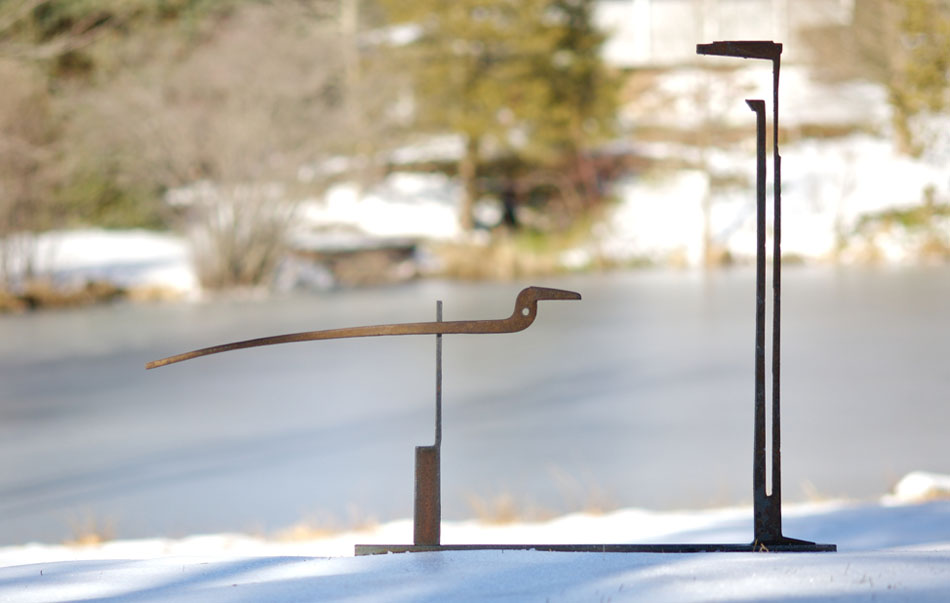
Tong Bird of Paradise
ET steel artwork, January 2008.

Olafur Eliasson: Take Your Time
Olafur Eliasson's show at the San Francisco Museum of Modern Art creates large, wonderful scenes of beautiful, complex, subtle color. Most installations are the size of a large museum room, with the entire space carrying original optical information.
Eliasson does all sorts of elegant magical things with light, space, time. There are hints in the work of ideas explored by Donald Flavin, Robert Smithson, James Turrell, and several architects. But Eliasson is entirely his own coherent unique magician.
Museum visitors are often active participants, or "engaged spectators" (as OE says), in the scenes, gracefully installed by the artist and SFMOMA.
In 2003 Eliasson filled the huge Turbine Hall at the Tate Modern in London with Weather project, an indoor spectacle of shifting fog, a pretend sun, and mirrors. Two million people came to see and play in that installation.
Surely most 3D artworkers would say that you have to be there, that 2D images (photographs, videos) are incomplete, flat, and completely different--sometimes in an interesting way--than the actual experience of seeing and walking around inside the real thing. The photographs in the catalog, Take Your Time: Olafur Eliasson, confirm the impossibility of adequate flatland representation of 3D installation art and of the 4D walking-around-in-space-time experience (just as Richard Serra's amazing MOMA show).
There is a thoughtful discussion by Olafur Eliasson and Robert Irwin reprinted in the catalog. The SFMOMA show closes Febrary 24, 2008.
The show will also appear at MOMA and PS 1 Contemporary Art Center in New York from
April 13, 2008 to June 30, 2008.
Open-Ended
A new series of artworks, Open-Ended, made from wood, steel, and tool steel.
Shown are Open-ended #1 (in the wooden box), Open-ended #2 (upright steel box with compartment), and Open-ended #3 (oblong steel box).
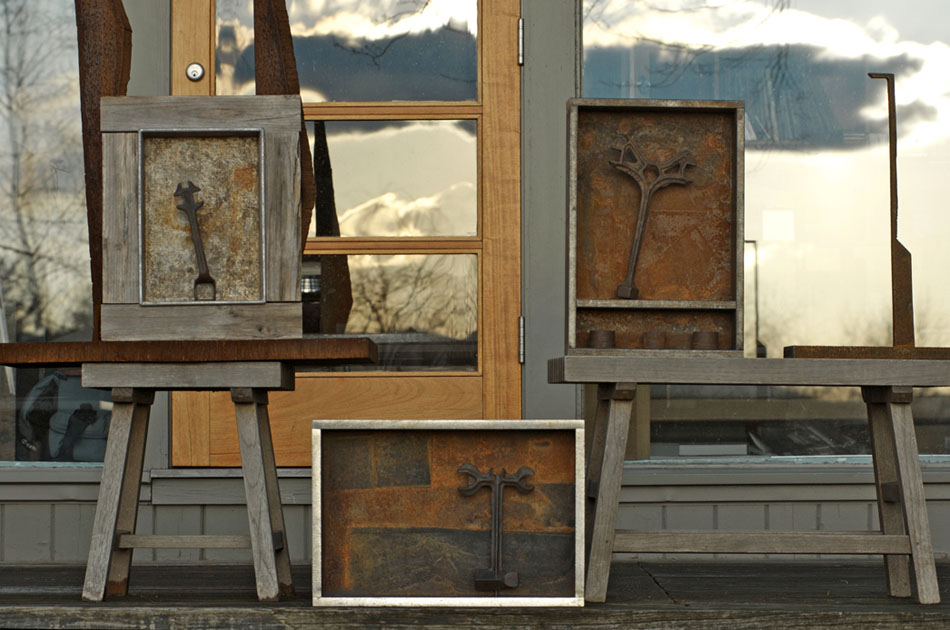

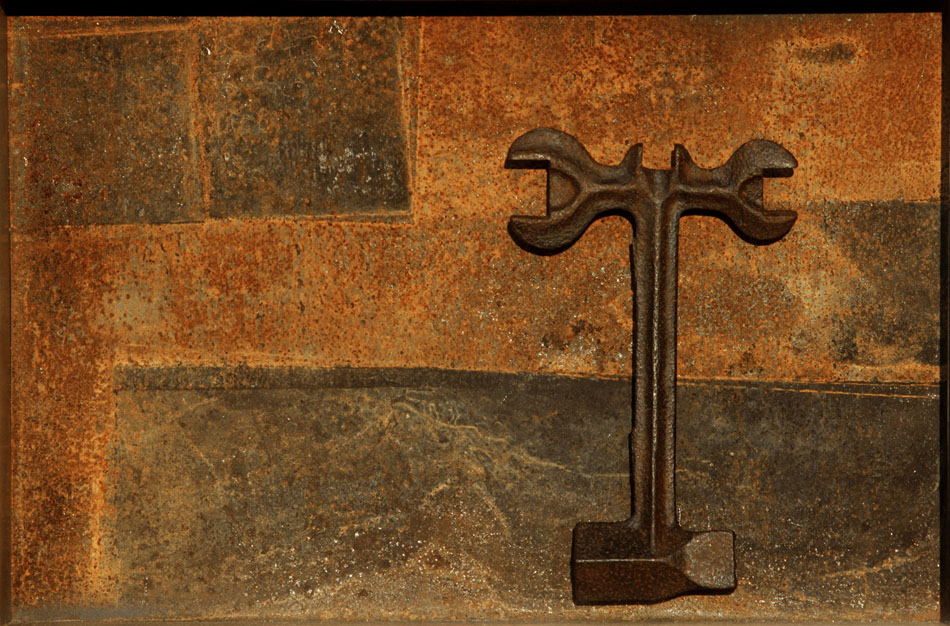
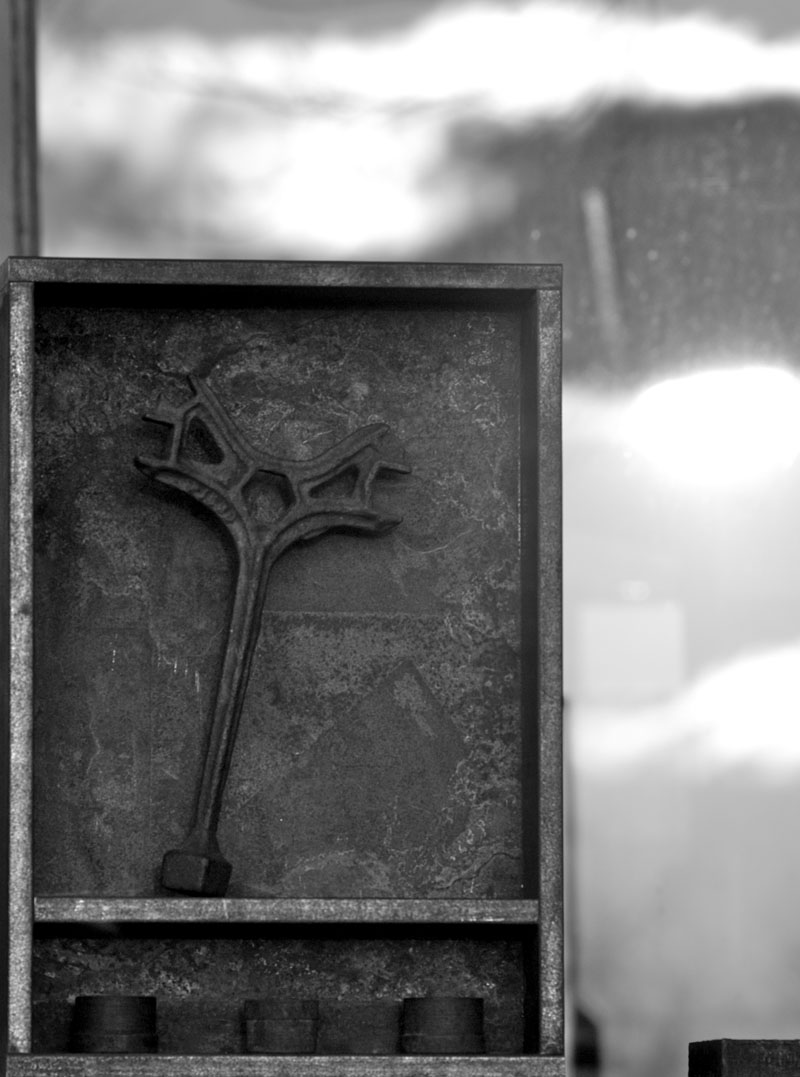 These works make visual references to Jasper Johns, Joseph Cornell, and Santa Fe. The art-historical idea is to restore cross-like forms to artwork vocabulary by avoiding the Christian vocabulary conventionally present in such shapes.
Thus the use of antique open-ended wrench forms: tools held in the hand, tools accommodating a variety of nuts and bolts. These "open-ended implement wrenches," as they are described by wrench collectors, were supplied by manufacturers of farm implements to serve as an all-purpose wrench for adjustments and repairs.
Andy Conklin and Peter Taylor did the fine craftwork for the pieces. The wood is milled from our ash tree cut down years ago, the steel is from the Logan Steel Bargain Barn run by my friends at Logan Steel, and the wrenches are from flea markets. Wrench identification assisted by Google Images. Andrei Severny took the photographs.
These works make visual references to Jasper Johns, Joseph Cornell, and Santa Fe. The art-historical idea is to restore cross-like forms to artwork vocabulary by avoiding the Christian vocabulary conventionally present in such shapes.
Thus the use of antique open-ended wrench forms: tools held in the hand, tools accommodating a variety of nuts and bolts. These "open-ended implement wrenches," as they are described by wrench collectors, were supplied by manufacturers of farm implements to serve as an all-purpose wrench for adjustments and repairs.
Andy Conklin and Peter Taylor did the fine craftwork for the pieces. The wood is milled from our ash tree cut down years ago, the steel is from the Logan Steel Bargain Barn run by my friends at Logan Steel, and the wrenches are from flea markets. Wrench identification assisted by Google Images. Andrei Severny took the photographs.
These works make visual references to Jasper Johns, Joseph Cornell, and Santa Fe. The art-historical idea is to restore cross-like forms to artwork vocabulary by avoiding the Christian vocabulary conventionally present in such shapes.
Thus the use of antique open-ended wrench forms: tools held in the hand, tools accommodating a variety of nuts and bolts. These "open-ended implement wrenches," as they are described by wrench collectors, were supplied by manufacturers of farm implements to serve as an all-purpose wrench for adjustments and repairs.
Andy Conklin and Peter Taylor did the fine craftwork for the pieces. The wood is milled from our ash tree cut down years ago, the steel is from the Logan Steel Bargain Barn run by my friends at Logan Steel, and the wrenches are from flea markets. Wrench identification assisted by Google Images. Andrei Severny took the photographs.Elegant water drainage methods: Levi Plaza in San Francisco and elsewhere
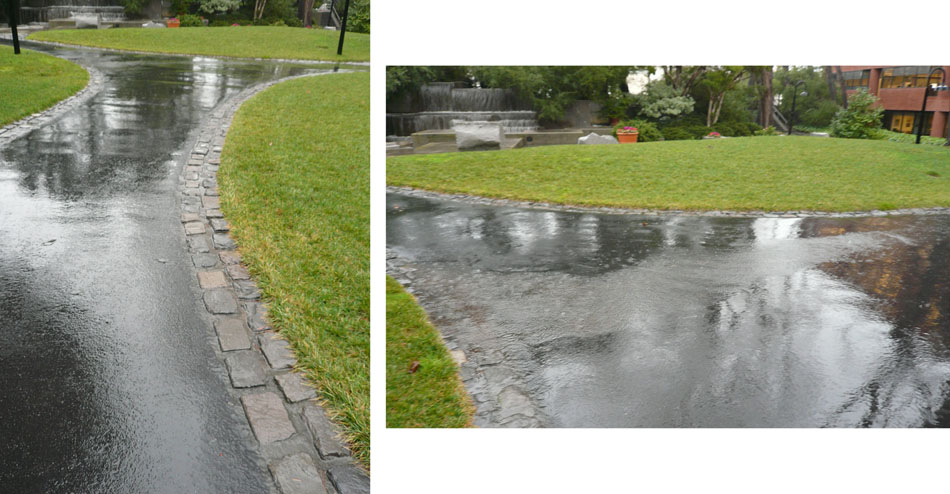
Walking to the Embarcadero in San Francisco provides an opportunity to visit Levi's Plaza Park, a tranquil and beautiful refuge that makes the nearby traffic almost disappear. On a very rainy day in San Francisco this January, we visited the empty park, walked around, and admired the brooks, fountains, and an ingeniously designed drainage system. The physics of drainage revolve around the hard fact that the erosive power of water is proportional to the fifth power of the water's velocity--double the velocity and the erosion goes up 32-fold! (See our discussion below)
My photographs show the diversion of water flow along the walkway margins, with elegant rip-rap breaking the velocity and swales directing the flow of water towards larger streams, a pool, and, ultimately, large drainage pipes.
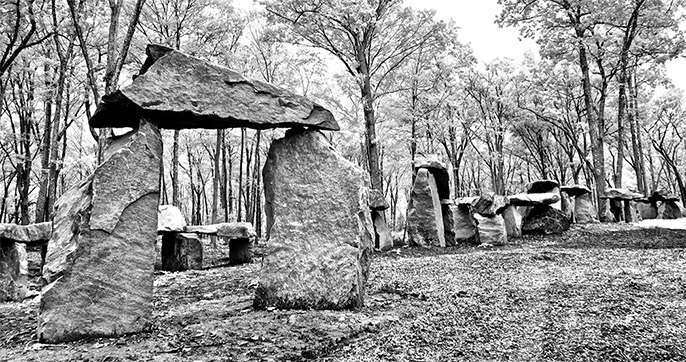
Drainage is always an issue when installing large outdoor sculptures. In our work, we want to avoid water pooling at inappropriate places around the piece and also to prevent nearby erosion. Freeze-thaw cycling in New England makes the drainage issues more complex.