Warning: Trying to access array offset on value of type bool in /nas/content/live/graphicspress/wp-content/themes/edwardtufte/archive.php on line 21
Ryszard Kapuscinski
Ryszard Kapuscinski, the reporter of revolutions and political drama, has died at age 74. The Guardian's obituary is here.
His books, The Emperor (1978) and Shah of Shahs (1982) were, over the years, on the reading lists for my courses in political economy. His on-the-ground deep-description, perhaps a bit magical as some critics have suggested, contrasted with the otherwise analytical and quantitative style of my courses.
In the pedestals chapter of Beautiful Evidence, there is a long excerpt from Kapuscinski's Shah of Shahs on depedestalization, which elaborates in complicated and ironic ways Richard Serra's comments beginning that chapter. As can be seen in the excerpt, his writing had an intense reality and physicality of direct experience.
Ryszard Kapuscinski was a great writer, a world treasure. May his songs always be sung.
Warning: Undefined variable $count in /nas/content/live/graphicspress/wp-content/themes/edwardtufte/archive.php on line 24
Stainless steel images: anisotropic calligraphy
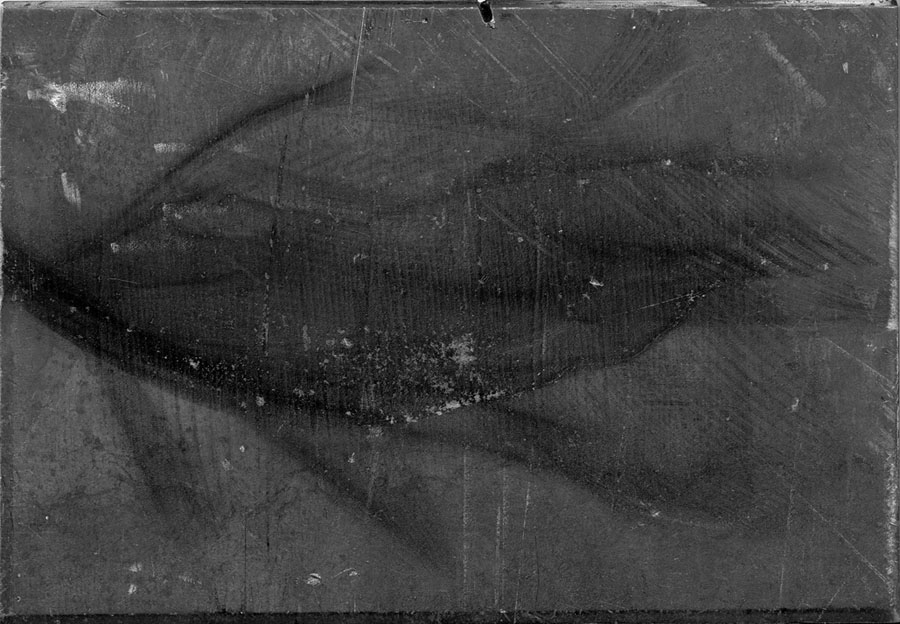
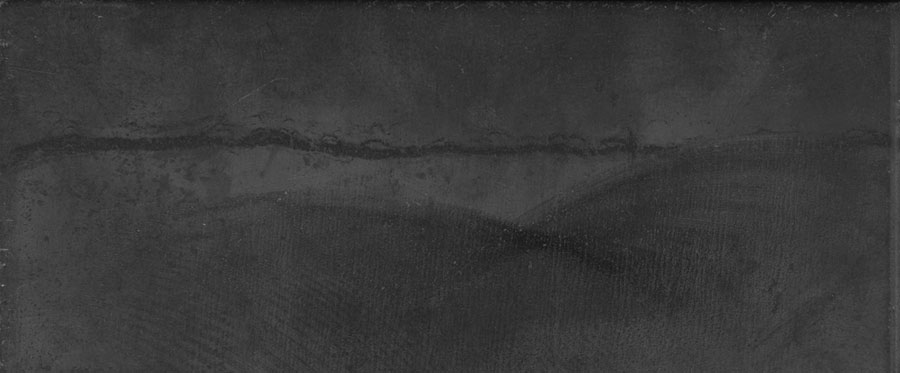
Here are the first of a series of images ground into steel. I did experiments with making gestural images in stainless steel, but they are hard to photograph since they generate a multiplicity of views depending upon the angle of the lights relative to the viewer and the image (examples to come). Below two images (the fish, the horizon scene) barely ground into the surface mill-scum of regular steel. Steel is harder than stainless and so the grinding is just on surface and therefore lacks the holographic quality of grinding into stainless steel.
Warning: Trying to access array offset on value of type bool in /nas/content/live/graphicspress/wp-content/themes/edwardtufte/archive.php on line 21
Punctuation typography
First some refugees from another thread:
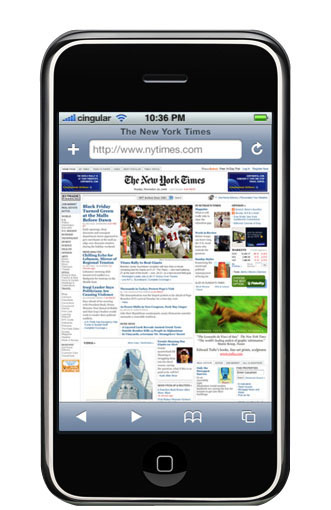
And, by the way, in the top line of the iPhone screen, the colon in the time stamp on iPhoto (10:36 PM) should be changed to a period (10.36 PM), just like the times in good railroad timetables. Also AM and PM should be in lower case. So instead of 10:36 PM use 10.36 pm. These and similar typographic delicacies for time-stamps and timetables are discussed in Enivisioning Information, 104-105. -- Edward Tufte, January 11, 2007
"." or ":", using a 24-h clock must be superior to am/pm? -- Peter H (email), January 12, 2007
In re: ET's inclination towards the "period" instead of a colon for time-stamps, I have begun to see (and use):
i) the "period" in phone numbers as well - 650.555.1212, and
ii) only a small "a" or "p" after time numerals - "....will meet you Tues. at Peet's on campus, 7:15a."
These seem tidy; any reason/s to think either confusing or unappealing? -- David J (email), January 20, 2007
Images as logos
For the book jacket of Beautiful Evidence, I used 4 photographs (Nikon N90, 105mm macro, Velvia film at probably ISO100) of our dog Max diving into a pond.
The photographs were taken around 1995 in about 10 minutes as our young athletic Golden Retriever was learning to dive and retrieve. The cover designed itself and was ready a couple of years before I finished the book itself. The book jacket mock-up (wrapped around an earlier book of mine) provided inspiration to get on with my work on Beautiful Evidence.
Then quietly the cover images turned into the logo for the book and maybe for logo-less Graphics Press.
The Max Diving logo is recognizable at fairly small sizes. For example, in its appearance (a happy luck-out) on the iPhone screen:
 Or as a small ad at The New York Times website:
 Unlike the twisted typography of conventional logos, the image-as-logo gets better and better, revealing more detail, as it gets larger and larger:
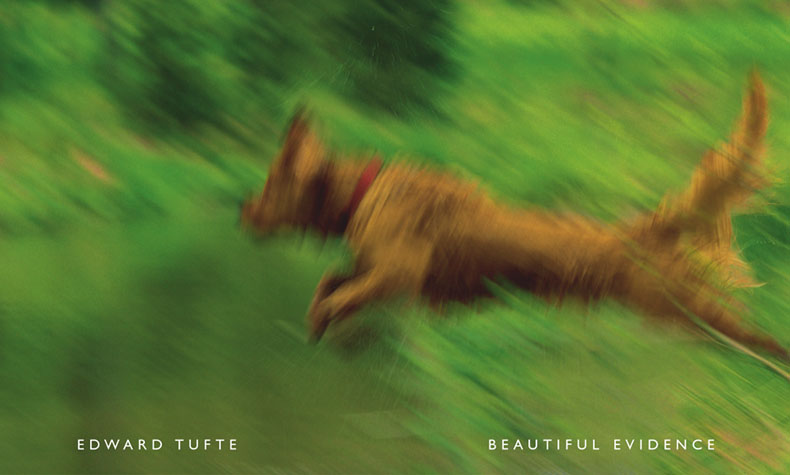 The 4 images of the cover provide a gentle multiplicity of logotypes (ala the MTV and Google logos):
 The Max Diving logo has some properties of classic engraved postage stamps: readable at small sizes, even more interesting at large sizes.
Or as a small ad at The New York Times website:
Unlike the twisted typography of conventional logos, the image-as-logo gets better and better, revealing more detail, as it gets larger and larger:
The 4 images of the cover provide a gentle multiplicity of logotypes (ala the MTV and Google logos):
The Max Diving logo has some properties of classic engraved postage stamps: readable at small sizes, even more interesting at large sizes.Showing 3D measurement scales in 2D images (including astronomical pictures)
Let us begin with some recent astronomical images, and then take up the issue of measurement scales in those images. See Phil Plait's good collection of the best astronomical images of 2006 here.
Few of the images have a scale of measurement built into the beautiful picture, yet the sizes are deeply interesting.
Go to the original sources cited by Plait for helpful details and explanations.
Multiple exposure experiments
Here are some multiple-exposure images to show sculptures that can't be constructed, and to get some sense of the visual dynamics of objects moving in 3-space.
I tried to figure out how to configure the camera, the movement of the object, and the background.
First, some indoor experiments of moving the camera (rather than the object) over an old painting of mine (London Dance Geometry, 1970). Multiple exposures produce multiplicity of elements at different value levels, a much richer and more subtle texture than the original painting.
This image, however, is smooth; it is a flat. The real painting, however, has a surface, a texture, and a depth from the stretched canvas--for the real painting exists in 3-space.
 OK, now let's go outdoors to photograph changing states of a 3D object (a new stainless piece).
The camera is on a fixed tripod mount. I missed a retrospectively obvious point, however,
for the unchanging background strongly comes forward because it is repeatedly photographed in the multiple exposure, whereas the piece is photographed only once in each of its changing positions!
Thus the knots in the background wood turn into eyes peering onto the changing scene. Oops.
OK, now let's go outdoors to photograph changing states of a 3D object (a new stainless piece).
The camera is on a fixed tripod mount. I missed a retrospectively obvious point, however,
for the unchanging background strongly comes forward because it is repeatedly photographed in the multiple exposure, whereas the piece is photographed only once in each of its changing positions!
Thus the knots in the background wood turn into eyes peering onto the changing scene. Oops.
 Let's try a better background and put the piece up against the sky. Now, fortuitously, the sky comes forward into the multiple images of the piece, creating this eerie and wonderful scene of a sculpture that can't be built.
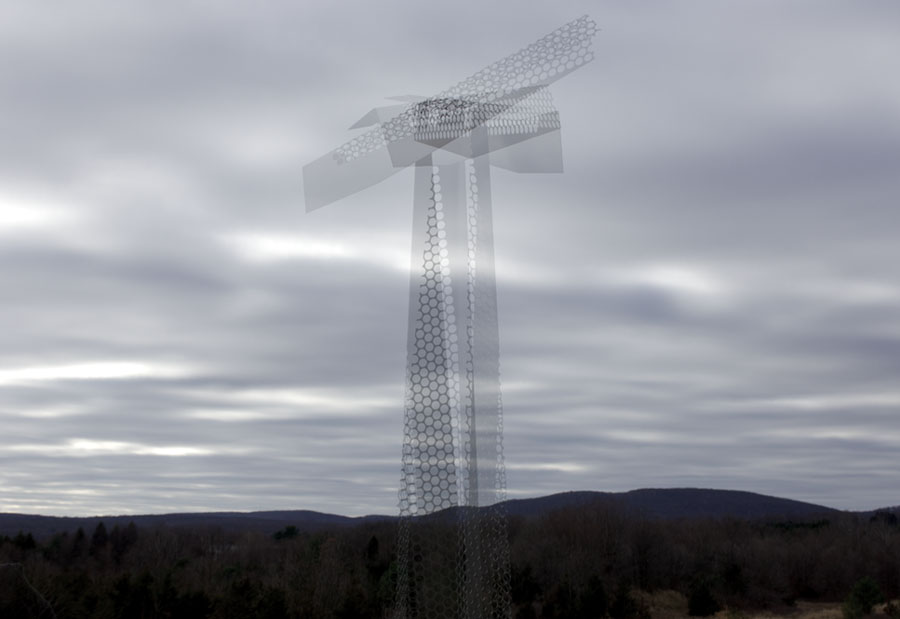
OK, now let's go outdoors to photograph changing states of a 3D object (a new stainless piece).
The camera is on a fixed tripod mount. I missed a retrospectively obvious point, however,
for the unchanging background strongly comes forward because it is repeatedly photographed in the multiple exposure, whereas the piece is photographed only once in each of its changing positions!
Thus the knots in the background wood turn into eyes peering onto the changing scene. Oops.
Let's try a better background and put the piece up against the sky. Now, fortuitously, the sky comes forward into the multiple images of the piece, creating this eerie and wonderful scene of a sculpture that can't be built.
Bouquet sculpture series--and Walking, Seeing, Constructing

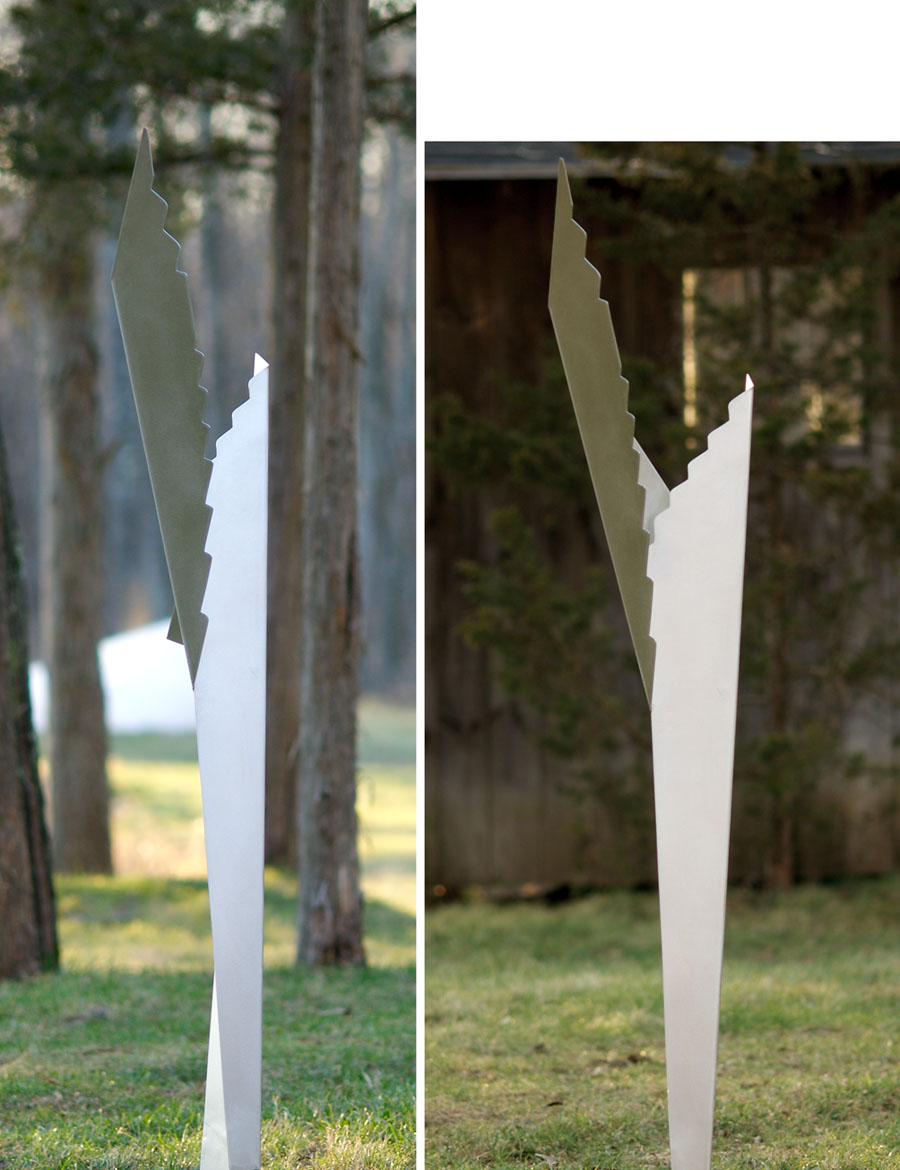
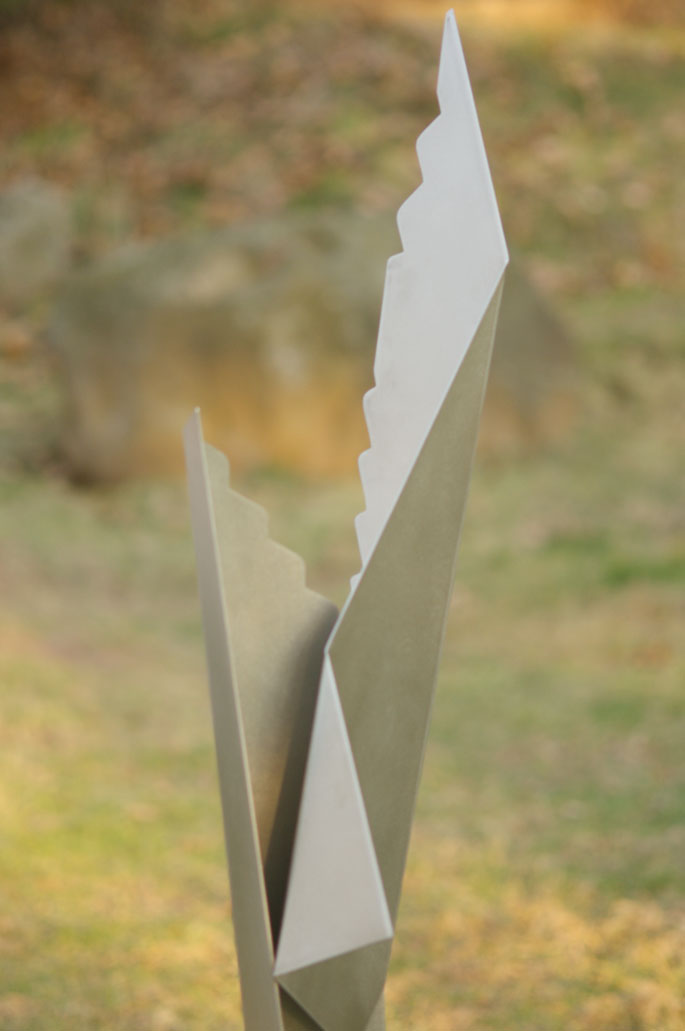
 Here's a recent stainless steel piece, about 4 feet tall, that looks just fine from all sides and thus resides deeply in 3-space, not in flatland of paper and computer screen and also not in frontal-flatland of representative sculpture. The images below go around the piece, showing some of the scenes generated by the sculpture.
This was the first day that the piece was in sunlight and there was more to see in borrowed sunlight, more intense light, more painted color fields than in the light of the welding shop.
As usual, there's an enormous difference between the quality of the visual experience of the actual piece experienced quickly by the eye compared to photographs viewed even under careful slow study.
Often the limits of photography are in its modest range of light intensity compared to what the eye sees. For Bouquet for the year 2006, however, the photographic narrowing is in the range of subtle color distinctions. There are many goings-on in reality-color compared to photographic color, which, I suppose, we already knew.
90% of experiencing landscape sculpture is just showing up.
The piece works with the 3-D play of the planes and the air volumes created by that interplay along with the art-deco edges. The planes create an interplay of air volumes in the negative space and also serve as local (internal to the piece) projection planes for reflected light and shadows from nearby elements. Hard to see in photographs; however, maybe some of the air-volume information can become visible and active in movies.
Here's a recent stainless steel piece, about 4 feet tall, that looks just fine from all sides and thus resides deeply in 3-space, not in flatland of paper and computer screen and also not in frontal-flatland of representative sculpture. The images below go around the piece, showing some of the scenes generated by the sculpture.
This was the first day that the piece was in sunlight and there was more to see in borrowed sunlight, more intense light, more painted color fields than in the light of the welding shop.
As usual, there's an enormous difference between the quality of the visual experience of the actual piece experienced quickly by the eye compared to photographs viewed even under careful slow study.
Often the limits of photography are in its modest range of light intensity compared to what the eye sees. For Bouquet for the year 2006, however, the photographic narrowing is in the range of subtle color distinctions. There are many goings-on in reality-color compared to photographic color, which, I suppose, we already knew.
90% of experiencing landscape sculpture is just showing up.
The piece works with the 3-D play of the planes and the air volumes created by that interplay along with the art-deco edges. The planes create an interplay of air volumes in the negative space and also serve as local (internal to the piece) projection planes for reflected light and shadows from nearby elements. Hard to see in photographs; however, maybe some of the air-volume information can become visible and active in movies.

Advice for effective analytical reasoning
This thread collects good general advice for analytical work. There will probably be some overlap with our thread Grand truths about human behavior, but the idea here is more toward prescriptive statements about good practices. Such advice should reach beyond the proverbial, and should be referenced, if possible, to those who have in fact performed at a high analytical level.
"Be approximately right rather than exactly wrong." John W. Tukey
"The first principle is that you must not fool yourself--and you are the easiest person to fool." Richard Feynman
Ask questions.
Develop and fine-tune a sense of the relevant, both for identifying the key leverage points in any problem and also for examining large amounts of information to find the rare diamonds in the sand.
Nearly all serious analysis requires multivariate-thinking, comparison-thinking, and causal-thinking. Develop such thinking.
Evidence blocking: secrets, censorship, and cover-ups as threats to learning the truth
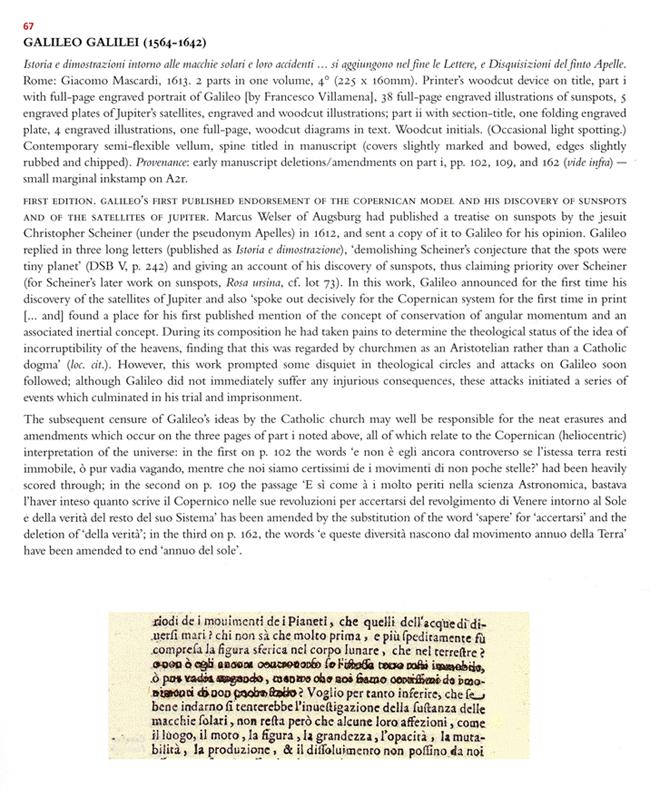
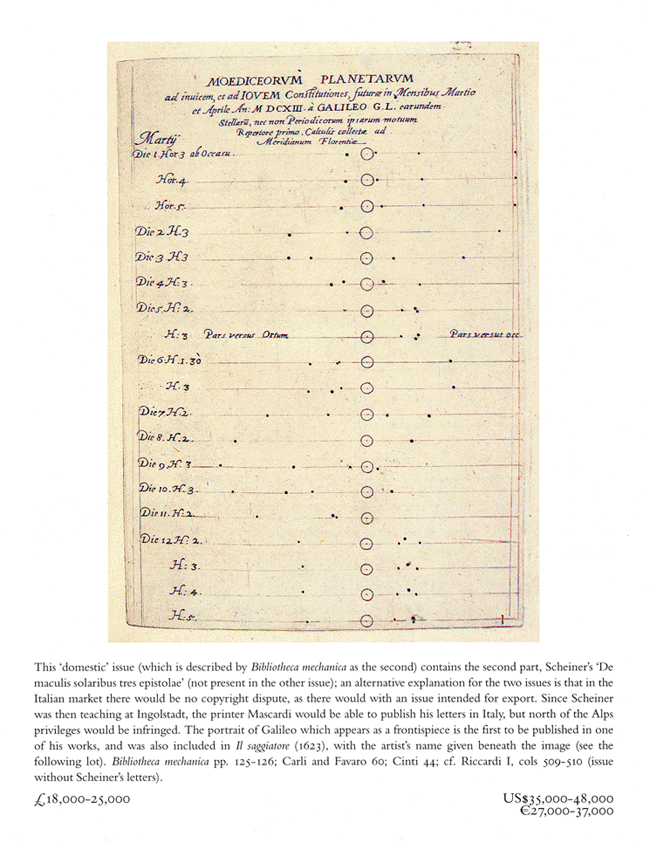
Source: Christie's catalogue, Landmarks of Science, London, 13 December 2006
Intolerance of free speech at colleges
Discussion by Wendy Kaminer here
Free speech is far more restricted in corporations and in government agencies but at least colleges and universities should get it right.