Warning: Trying to access array offset on value of type bool in
/nas/content/live/graphicspress/wp-content/themes/edwardtufte/archive.php on line
21
Space-Time Joiner Photographs
David Hockney has published many
spatial "joiner" photographs, an overall image built out of many smaller photographs. Hockney's spatial joiners provide multiple local perspectives that create a richer 3-D perspective in the overall image.
Here is Hockney's
Pearblossom Hwy. 11-18th April 1986, #2.

In his very beautiful and smart book,
That's the Way I See It, Hockney writes, "I started
Pearblossom Hwy. when I was commissioned by
Vanity Fair to illustrate a piece by my friend Gregor von Rezzori, retracing Humbert Humbert's journey in search of Lolita. It was my last photo-collage and the most painterly. I spent nine days doing the photographs and two weeks assembling it. I see it as a panoramic assault on Renaissance one-point perspective."
Joiners can be simultaneously temporal and spatial. Here's a small experiment.

And shown
here in a large screen JPEG.
Note the intensified 3-D quality resulting from Abby's leap in the direction of the expanded space. The sculpture is
Escaping Flatland #3; its stainless steel surface is borrowing (indeed directly appropriating) light from the sky.
: Undefined variable $count in
/nas/content/live/graphicspress/wp-content/themes/edwardtufte/archive.php on line
24
Warning: Trying to access array offset on value of type bool in
/nas/content/live/graphicspress/wp-content/themes/edwardtufte/archive.php on line
21
Sports graphics
Runnings - Baseball Standings on the Run
(ET edition)I recently created some simple graphs that display baseball standings over an entire season and then came here to look for more ideas. I was surprised to find sparklines of baseball win/loss records. My graphs have no innovation beyond our common idea of displaying a season's worth of standings on a single graph. Until a better term comes along, I call my graphs "runnings" since that implies position change over time and "standings" imply just positions. My traces are simply games above .500 vs. game number, which is pretty close to time. A win goes up and to the right, a loss continues the trace and goes down and to the right. They're just sparkline tics assembled differently.
The Orioles spent most of the season playing just under .500 ball. They last saw that standing 27 games ago after a 4-0 run gave diehard fans hopes of a strong finish. No one anticipated that the team would win just 4 more games this season, finishing a dismal 67-95. Only the Tampa Bay Devil Rays (55-106) kept the Orioles out of the basement.
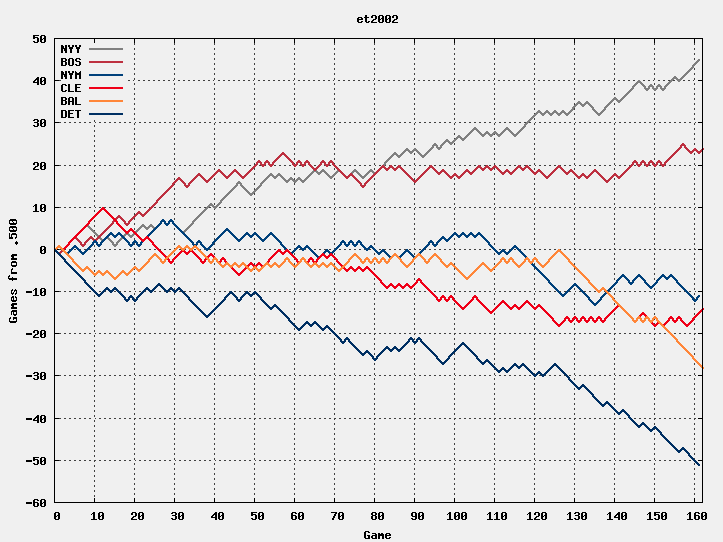
The key thing that is easier to see with runnings is the relative position of one team vs. another over time. The Red Sox get off to a good start, but the Yankee's consistant play lets them catch the Red Sox while the Sox have an extended stretch of .500 ball. It would be interesting to make an interactive variant where selecting a team's trace would highlight it (e.g. use a wider line) and also highlight the corresponding segments in the opponents' traces. A pastel color could denote the away games (mnemonic - the colors of distant mountains becomes more pastel). A parallel line or tic marks could
denote shutouts. ET suggested it would be interesting to show teams' performance vs. another, e.g. giving the reference team the X axis and showing the others as games ahead or behind the reference.
At the very least, my graphs need a couple improvements - the legend ought to be on the teams' traces, not in a stray corner, and at the right end of each trace should be the win/loss/ratio data representing the final standing. I've experimented with shifting each team's trace slightly vertically so that tie stretches don't overlap but have't tried it on a full season. The overlaps aren't necessarily bad, but there cases where ambiguities can appear for a while when more than two teams have similar or identical records.
Of course, a sparkline saves vertical space, but note that my graph can overlay multiple teams pretty well, but the sparklines need vertical separation as they can't be overlaid. Perhaps the graphs belong in the Sunday newspapers and the sparklines belong in the rest of the week an inside articles any day.
The data behind the graphs is excerpted from WWW pages like
http://www.baseball-reference.com/teams/BAL/2002_sched.shtml which got it from
RetroSheet. Pertinent data was extracted by a Python program which wrote a gnuplot control file to produce the traces. I chose the colors by picking out representative pixels from team logos at
mlb.com.
I have
graphs of the AL 2004 season including a couple key post-season series of some
interest to Boston's fans, but there's little reason to include them here.
-Ric Werme
Interesting logos
My friend Jamy Ian Swiss, the excellent magician and co-author of the magic chapter in my Visual Explanations, sends this interesting link about the FedEx logo and its clever understated use of negative space:

The Man Behind the FedEx Logo
Jamy Ian Swiss
Commencements and honorary degrees
Two essays. First, on honorary degrees and commencement speeches.
Then my commencement address "Cognitive Art," at Cooper Union
When Academics Receive Honorary Degrees
Edward Tufte
Minor celebrities, as they grow older, gratefully accumulate honorary degrees, medals, and trophies. Awards made from stone, plastic, and metal tend toward the tacky, in the style of Bowling League Winner or Tortured Metal Art. I prefer the paper of honorary degrees.
The graduation festivities accompanying honorary degrees are notable and even moving. Everyone is robed up, the faculty outfitted in a quirky diversity of academic gowns; best are the gowns and especially the little hats from British and European universities. And the ritual itself is suitably majestic.
In exchange for continual intense flattery, honorary degree recipients usually must give a speech. The commencement speaker's tasks are (1) to remember that this is an academic occasion honoring the graduating students and their teachers, (2) to provide an exemplar of accomplishment, (3) to say something that has some power and a gently provocative quality, and (4) to be brief, very brief. I usually talk about forever knowledge, because that is what colleges should provide and that is what will last for the students. I also try to advance my field of analytical design.
Commencement speakers, to remind themselves of the oratorical importance of false modesty, should remember that they were probably not the college's first choice. Perhaps I'm receiving an honorary degree because Maya Lin and G. B. Trudeau were already booked up. If all three of us turn the college down, then it's a rich donor or a bubbly television news reader.
Occasionally the degree is accompanied by a modest honorarium, thereby providing a precise measure of the modesty of one's minor celebrity. My policy is to donate the money back to the college and to walk off with the colorful hood that comes with the degree. A real celebrity might get $75,000 for a commencement speech, providing a precise measure of the modesty of a school that has to pay for it.
At graduation ceremonies, some schools award degrees to students by department cohorts, provoking amateur sociological analysis and fashion critiques by those sitting up on the stage passing the time. At the University of Arts in Philadelphia, several of us noted the elegant beauty and animated grace of the graduates in dance compared to, say, the sculptors.
To make effective use of my visit to the school, I try to give a talk about my work a day or two before graduation and also meet with students and faculty in a round-table discussion, as the emotion of the occasion permits a certain frankness. One more chance to teach, to try to have consequences.
It is enlightening and even thrilling to meet the other honorary degree recipients. At Saint Joseph's College, I was fortunate enough, up on stage as every graduate's name was called out, to chat for an hour with Sister Helen Prejean (author of Dead Man Walking). Or meeting Don Knuth and George Miller and Nobel Prize winners in science at Williams College during the honorary-degree parties, when everyone is just glowing and I feel very lucky and happy to be included. Once the exchange of mutual admiration is over, it is possible to learn something if you ask good questions, listen carefully, and don't party too much. And how excellent to be among those with whom you share the values, strategies, and responsibilities of creating new knowledge and new art.
Since the other recipients of honorary degrees are from fields other than one's own, the usual within-field jealousies and competitive honor-counting are largely absent. Up to a point. John Kenneth Galbraith said his goal in picking up honorary degrees was to always have one more than his friend Arthur Schlesinger. (Honorary-degree stars such as John Hope Franklin, Joyce Carol Oates, and Stephen Jay Gould have dozens.) As Helen Prejean and I were marching out together after the ceremony, she kindly remarked, "Edward, you must do this rather often." Since her powerful and witty commencement speech had already totally wiped out mine, I was alert to possibilities of further humiliation and finessed the matter by politely responding, "Not as often as you, Sister Helen."
Honorary degrees have but one consequence beyond the pleasantries of graduation day: you will forever receive fund-raising pleas from the school. For years now, I have been an involuntary subscriber and constant reader of the Saint Joseph College Alumnae Magazine and many similar, where from time to time I check out the credentials of the more recent honorary-degree recipients.
Edward Tufte is Professor Emeritus of Political Science, Statistics, and Computer Science at Yale University. |
Feynman-Tufte principle
I prefer the general form of the principle -- "simple design, intense content" --to the van metaphor. ET
From the April 2005 Scientific American:
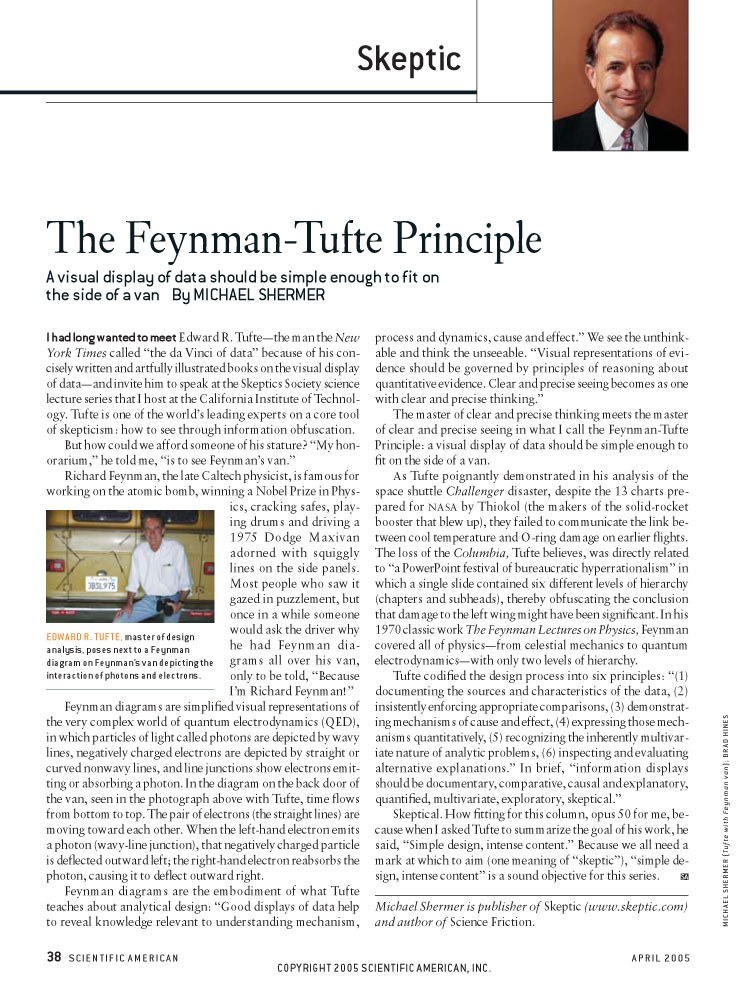
Medical information exchange: The patient, doctor, computer triangle
The usual concern is that patients feel left out with the physician is "looking" at the computer. How is this different than the physician looking at the paper chart? While in medical school many years ago I was taught not to make notes while seeing the patient and to do the recording afterward. In today's environment there is far more data to contend with than there used to be. Achieving ever more stringent theraputic targets are demanded of the physician.
The suprise has been the level of interest that patients show in seeing what is on the computer screen. Patients are participating in the data entry and editing of the data. I have heard that physicians are not that interested in graphs. They want to see the data. I think that this is a mistaken response to not haveing seen good graphs. The even bigger suprise is how interested patients are in seeing graphs of their lab results. This is not reported yet but in conversations with physicians from various countries this observation seems to be consistent.
Images used as data points
Jim Bumgardner has created some intriguing data displays using images as data points. See https://www.flickr.com/photos/krazydad/4992355/
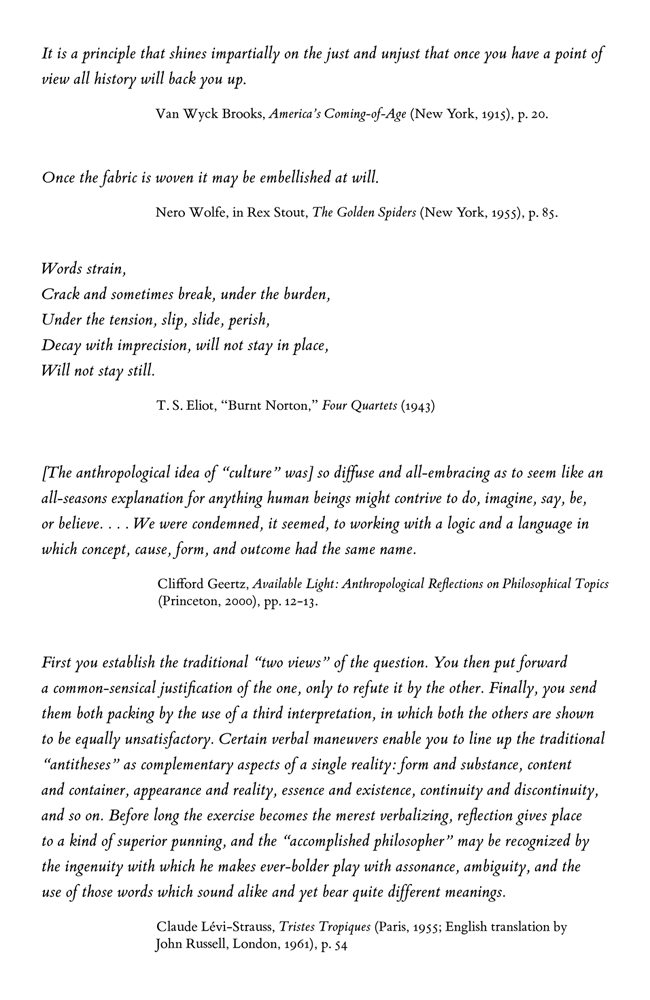
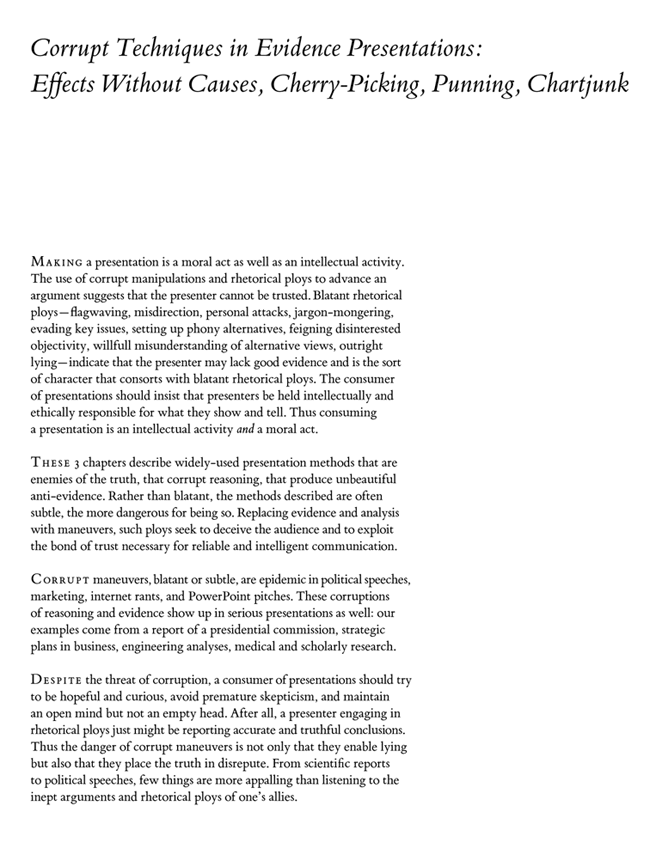
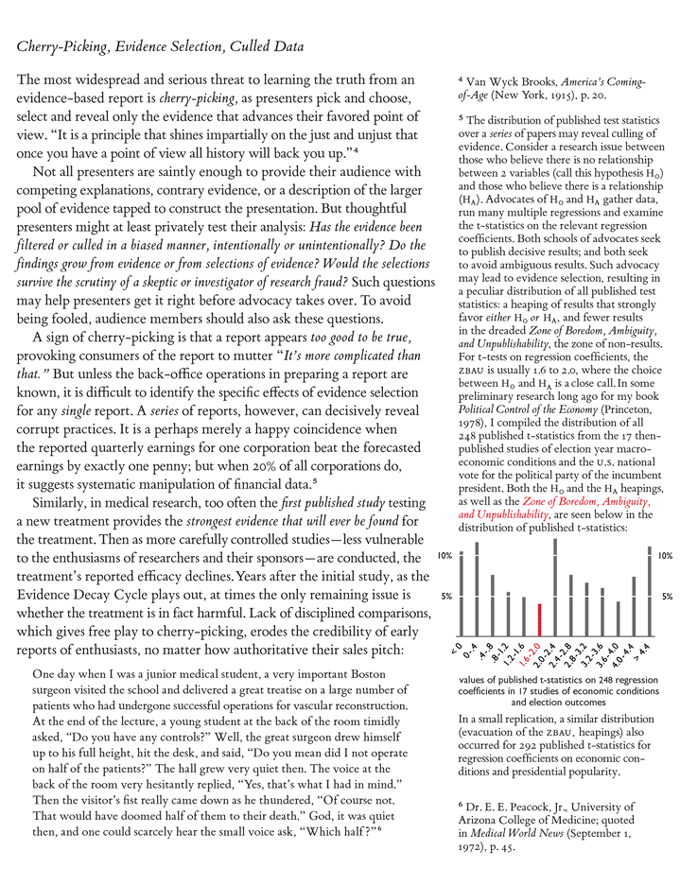
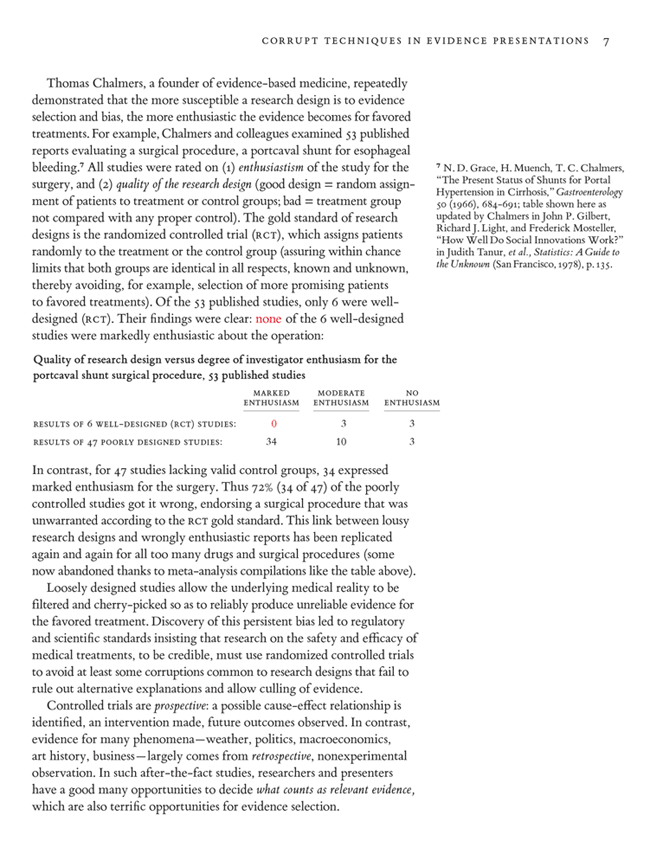
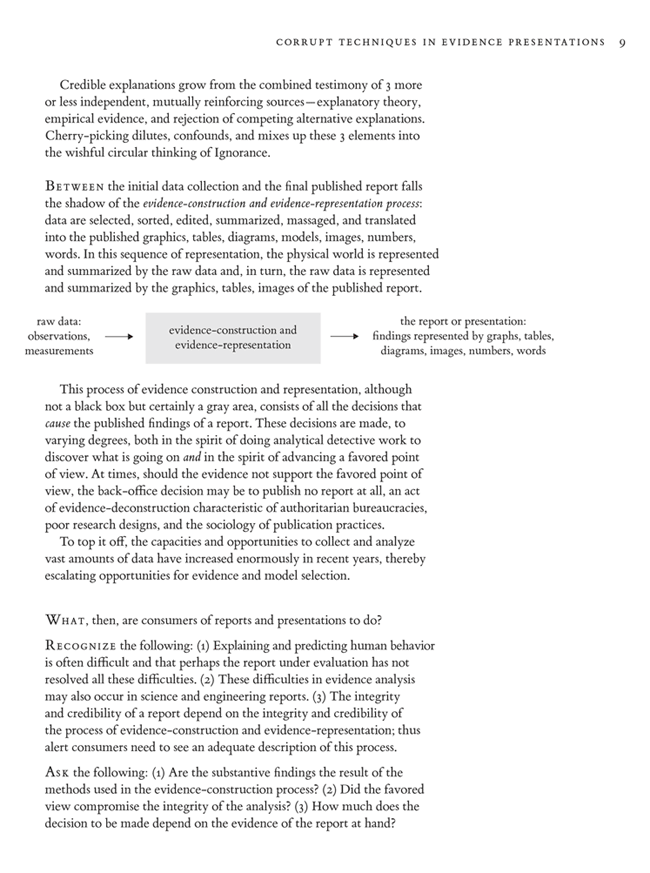
Corrupt Techniques in Evidence Presentations
Validation of Sparkline Computer Code
How can we collect, check, validate, and certify the major computer implementations of sparklines?
Checks and validations should include (1) robust functioning of the code, particularly in the face of wild data or in the face of corrupting interactions with other aspects of computing, (2) closeness of output to the sparkline concept (word-like, high resolution, integrated with text and numbers, contextual labeling, and the availability of "boxing" for each sparkline (as in the euro example in the sparkline chapter, with begin/ end and high/low dots and numbers), (3) ease of use by innocent users trying to implement the code, (4) avoiding malicious codes, and (5) demonstration, by examples, of the output. Maybe we should develop a set of test data that each implementation must handle.
How do we validate the validators? What does Linux do? We'll need real names of those involved, working email addresses, and possibly even some credentials. We don't want to get too bureaucratic about this but we need to maintain rigorous standards.
This project gains strength, I hope, from its open-source character: publicly available code, public reviews, many Kindly Contributors. At this board, the result is that we would provide for various sparkline coding schemes a public validation/certification.
This project needs some discussion or at least an example validation/certification. All told, there are probably somewhere between 25 to 50 necessary codings for various products and various languages (LaTex, Word, Excel, Flash, Illustrator, the major statistics packages, scientific data analysis, Microsoft, Apple, Linux and so on). Or is there a way to build this in at the OS level?
What do our Kindly Contributors think? Some discussion is needed before we undertake this useful project, which ultimately should make high-quality sparklines available to everyone regardless of computer system or application. This should accelerate the use of sparklines and also avoid having endless messed-up proprietary codes that fail to maintain the integrity of the sparkline design.
If this works, one could imagine a few other good data designs worthy of the same process.
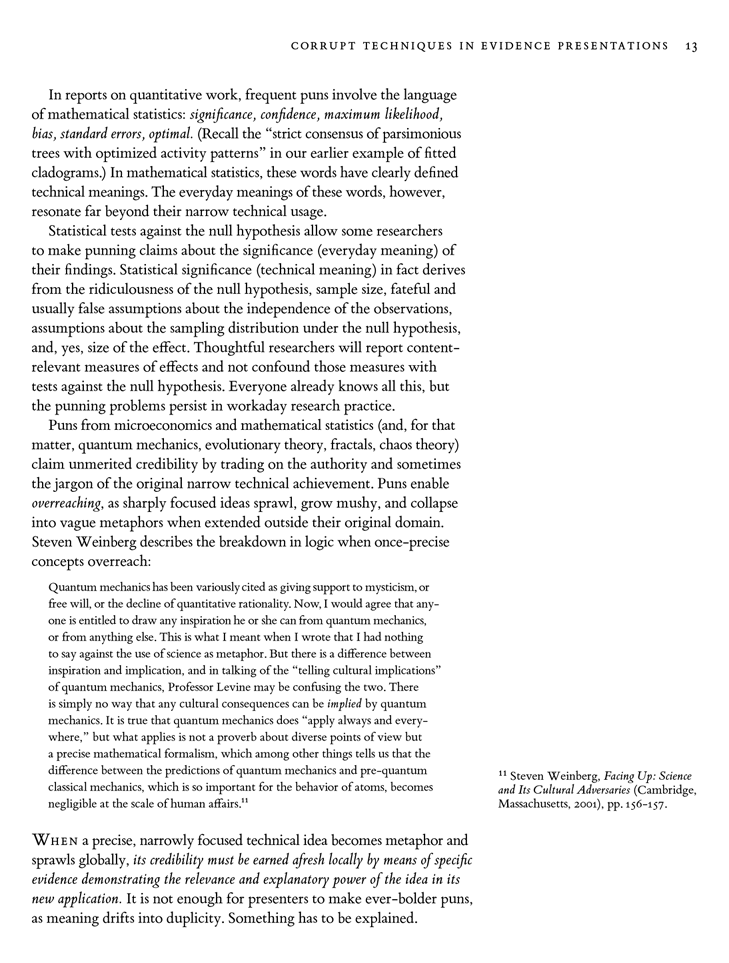
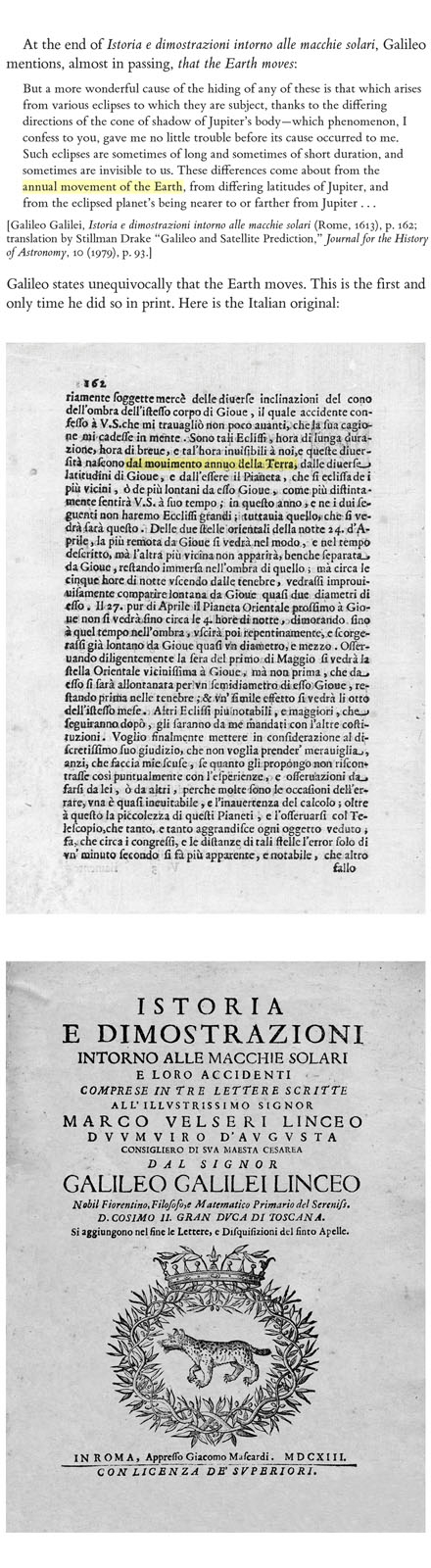
Galileo on the annual movement of the Earth