Warning: Trying to access array offset on value of type bool in
/nas/content/live/graphicspress/wp-content/themes/edwardtufte/archive.php on line
21
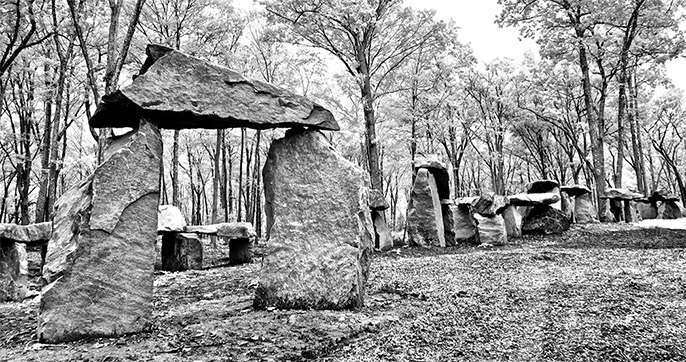
Sculptures in the October storm
Here are my sculptures at Hogpen Hill Farms during a recent catastrophic snow storm in Connecticut.
Skewed Machine, 2007:
 Rocket Science #3, Airstream Interplanetary Explorer,
 2011:

 Magritte's Smile,
 2009, on the front deck of a farm cottage:

 Hogpen Hill Twig,
 2011, about 32 feet or 9.8 meters tall:
 Escaping Flatland, 5-10
, 2001-2004:

Stone walls with barbed wire catching snow to make a snow/steel line in the air:

: Undefined variable $count in
/nas/content/live/graphicspress/wp-content/themes/edwardtufte/archive.php on line
24
Warning: Trying to access array offset on value of type bool in
/nas/content/live/graphicspress/wp-content/themes/edwardtufte/archive.php on line
21
The US Patent and Trademark Office creates a really stupid interface
The US Patent and Trademark Office spawns another disaster: one of the worse interfaces ever designed.
Here's a critique from the Coronado Group of the new USPTO Data Visualization Center Patents Dashboard:
http://searchthewayyouthink.blogspot.com/2010/09/calling-edward-tufte.html
Can someone, perhaps an Inspector General, find out the cost and the contracting company that did this? And the USPTO employees responsible? Direct responsibility begins with USPTO Director David Kappos, who enthusiastically endorses the dashboard.
Dashboard design is nothing special and does not deserve some special category or money-pit visualization contractor. Ten years ago I posted this essay on this board dealing with executive decision support systems:
IDEAS FOR MONITORING BUSINESS AND OTHER PROCESSES
Edward Tufte
(1) See Peter Drucker's book, The Essential Drucker, for a thoughtful chapter on "the information executives need today." That is, you should start by considering the intellectual problems that the displays are supposed to help with. The point of information displays is to assist thinking; therefore, ask first of all: What are the thinking tasks that the displays are supposed to help with?
(2) It is essential to build in systematic checks of data quality into the display and analysis system. For example, good checks of the data on revenue recognition must be made, given the strong incentives for premature recognition. Beware, in management data, of what statisticians call "sampling to please"--selecting, sorting, fudging, choosing data so as to please management. Sampling to please occurs, for example, when the outflow from a polluting factory into the Hudson River is measured by dipping the sampling test-tube into the cleaner rather than the dirtier effluent.
(3) For information displays for management, avoid heavy-breathing metaphors such as the mission control center, the strategic air command, the cockpit, the dashboard, or Star Trek. As Peter Drucker once said, good management is boring. If you want excitement, don't go to a good management information system.
Simple designs showing high-resolution data, well-labelled information in tables and graphics will do just fine. One model might be the medical interface in Visual Explanations (pages 110-111) and the articles by Seth Powsner and me cited there. A model for tables might be the supertable, shown in The Visual Display of Quantitative Information, p. 179. More generally, see chapter 9 of The Visual Display of Quantitative Information. The displays should often be accompanied by annotation, details from the field, and other supplements.
Sparklines show high-resolution data and also work to reduce the recency bias prevalent in data analysis and decision-making. Sparklines are ideal for executive decision support systems. See my threads on sparklines:
https://www.edwardtufte.com/bboard/q-and-a-fetch-msg?msg_id=0001OR&topic_id=1&topic=
and on the implementation of sparklines
https://www.edwardtufte.com/bboard/q-and-a-fetch-msg?msg_id=0000Lk&topic_id=1&topic=
(4) For understanding a process and for designing a display for understanding a process, a good way to learn about what is going on is to watch the actual data collection involved in describing the process. Watch the observations being made and recorded; chances are you will learn a lot about the meaning and quality of the numbers and about the actual process itself. Talk to the people making the actual measurements; maybe you'll learn something.
(5) Measurement itself (and the apparent review of the numbers) can govern a process. For example, in printing my books, I ask that during the press run that the density of the black ink be measured in 6 or 8 different positions on every 3000th sheet being printed. These pulled sheets are then inspected shortly after the run and before the next run. The idea is to try to ensure that the color of the black type is uniform and at the right level of blackness in 3 ways: (1) across the 8 pages printed up on each sheet of paper, called a "form", (2) over the 40,000 sheets printed of that form, and (3) over the many forms making up the entire book. We sometimes review these pulled sheets the next day to check these density readings and to yell at the printer if there is a problem. But mainly the mere fact that the printers are making these measurements keeps the process in control. And the fact that someone might review the measurements.
Note that this example is mainly just common sense in workaday action; no jargon about an Executive Decision Protocol Monitoring Support Dashboard System is needed. In fact, such jargon would be an impediment to thinking.
(6) My own encounter with a real business trying to improve management data and the display of that data was in consulting for Bose. At one point it appeared to me that too many resources were devoted to collecting data. It is worth thinking about why employees are filling out forms for management busybody bureaucrats rather than doing something real, useful, productive. The story of this work is told in Michael H. Martin, "The Man Who Makes Sense of Numbers," Fortune, October 27, 1997, pp. 273-276; and in James Surowiecki, "Sermon on the Mountain: How Edward Tufte led Bose out of the land of chartjunk," Metropolis, January 1999, pp. 44-46. Both accounts make me appear excessively heroic. These articles are posted in the NEW section at https://www.edwardtufte.com/tufte/fortune_97 https://www.edwardtufte.com/tufte/metropolis_0199
(7) Most of all, the right evidence needs to be located, measured, and displayed. And different evidence might be needed next quarter or next year.
-- Edward Tufte, August 27, 2001
Philosophical Diamond Signs

When visitors come up the long road to the sculpture fields, on the way they encounter this undiplomatic diamond sign.
Here's why:
"The great, big thing is to try to devote most of one's brain-processing power to the seeing. Studies of cell phones and driving automobiles demonstrate that people don't do very well in seeing where they're going when they're talking. Intense seeing, intense focus requires a self-serenity and also serene environment. And in that way, all the brain's processing power can be into seeing.
"I had this experience, almost a magical experience. Out walking on our farm by a long stone wall, I said to my friend, let's not talk. And after about five minutes, you first hear the internal sounds produced by the inner ear. And then, after a while, you hear things, just the slightly rustle of leaves. But what happened to seeing after 10 to 12 minutes of just seeing - not talking, not doing anything else - was the ambient light became nearly perfect. That perfect light for photography, filtered light from the sun, and shadows under the trees now didn't blow out to dark, and the brights from the snow don't blow out to white.
"The ambient light hadn't changed, but rather the seeing had changed. Because all brain power was devoted to seeing, it was if you were creating your own improved light."
Edited from
NPR - Edward Tufte wants you to see better
In addition to the blunt "Shut up and look" instruction, most subtle prompts are being deployed. For example, a series of 30 megaliths are called "Continuous Silent Megaliths: Structures of Unknown Significance," to suggest to viewers that they should be as silent as the stones. And, some more subtle diamond signs will show up at our Fourth annual open house late this September at Hogpen Hill Farms:

PHILOSOPHICAL DIAMOND SIGNS
Using the format of diamond signs that provide alerts and warnings about the road ahead, this series of works on canvas shows philosophical alerts, imperatives, and thoughts about the path past and future.

Edward Tufte,
Road Never Ends, print on canvas, 29 ½" x 29 ½", edition of 3
This all started with real diamond signs made by a traffic sign company.
I placed them along a curved road leading to my sculpture fields. The words are those of Ad Reinhardt and suggest the wonders of the pure domain of art-as-art.

Then, 3 prints on canvas:

Edward Tufte,
Art is Art And Everything Else Is Everything Else, 3 prints on canvas, 29 ½" x 29
½", edition of 3
Below, from
The Whole Earth Catalog, and, later, in the conclusion to Steve Jobs'
commencement address at Stanford University. A good thought for some, but inappropriate advice for all the 22 year-old graduates who seek to become investment bankers:

Edward Tufte,
Stay Hungry, Stay Foolish, 2 prints on canvas, each print 29 ½" x 29 ½", edition of 3
Stevie Smith, from her poem,
Not waving but drowning.
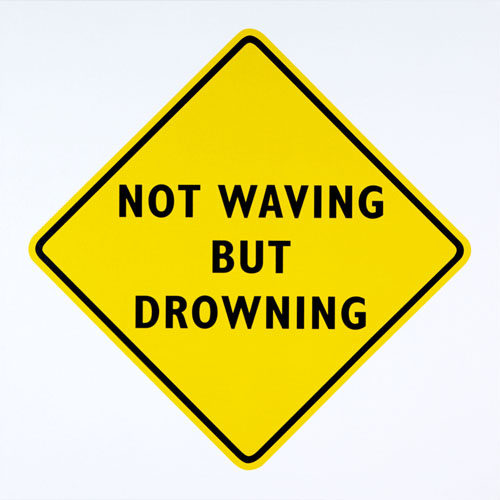
Edward Tufte,
Stevie Smith, Not Waving But Drowning, print on canvas, 29 ½" x 29 ½", edition of 3
Below, there are many variants of the just-show-up advice.
While making a movie, Woody Allen reportedly wears these words on a tee-shirt.

Edward Tufte,
Just Show Up, print on canvas, 29 ½" x 29 ½", edition of 3
Below, a more optimistic play on "Road Never Ends."
From a rowdy bar song by Robert Earl Keen, a Texas bluegrass singer and song-writer:

Edward Tufte,
Forever Road/Party, 2 prints on canvas,
29 ½" x 29 ½", edition of 3
Among the galleries in Chelsea, about one-third show amazing works of great artists, another third show new artists, and the last third show art that looks like art (or sophisticated kitsch).
Below, from Dwight Macdonald's esay "A Theory of Mass Culture:"

Edward Tufte,
Sophisticated Kitsch, print on canvas, 60" x 29 ½", edition of 3
There are more philosophical diamond signs to come.
Until then:

Edward Tufte,
Nothing is More Important, print on canvas, 29 ½" x 29 ½", edition of 3
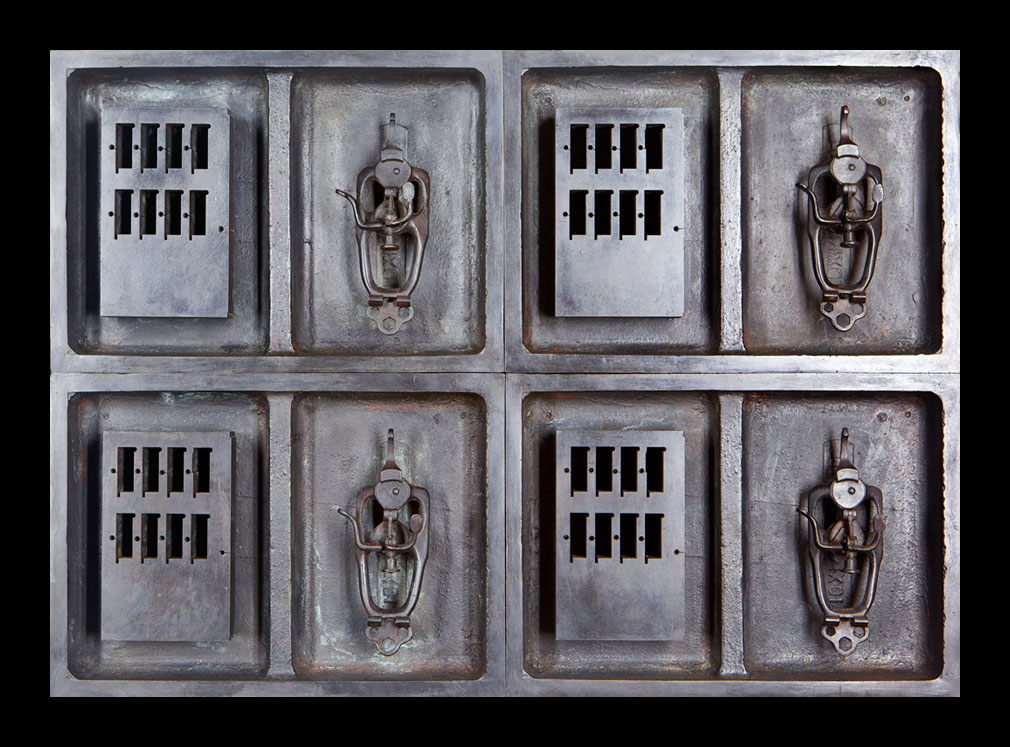
Masks Quartet, 2011
Edward Tufte,
Masks (Quartet), 2011, bronze casting,
19 ⅝ x 27 ½ x 3 ⅝ inches or 49.8 x 69.8 x 9.2 cm
Feynman Diagrams, Edward Tufte sculptures and exhibits
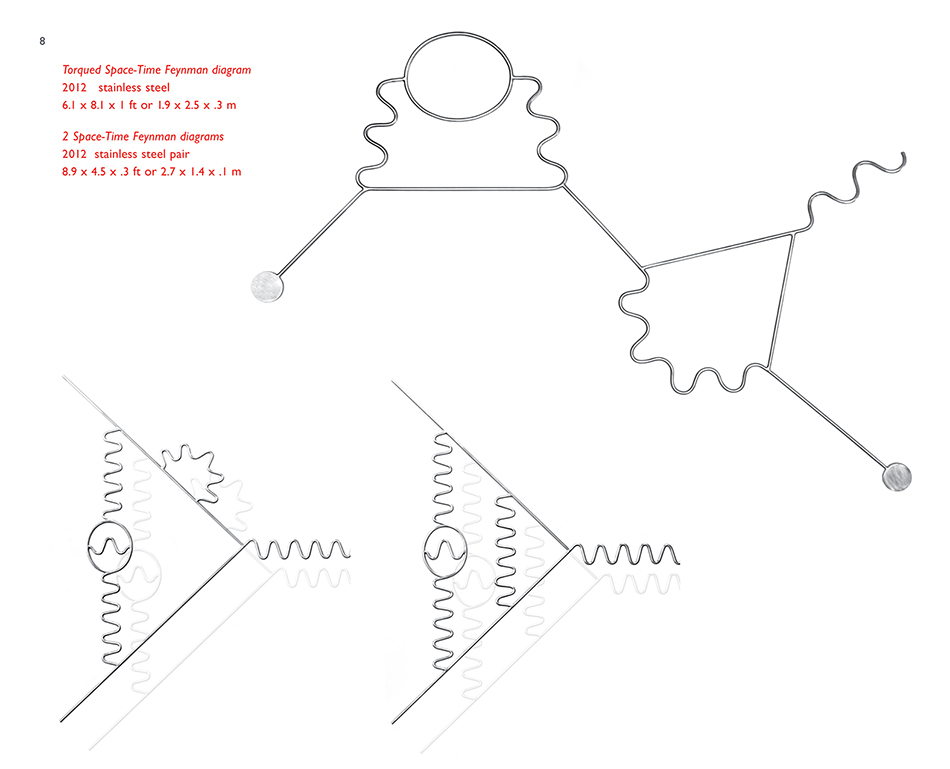
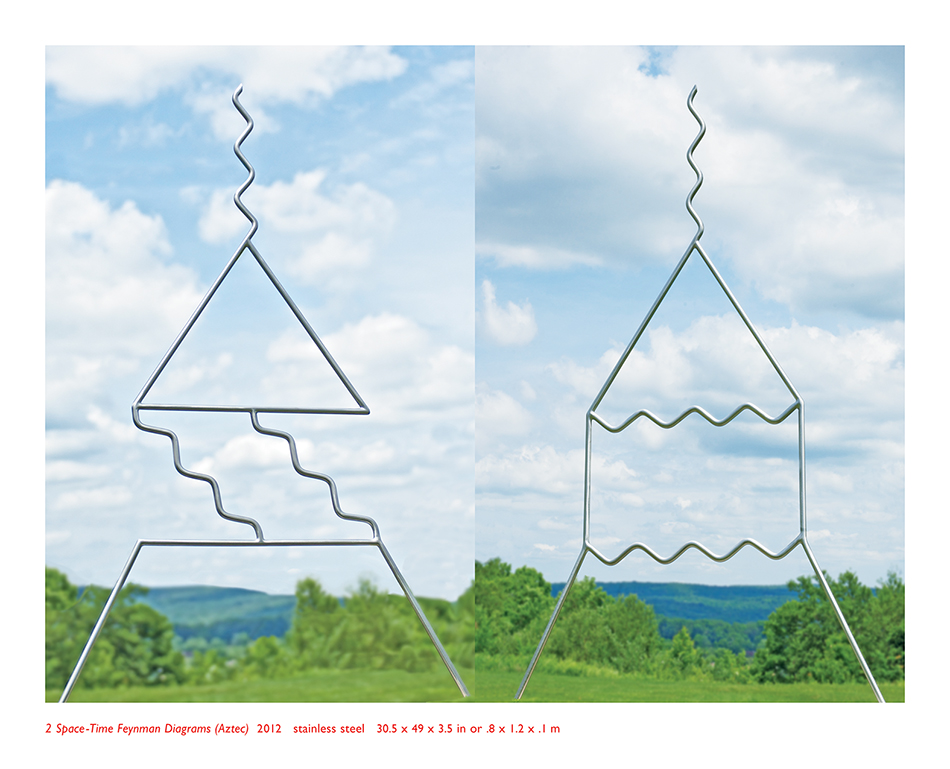
[ET's Feynman diagrams are] "Art, science, authenticity, precision, beauty, insight."
— Chris Quigg, theoretical physicist at Fermilab, author of
Gauge Theories of the Strong, Weak, and Electromagnetic Interactions.
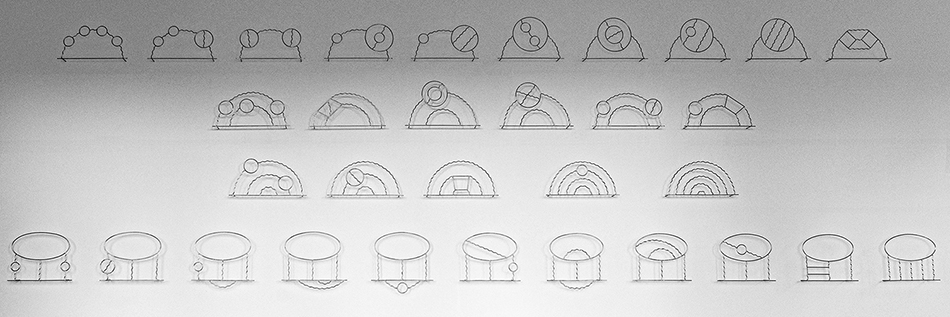
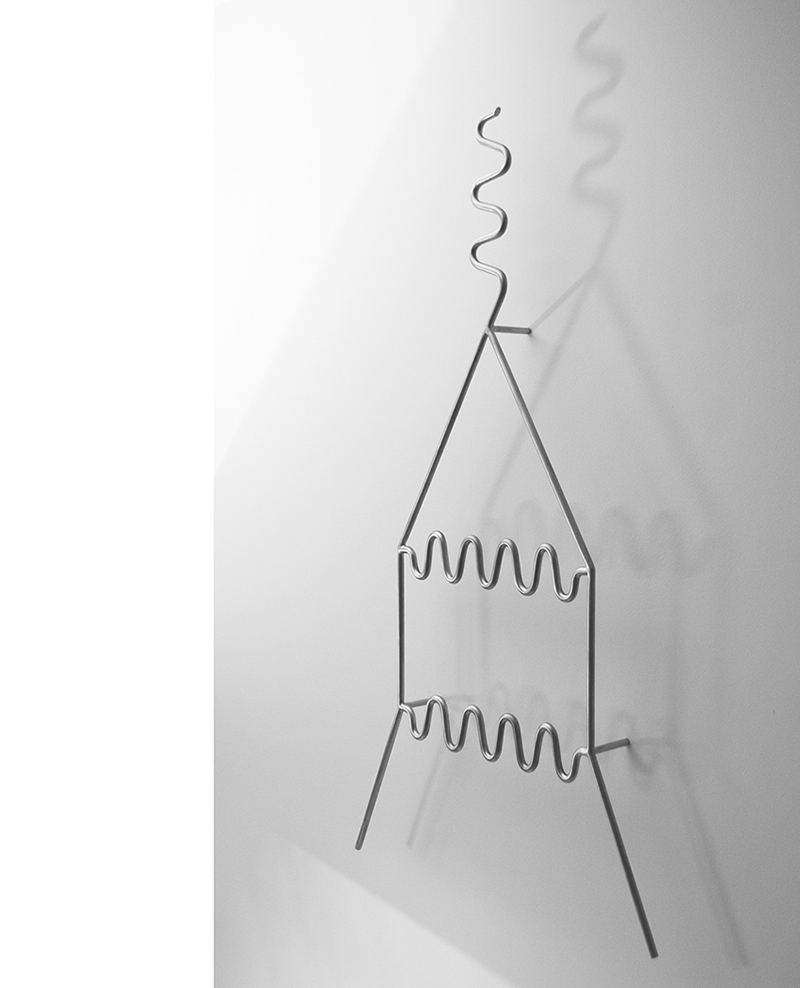
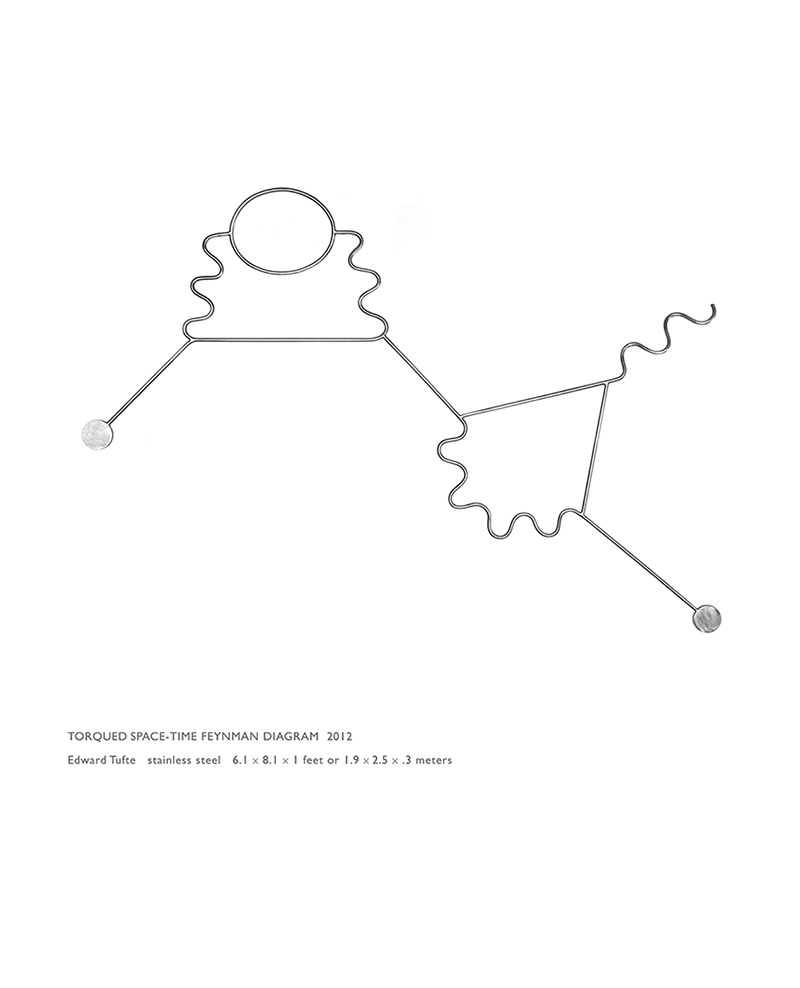
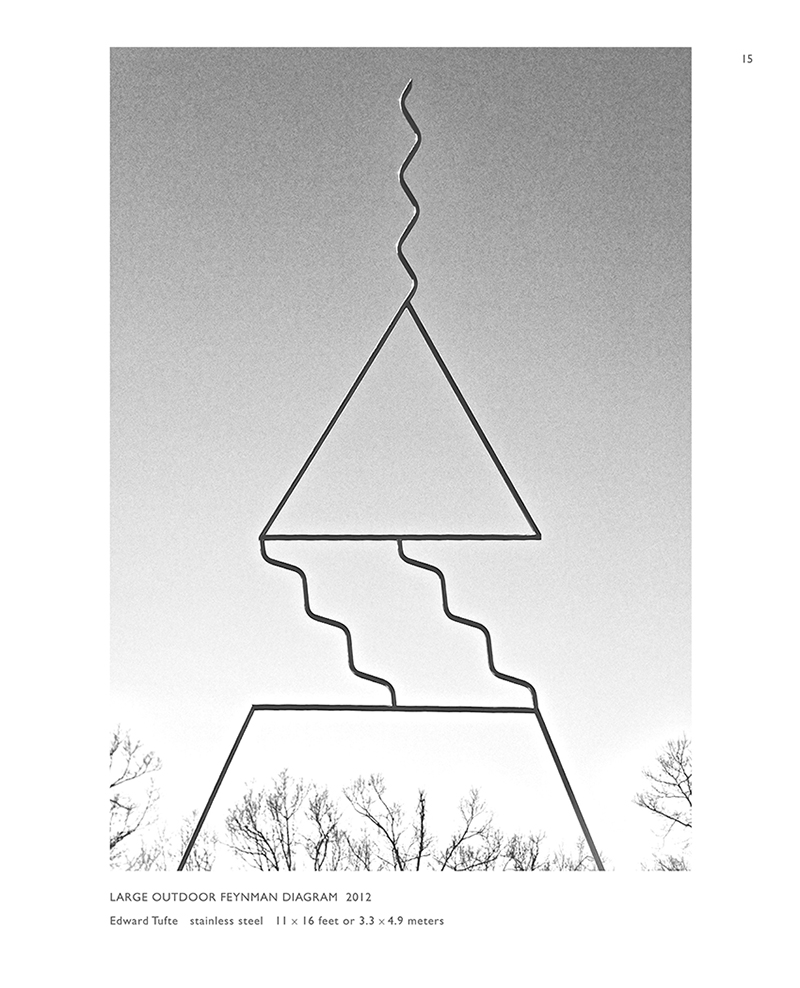
ET's stainless steel Feynman Diagrams are installed at the new World Trade Center building, Fermilabs, Hogpen Hill Farms, and in many private collections.
A current exhibition is at the Williamson Gallery, ArtCenter College for Design. Planning in underway for an exhibit at the Nobel Museum in Stockholm honoring Richard Feynman's 100th birthday.
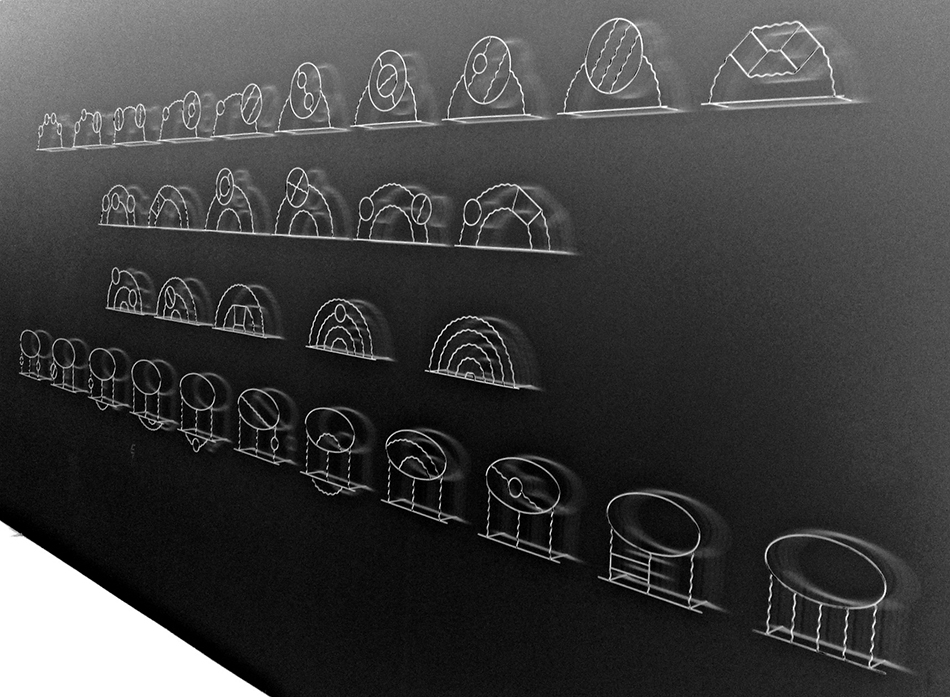
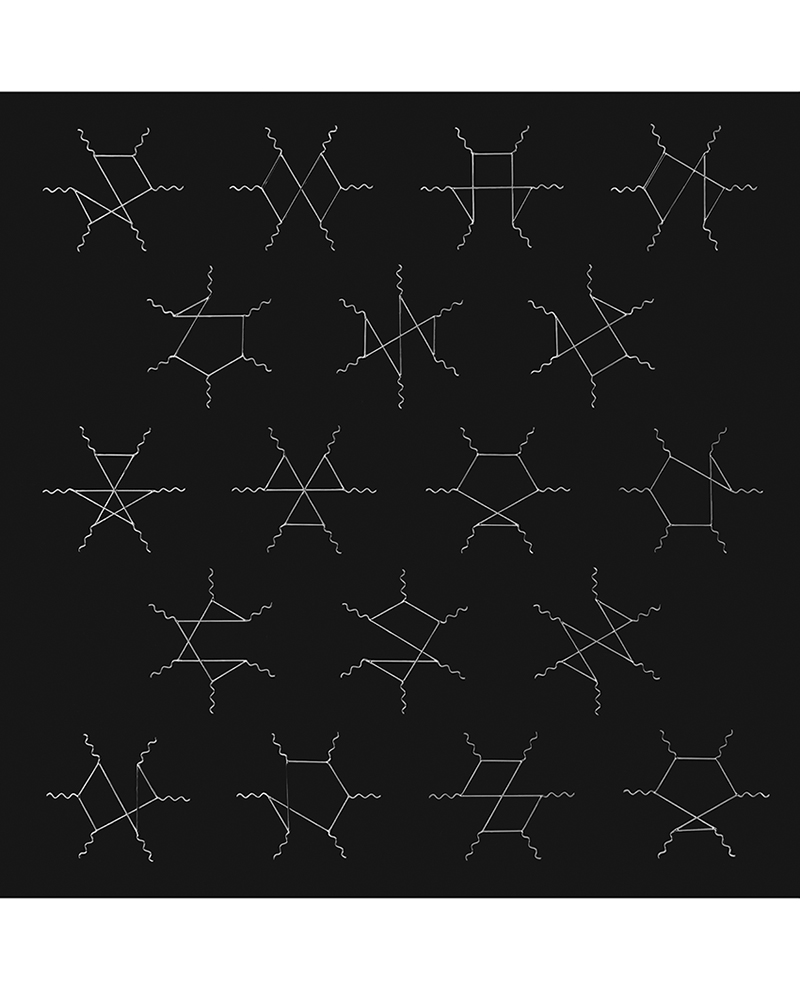
32 new stainless-steel Feynman diagrams by Edward Tufte at Fermilab.
The matrix of 32 diagrams was constructed by Tatsumi Aoyama, Masashi Hayakawa, Toichiro Kinoshita, and Makiko Nio, "Complete Tenth-Order QED Contribution to the Muon
g - 2," Physical Review Letters, 109, 111808-3 (2012) and represent
"Self-energy-like diagrams representing 32 gauge-invariant subsets contributing to the lepton
g - 2 at the tenth order. Solid lines represent lepton lines propagating in a weak magnetic field."
In the stainless steel artwork, the 32 visually delightful diagrams cast changing shadows on the wall mounting. These new diagrams supplement the Fermilab exhibit
The Cognitive Art of Feynman Diagrams, which will close on June 26.
The artwork was designed and constructed by Edward Tufte, Andy Conklin, and Brad MacDougall. Thanks to Chris Quigg for pointing out PRL paper.
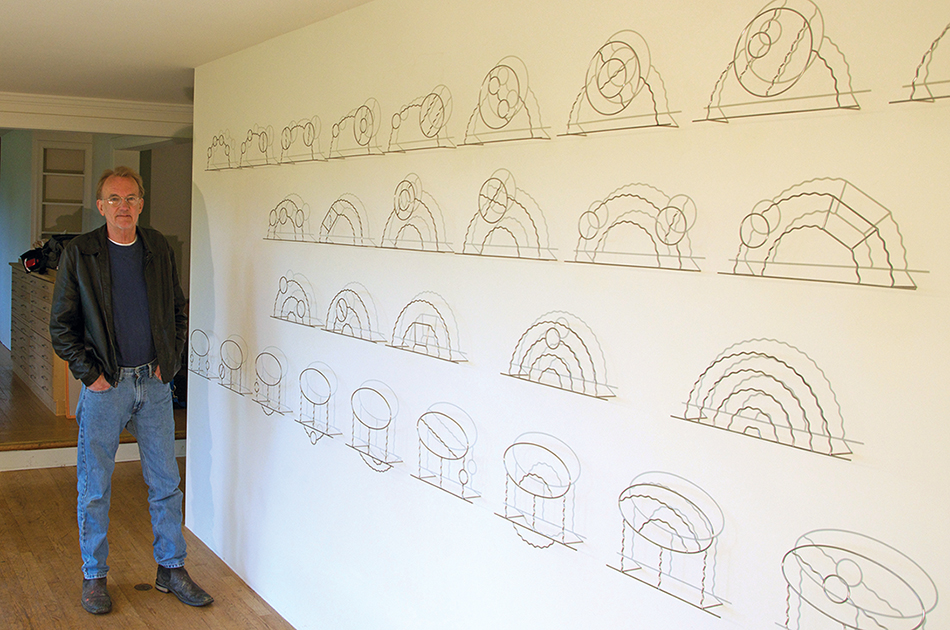
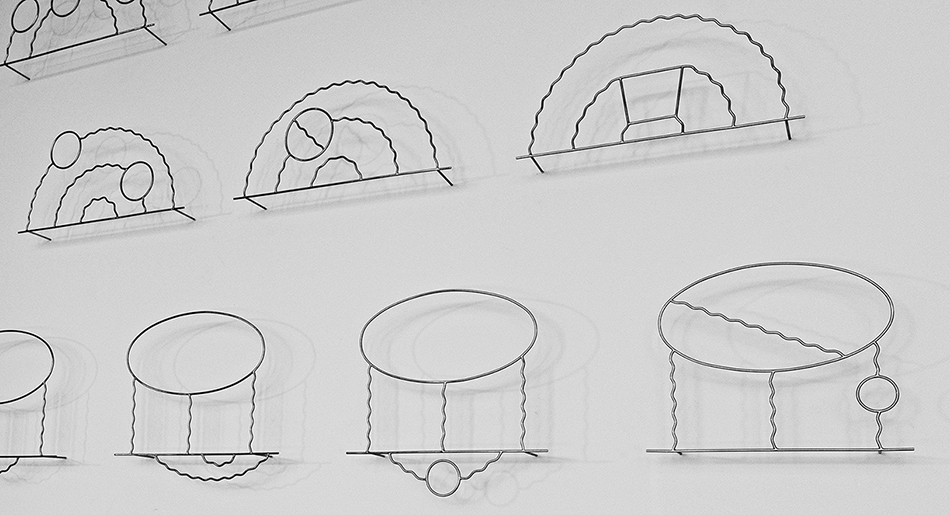
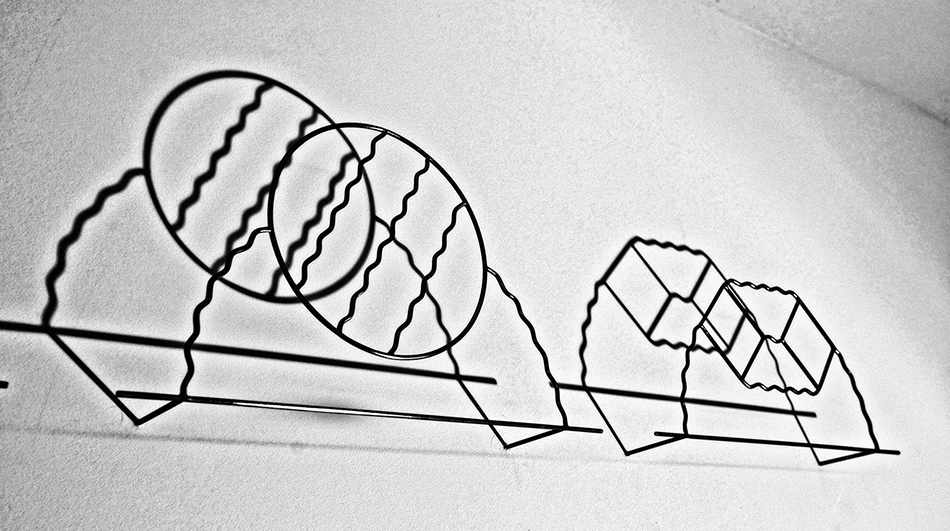
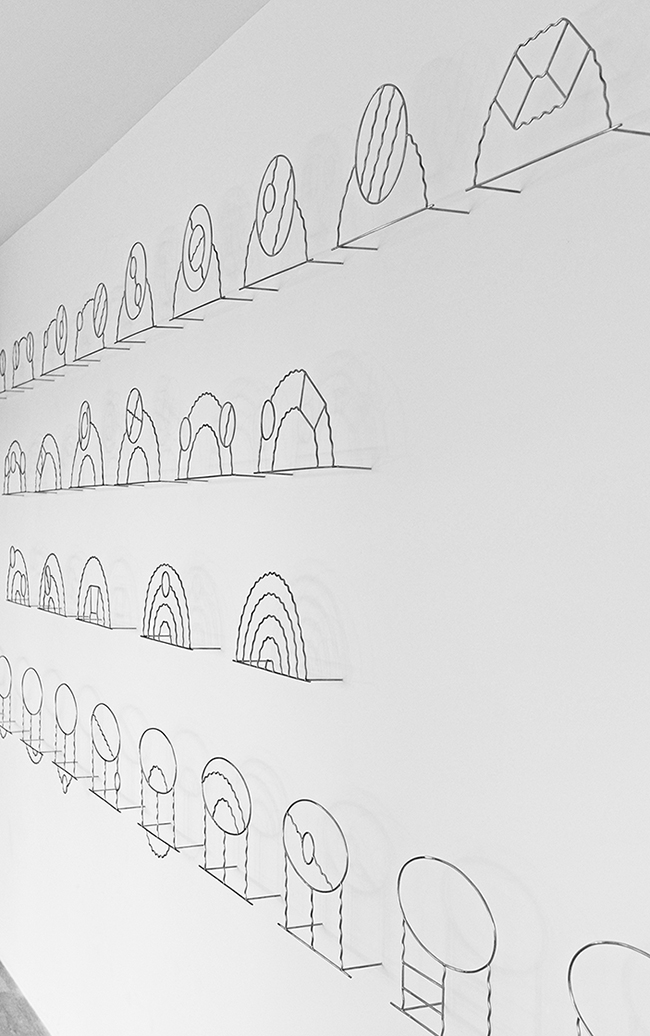
 Edward Tufte, The Cognitive Art of Feynman Diagrams exhibit,
Fermilab Art Gallery, Fermi National Accelerator Laboratory, April 12 - June 26, 2014.
Edward Tufte, The Cognitive Art of Feynman Diagrams exhibit,
Fermilab Art Gallery, Fermi National Accelerator Laboratory, April 12 - June 26, 2014.
Here is the 20-page catalog for the Fermilab exhibit:






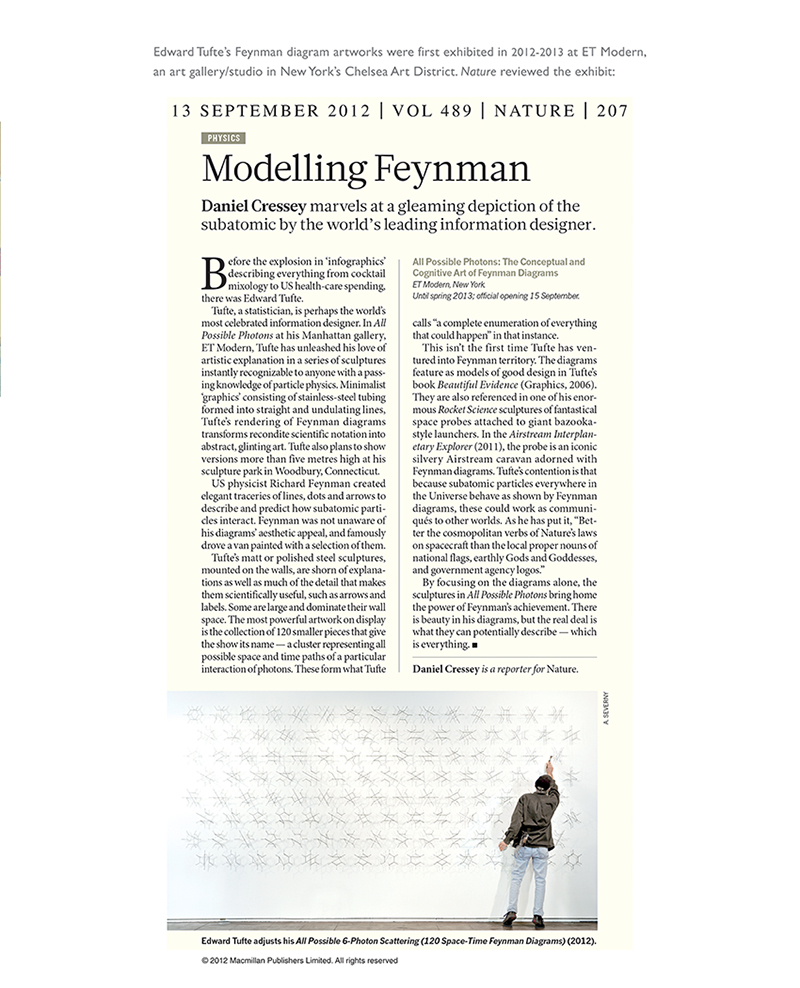
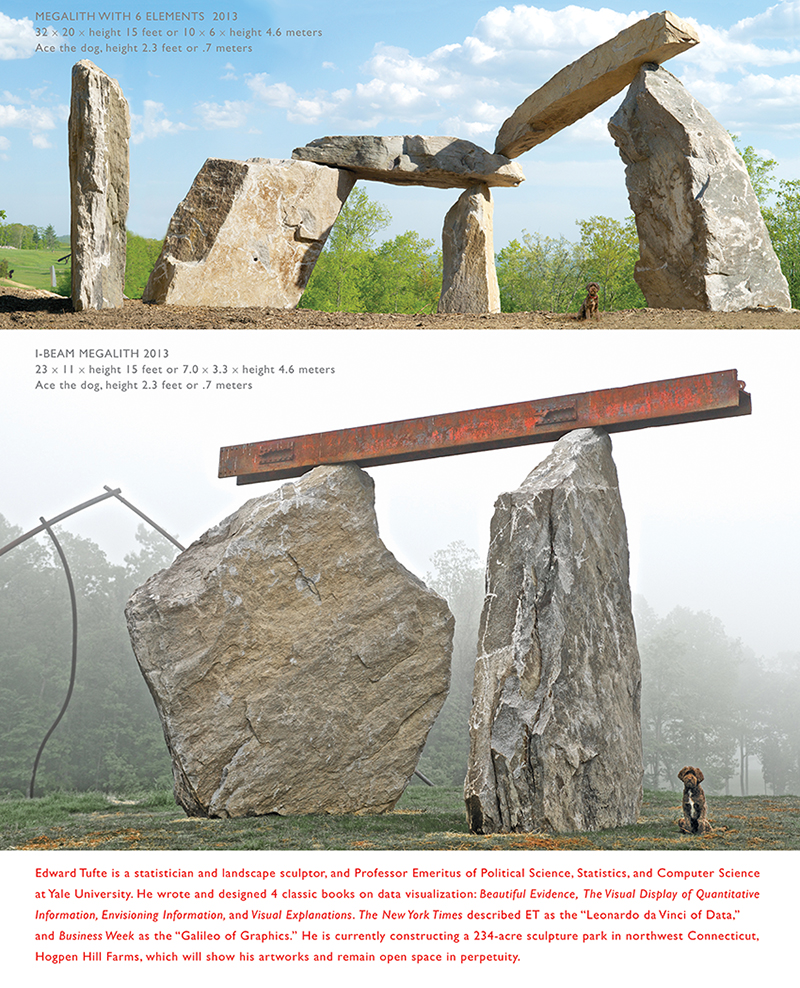
Fermilab has a most interesting architecture. Here are some of the buildings and Fermilab sculpture. Photographs below taken late January 2014:

My exhibit at Fermilab makes me very happy: will also teach a short course on scientific visualization for the staff, and meet people who actually know how Feynman diagrams work!
Fermilab have some Feynman diagrams cut out of steel as part of a walkway.
Below an ImageQuilt from our Chrome app
ImageQuilts and the images:


Below, here is the
16-page exhibit catalog (PDF), with a paper edition for the exhibit at ET Modern.

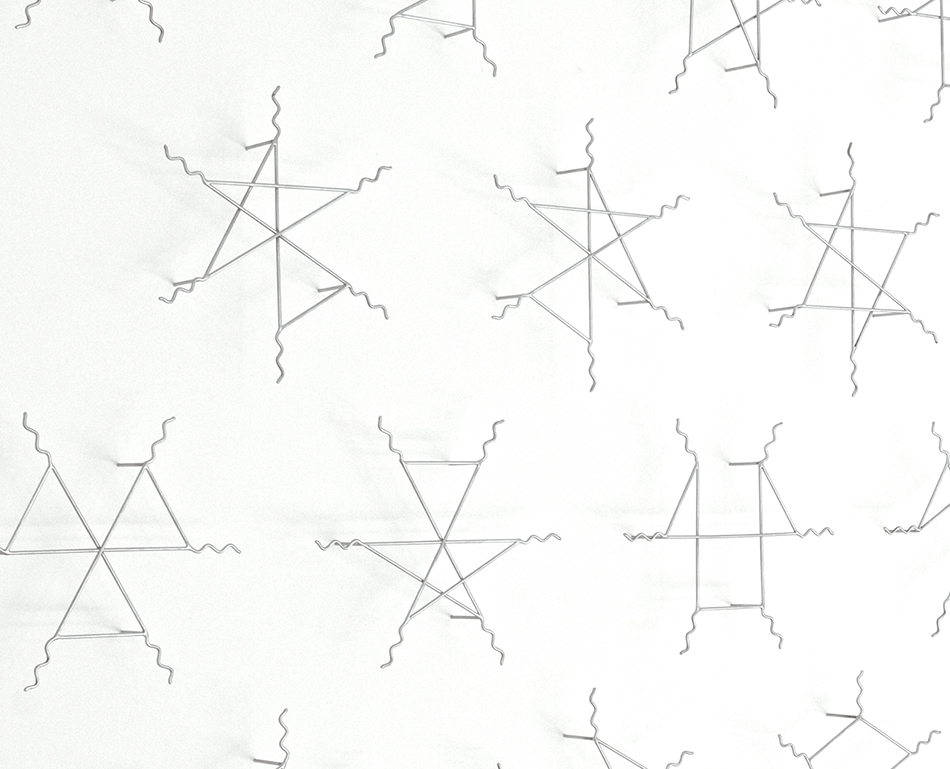
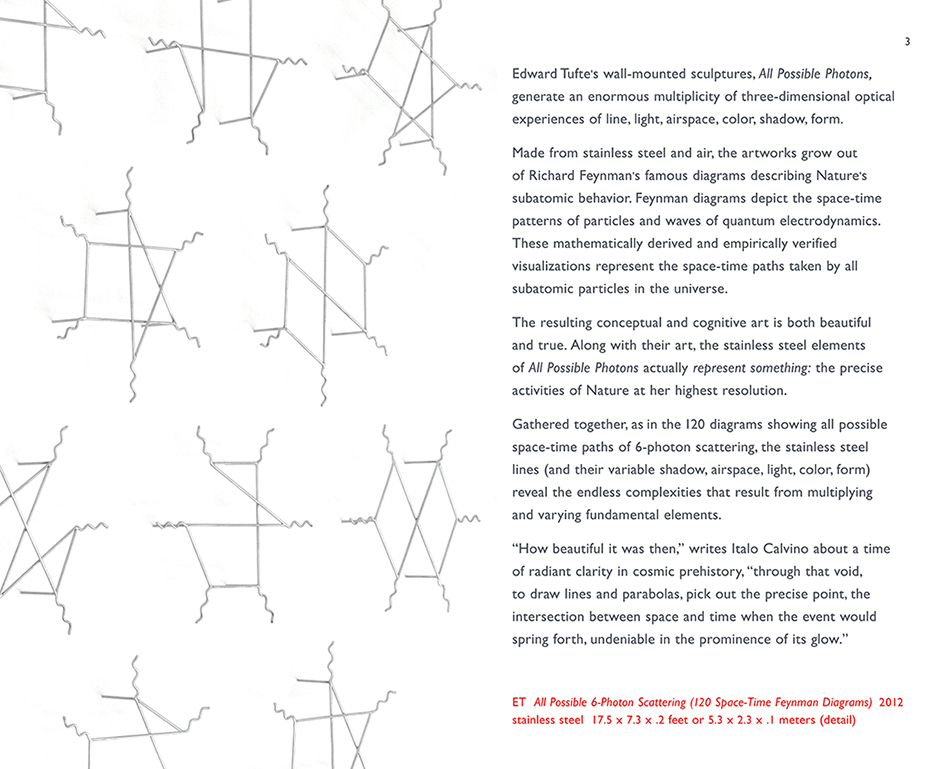

This thread below served during the last 18 months as an on-going rough draft of the exhibit essay now published as a pdf (above) and also in paper.
Now back to the original thread that began August 2011:
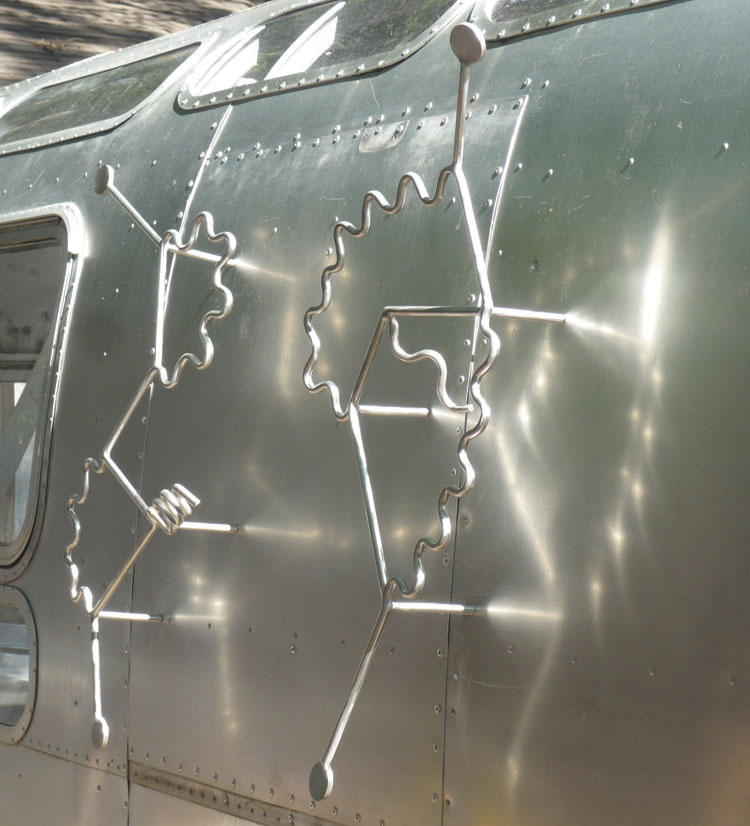
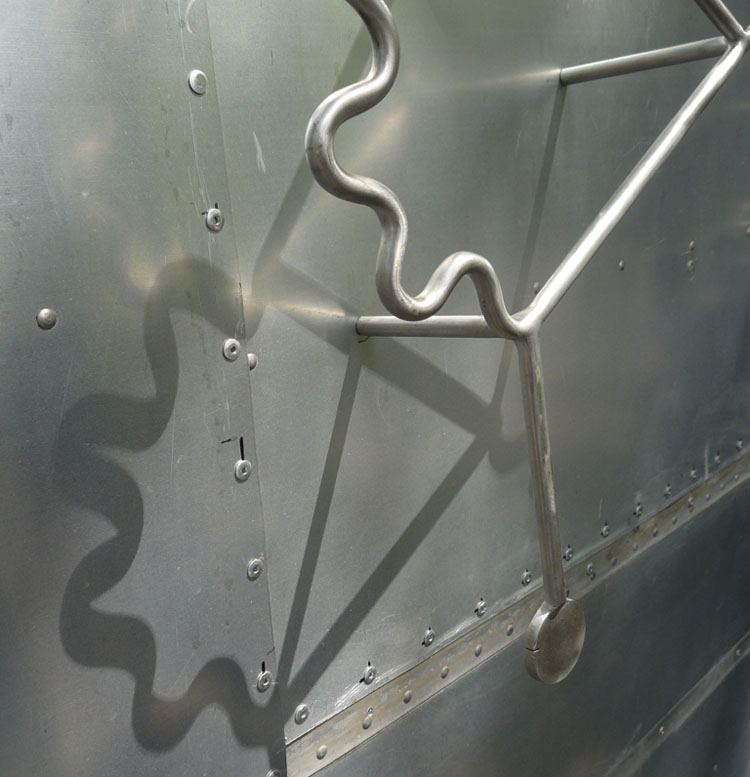
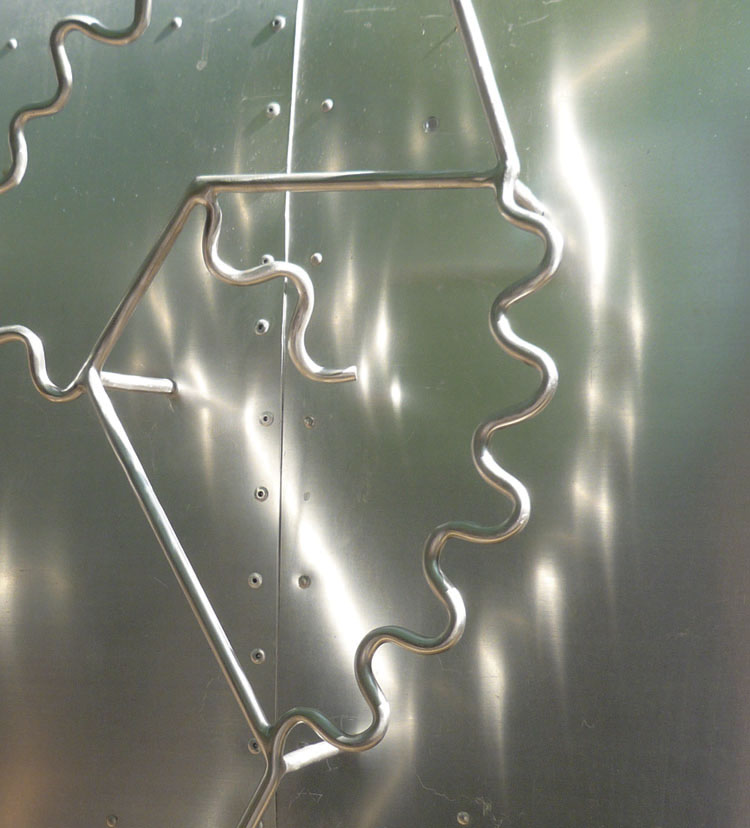
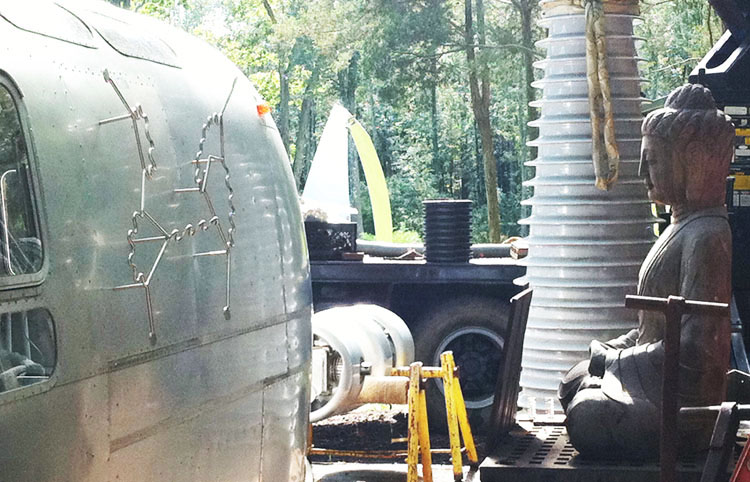
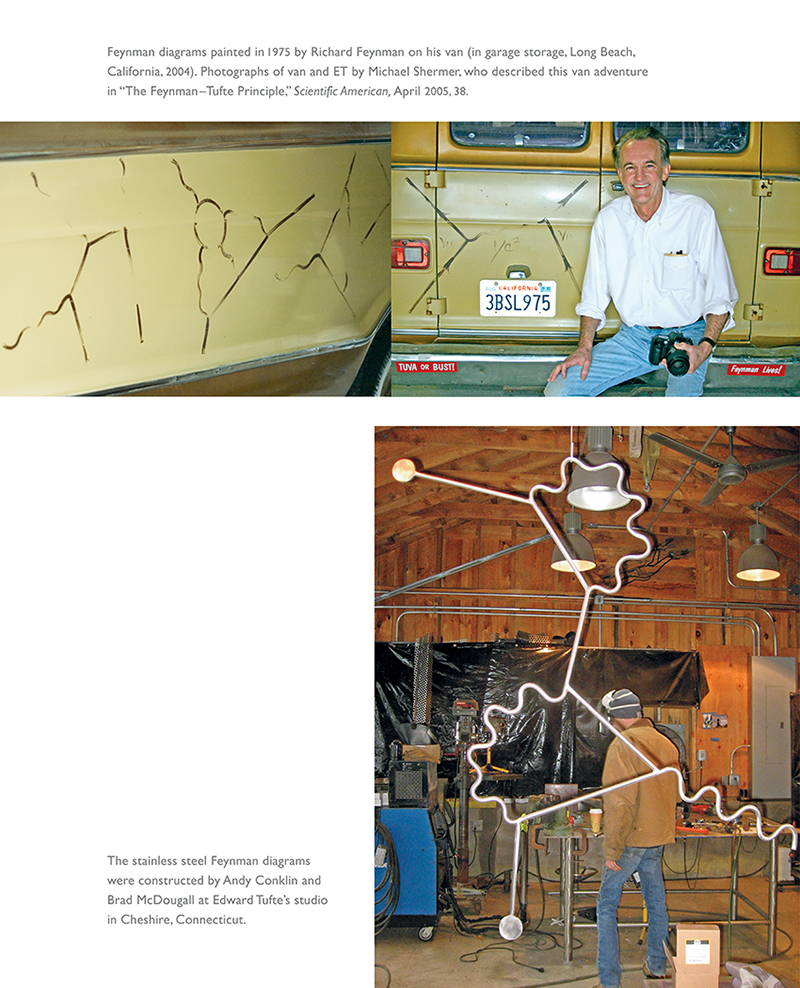
My studio colleagues Andy Conklin and Brad McDougall bent and welded the stainless steel based on my templates and consequent editing of the steel.
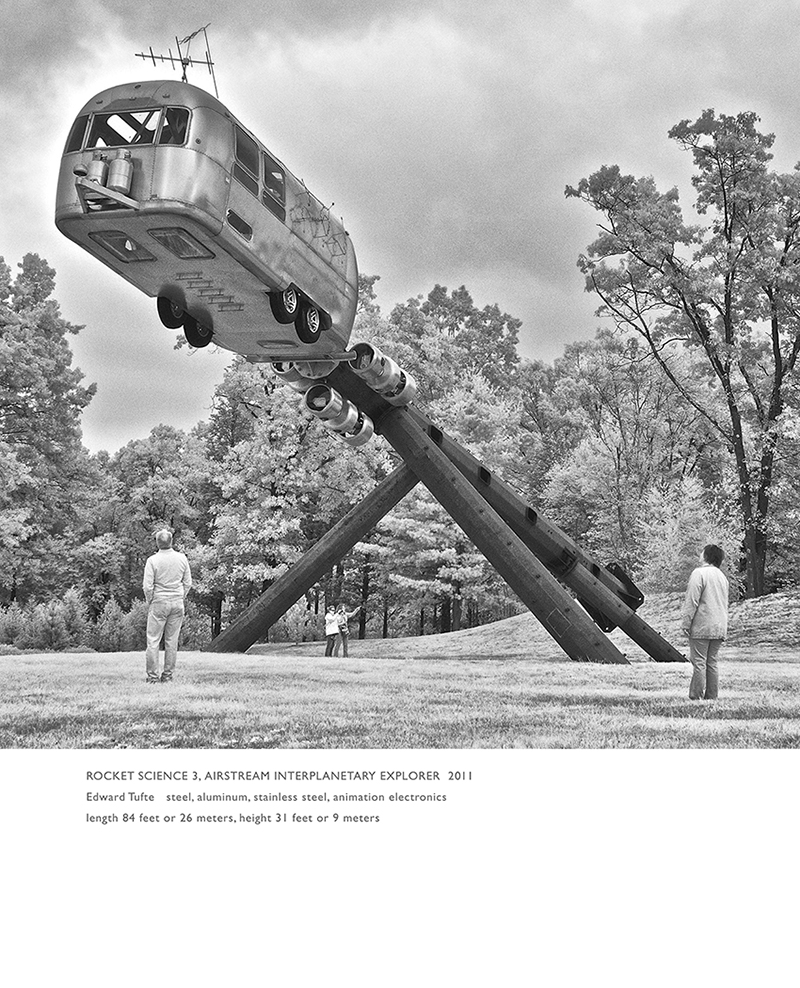
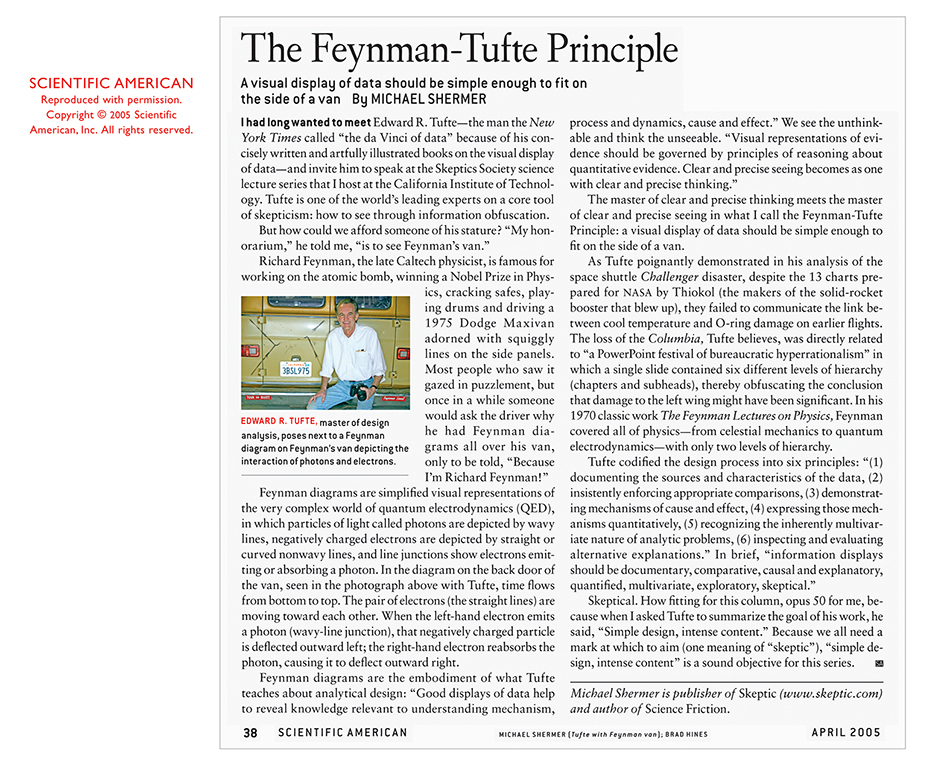
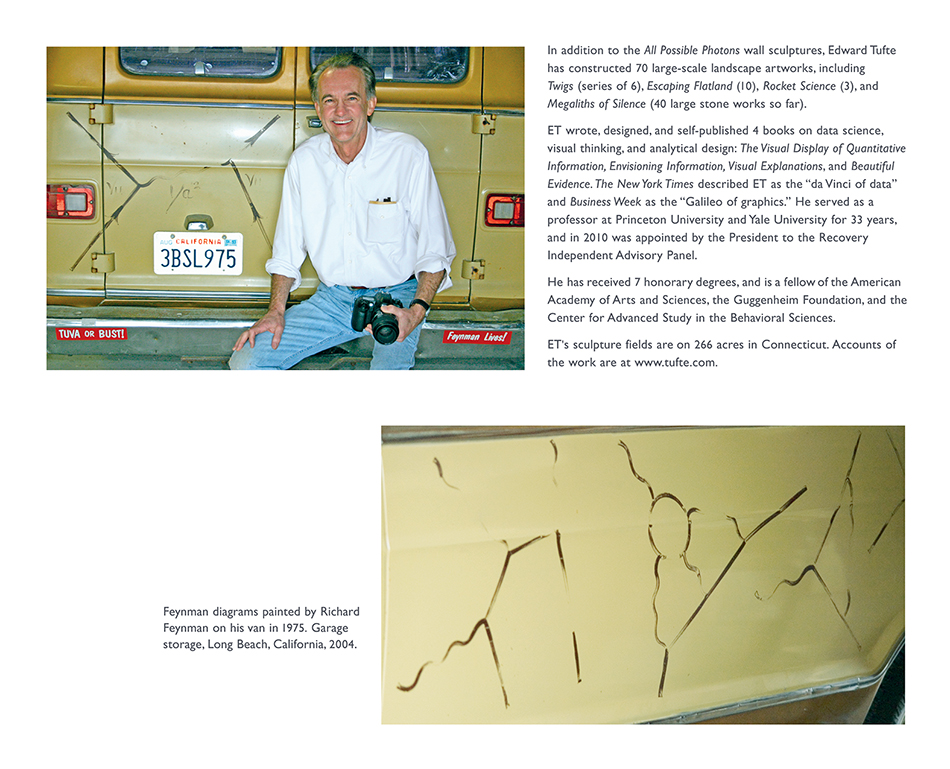
Our stainless Feynman diagrams are mounted on an Airstream trailer, a reference to Richard Feynman's 1975 Dodge Maxivan which he customized with a diagrammatic mural. Below are pictures of my 2004 visit to Feynman's van, then garaged in Long Beach, California. (An account of that visit is in Michael
Shermer's
Scientific American article
"The Feynman-Tufte Principle".)
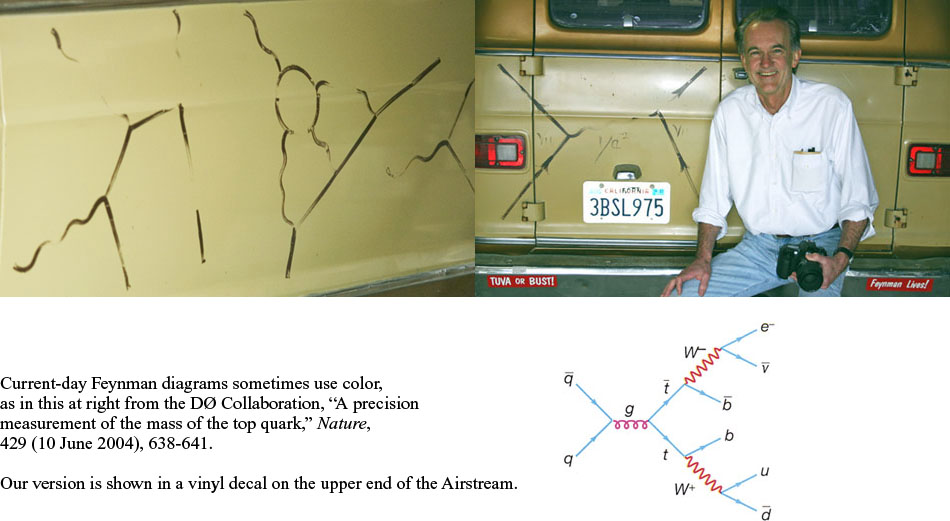
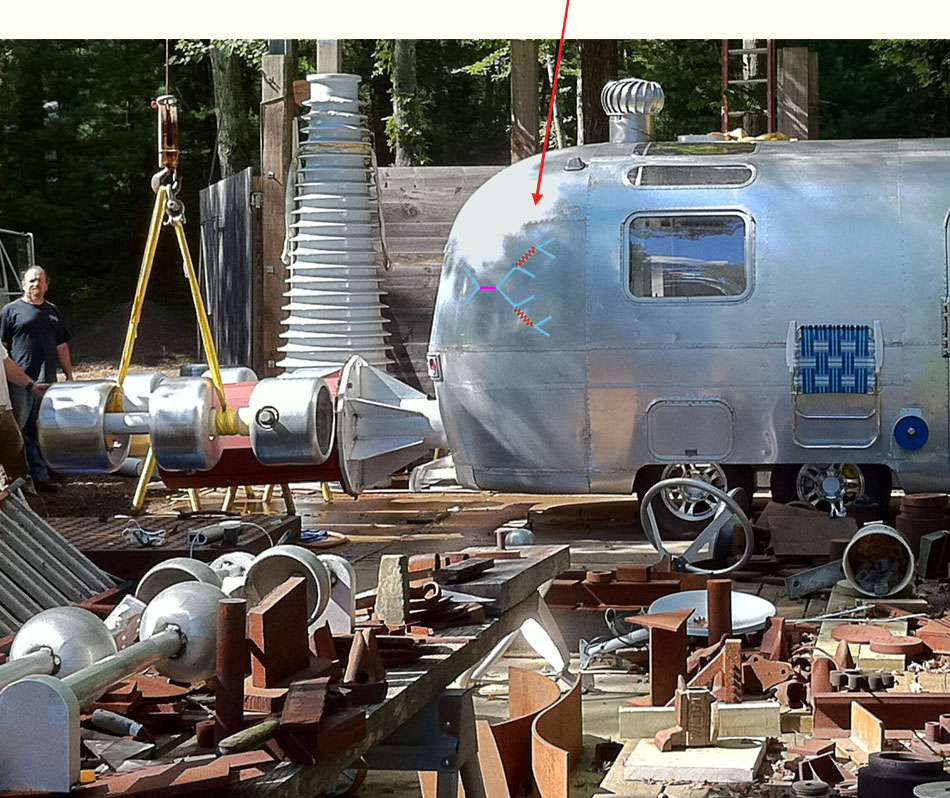
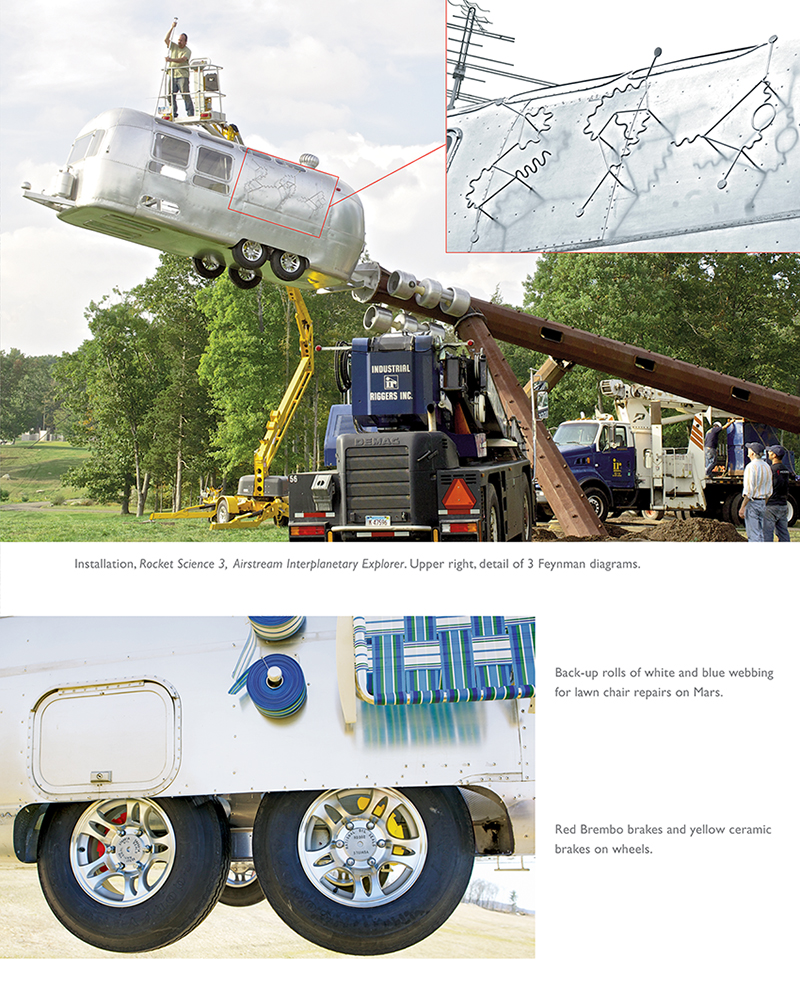
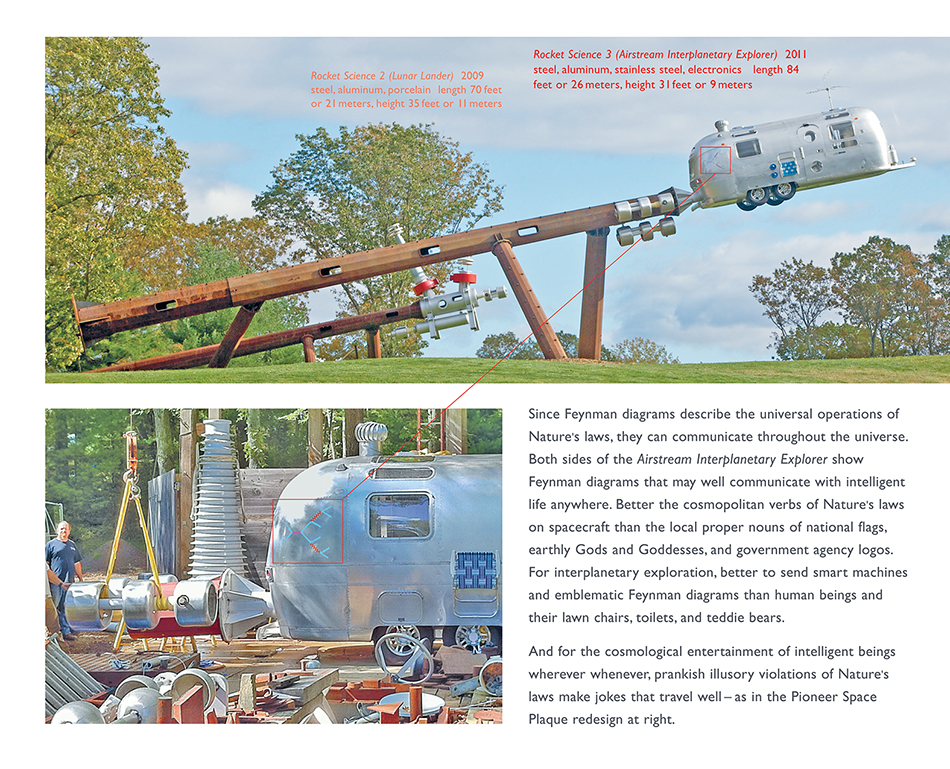
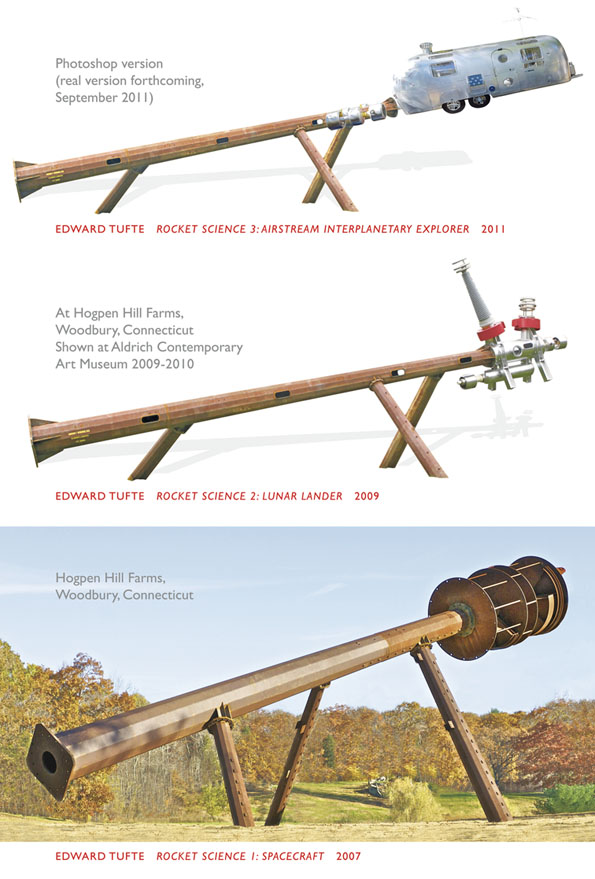
Shown here above in our sculpture studio, the Airstream trailer is a proposed Mars Exploration Vehicle, or perhaps an Intergalactic Explorer, and is part of a larger sculpture (Rocket Science #3) in the
Rocket Science #1 and
Rocket Science #2 sequence.
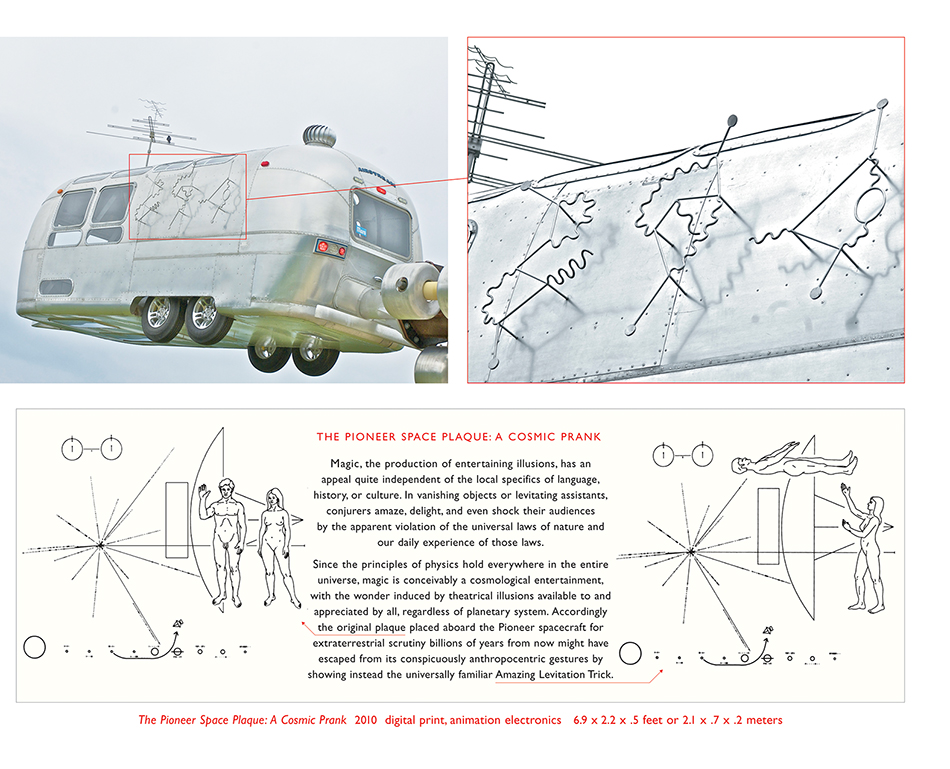
Since the Feynman diagrams describe universal events in Nature, intelligent extra-terrestrial life may well know all about them. On this point, see the
Pioneer Space Plaque Redesign.
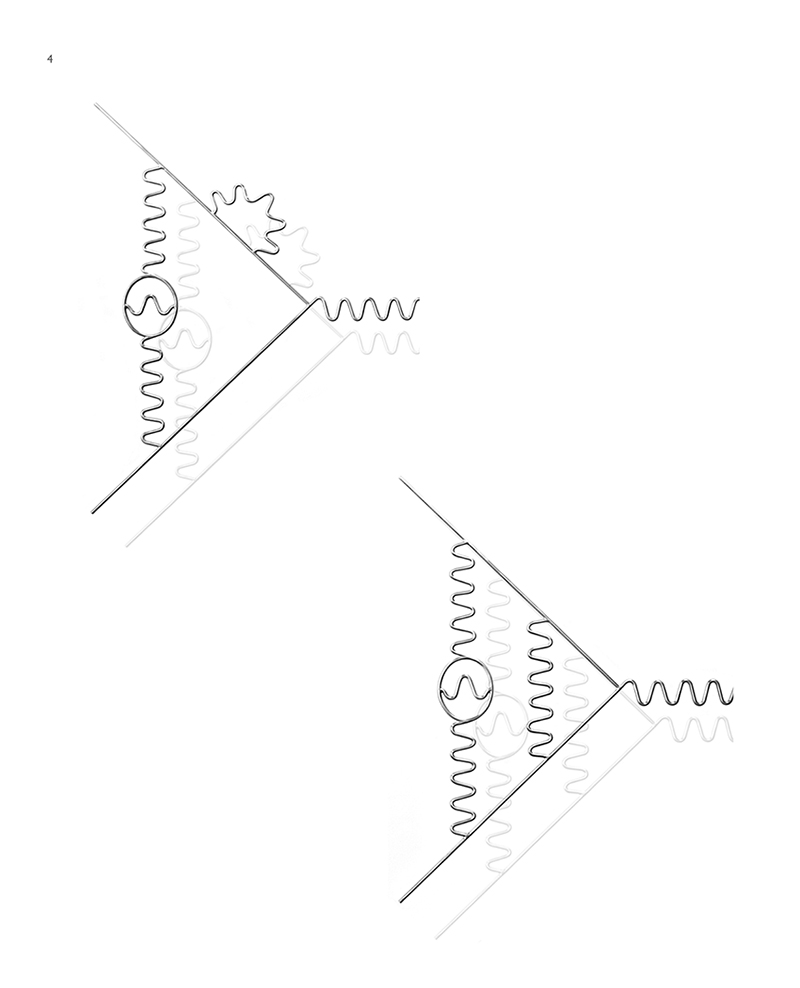
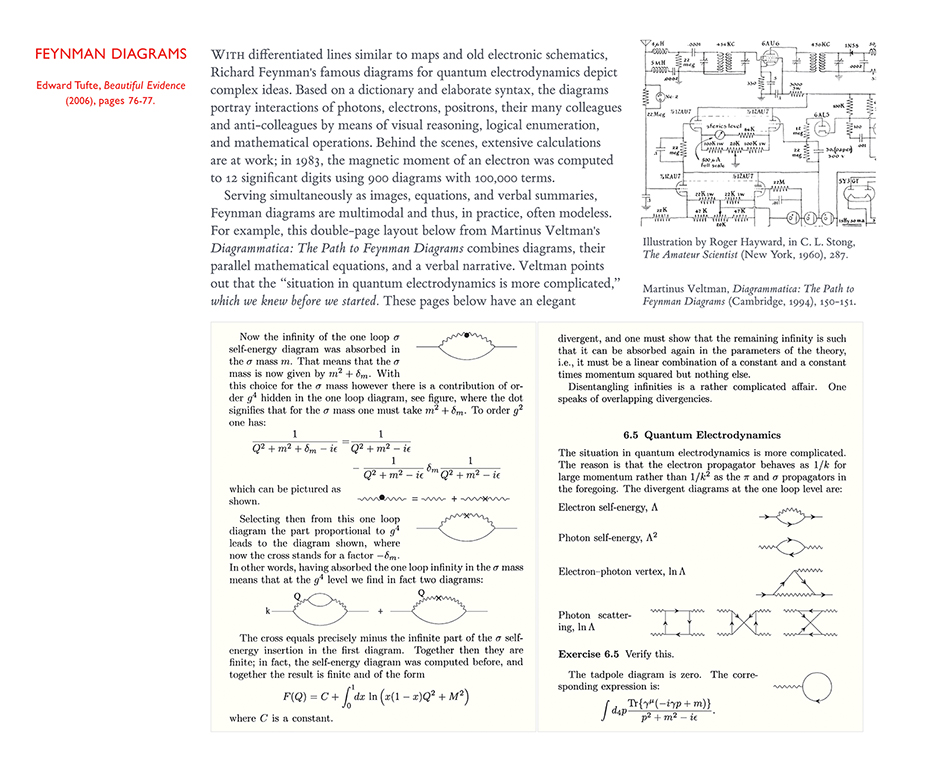
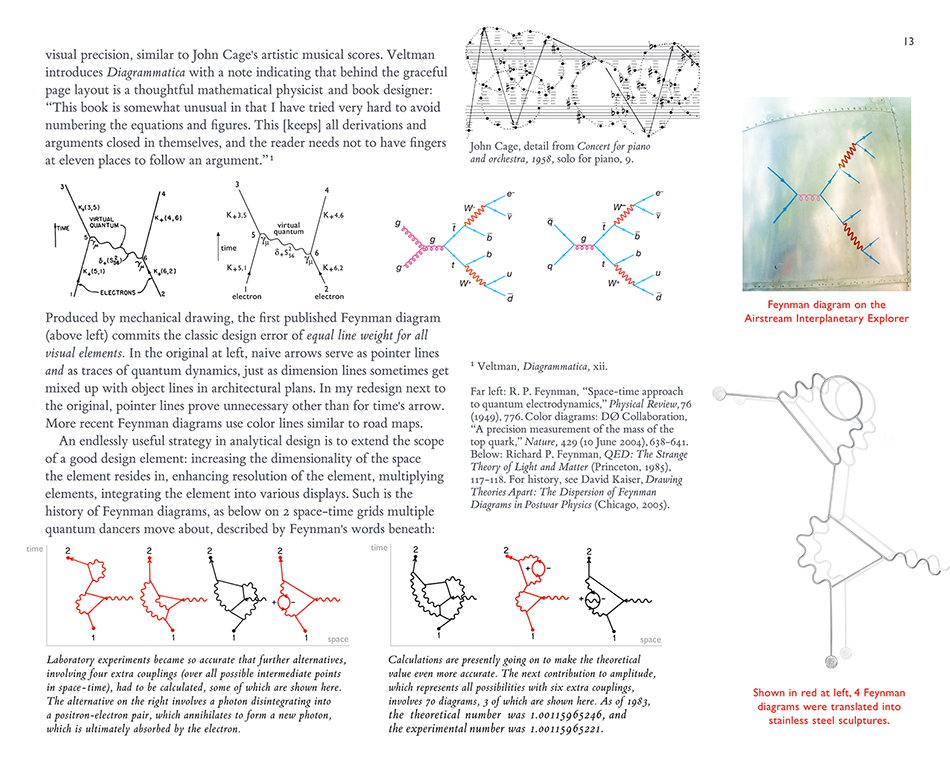
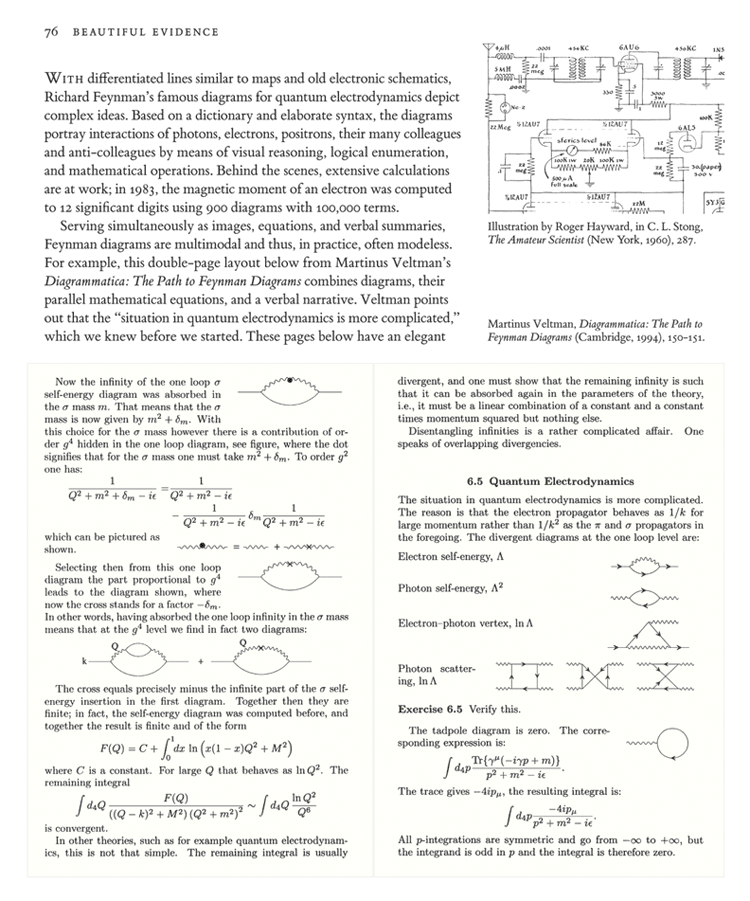
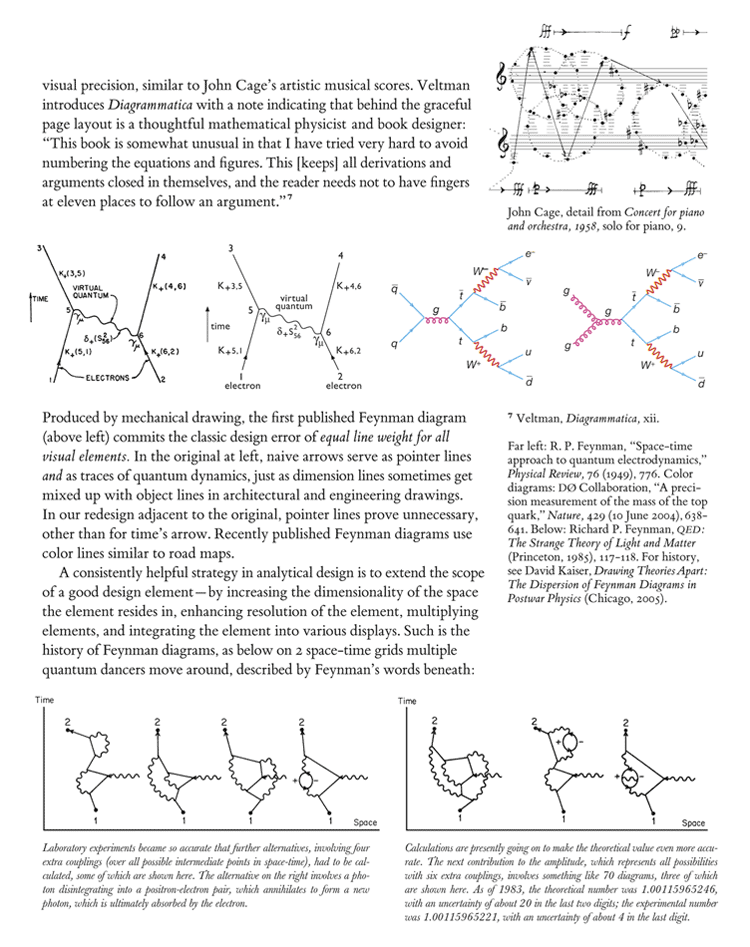
I wrote about (and gently redesigned) Feynman diagrams in
Beautiful Evidence, pages 76-77 shown below.
These pages also provide explanations of the diagrams used on the Airstream Interplanetary Explorer.
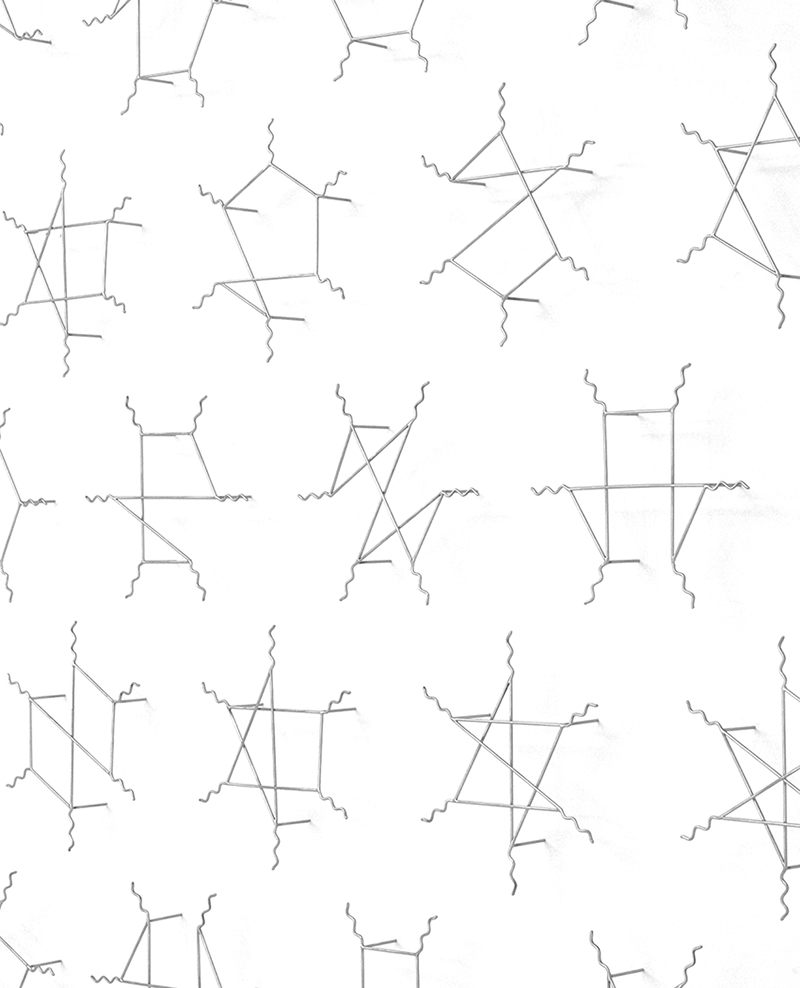
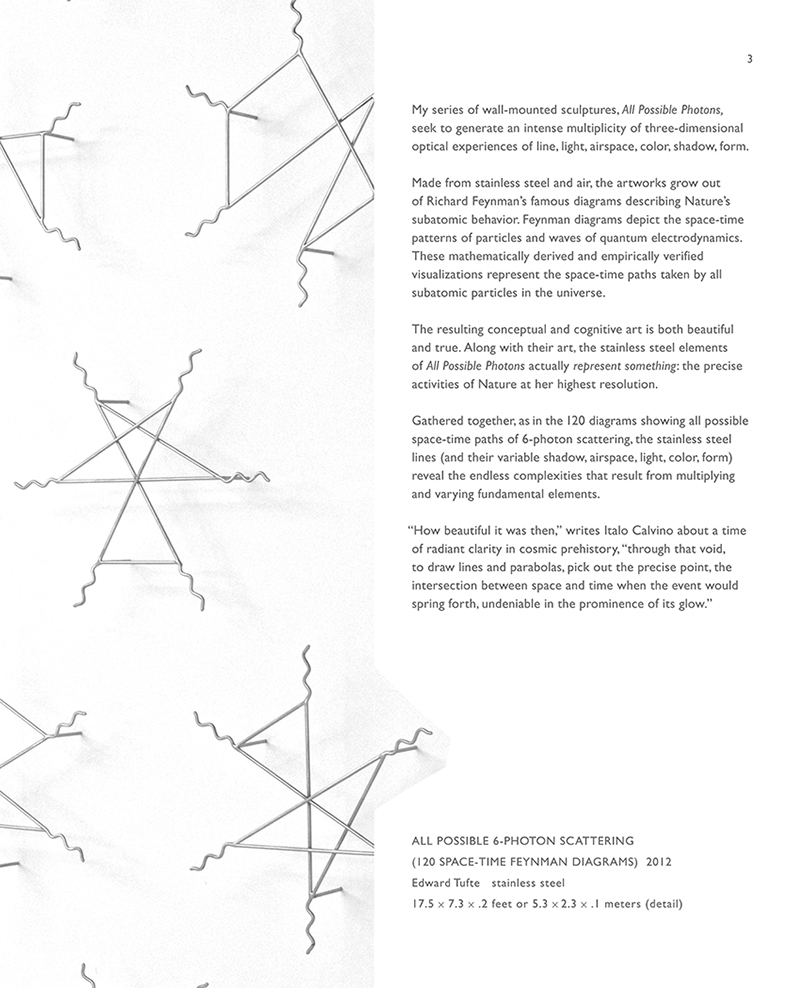
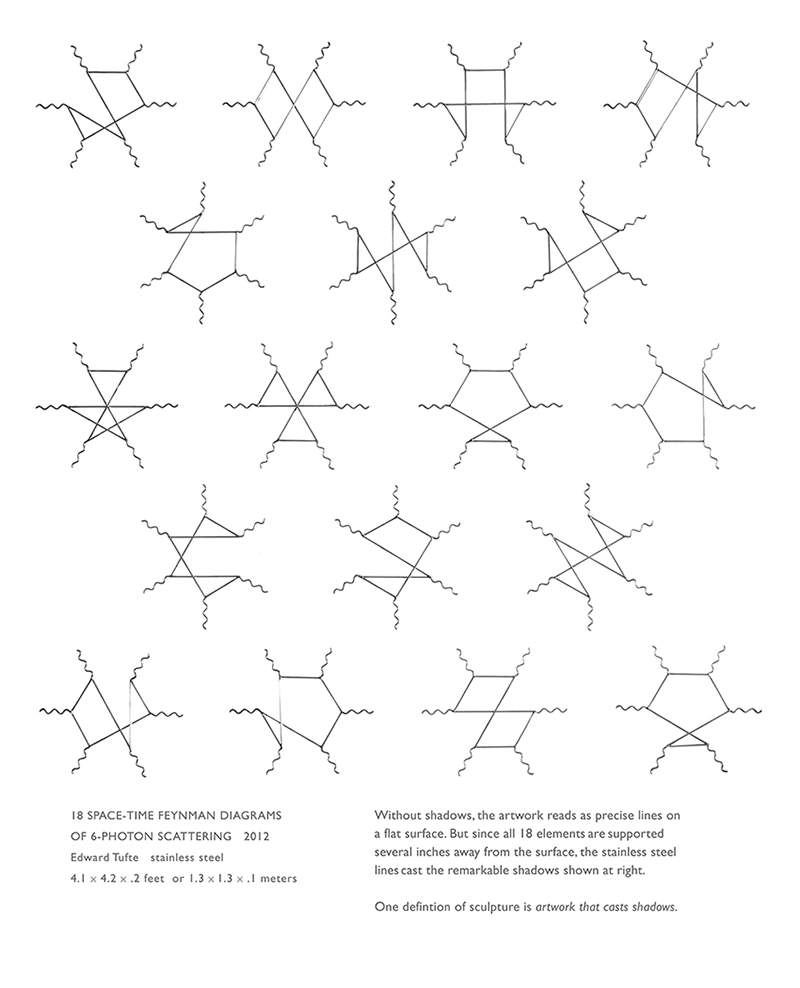
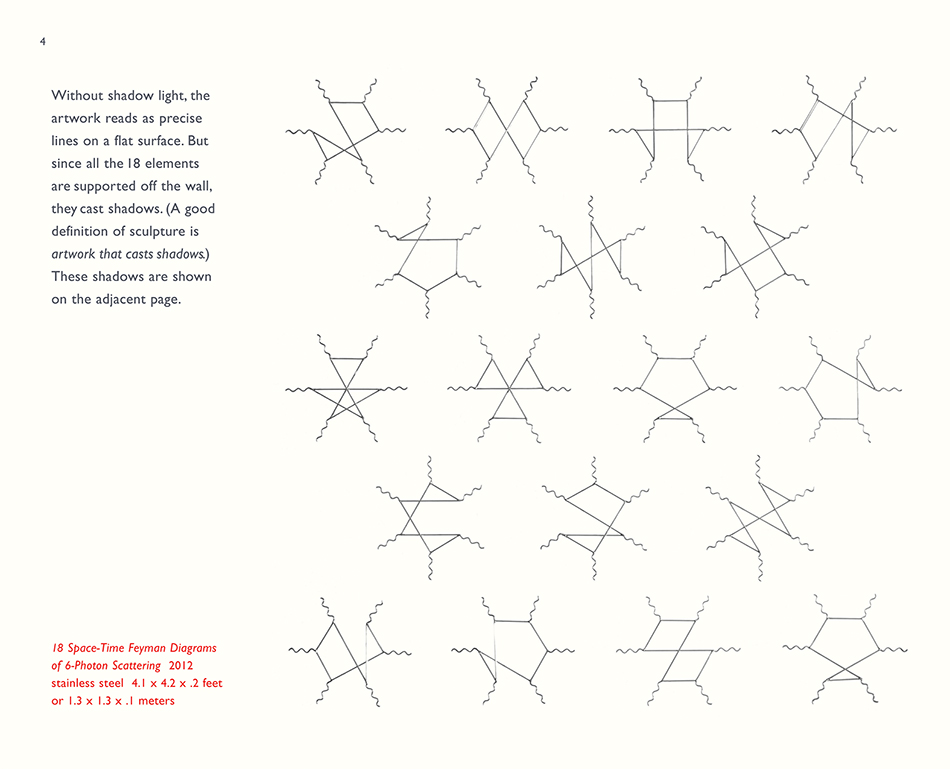
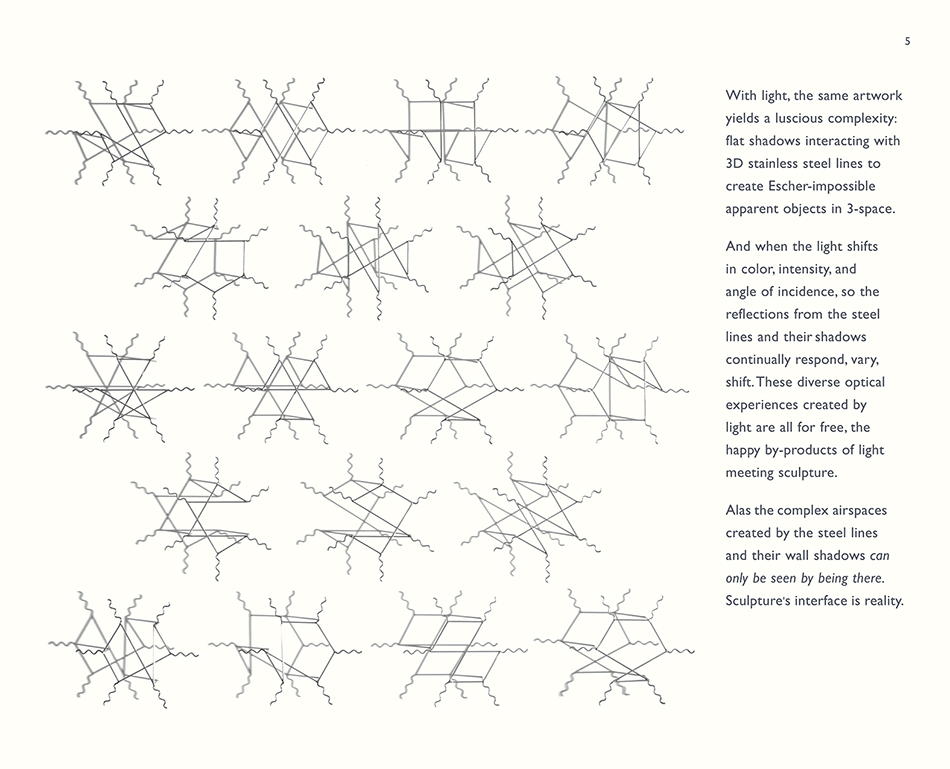
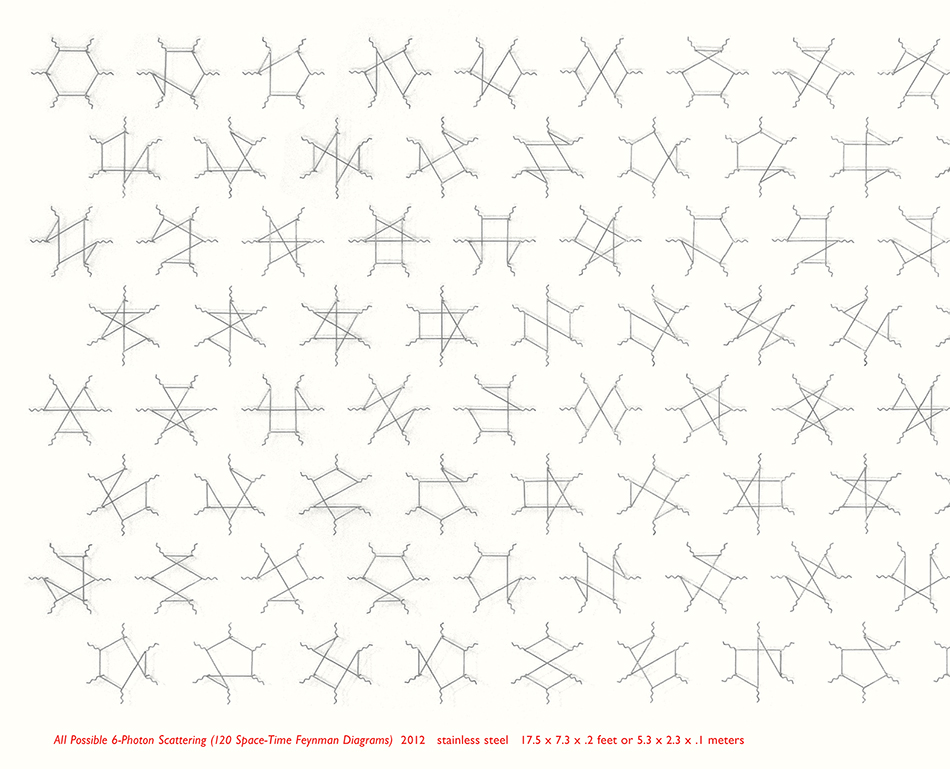
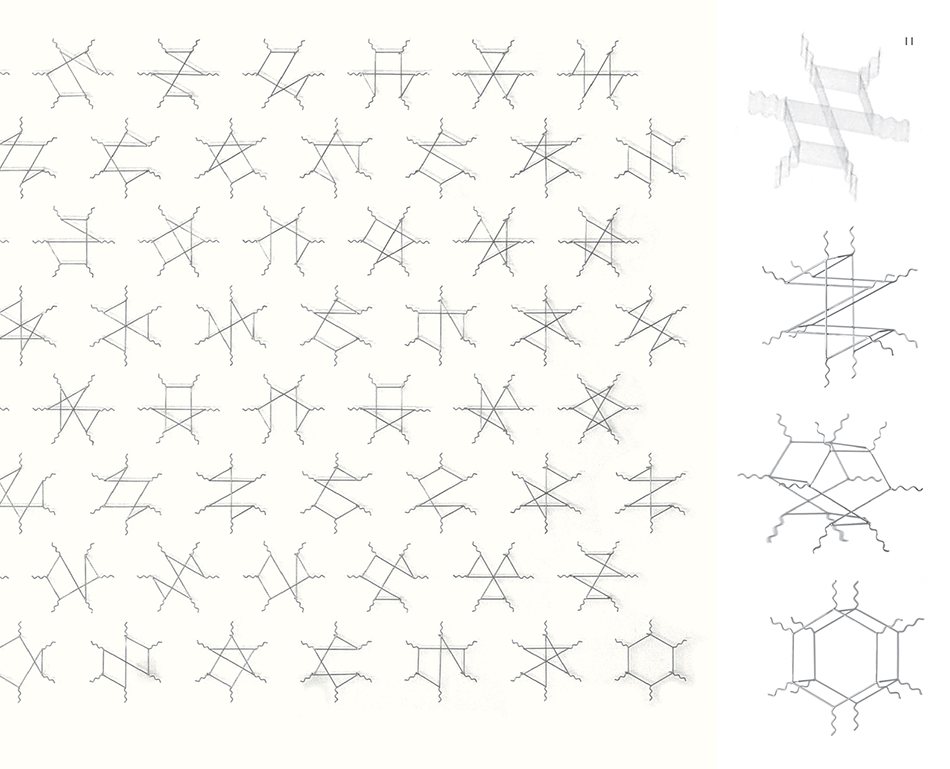
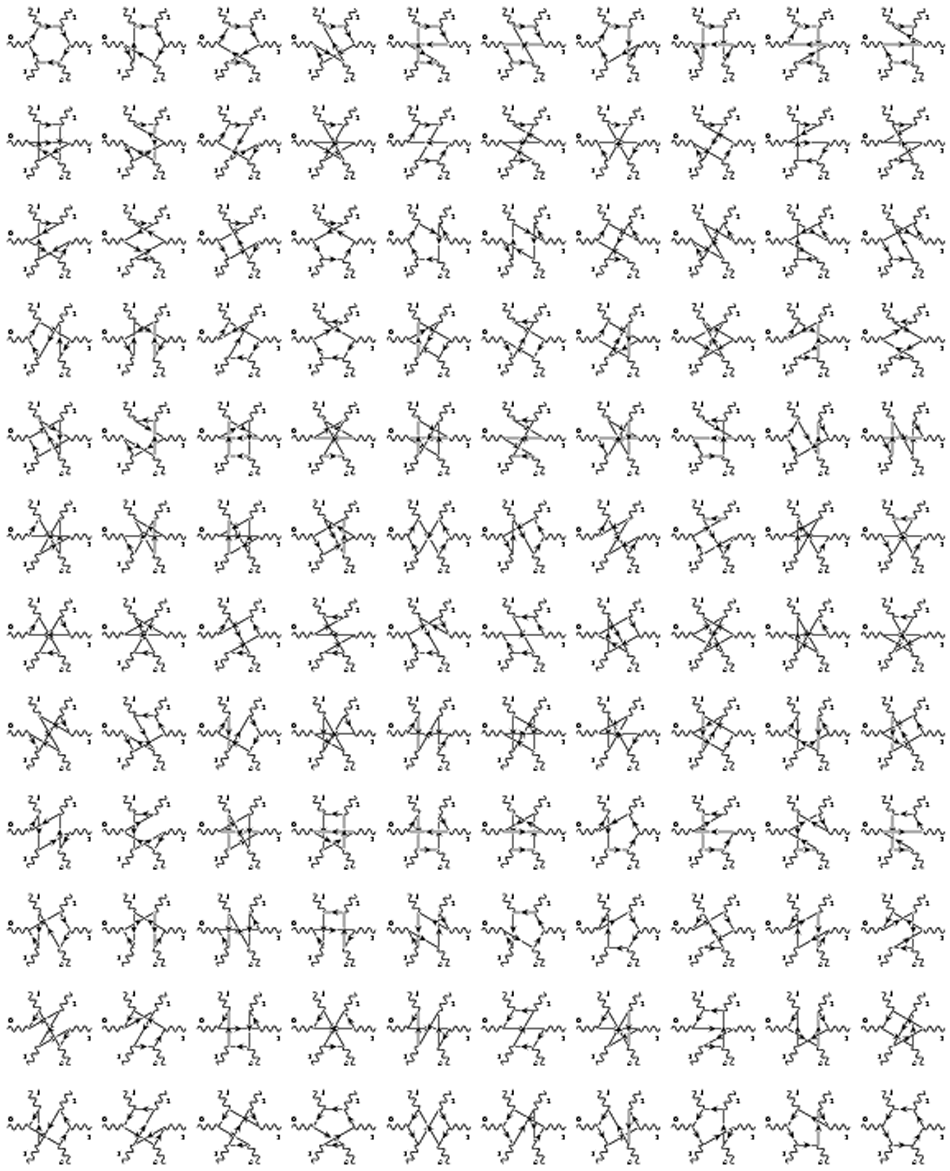
Feynman diagrams enumerate all possible sequences for a fixed set of quantum objects and events. Therefore a complete set provides intriguing design permutations and optical experiences.
Greg Mahlon's example below shows a small multiple of the 120 possible event-sequences for 6-photon scattering by means of Bill Dimm's helpful computer program at
FeynDiagram.com
Source:
http://feyndiagram.com/examples/photon6.php
Sparkline > Steve Jobs > Andy Warhol in Google results
Sparkline appearances in Google results
A few years ago I made prankish comparisons of Google results for
sparkline (a statistical graphic) with
Andy Warhol (an artist).
Andy Warhol and
sparkline ran about even.
Now, below are the Google results from searches today 2011 July 11, 2:10pm EDT:
Number of Google search results:
Sparkline 74,300,000
Steve Jobs 74,000,000
Andy Warhol 25,900,000
From their beginning around 1996, I wanted sparklines to be open source and in the public domain. My benefit and great joy is to see sparklines widely used.
The
Andy Warhol surge was partly facilitated by Google's introduction of sparklines into their API data products in 2007.
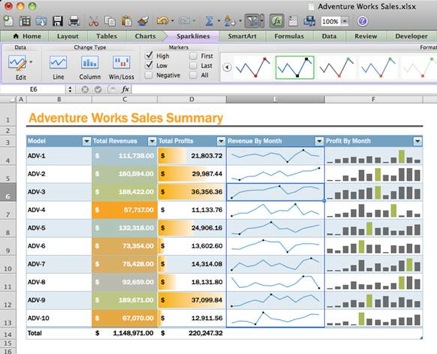
And the recent surge was largely produced by the 2009 introduction of sparklines into Microsoft's Excel 2010. I am grateful for that.
Sparklines also now appear in Mac Excel 2011:
Slopegraphs for comparing gradients: Slopegraph theory and practice
Slopegraphs compare changes usually over time for a list of nouns located on an ordinal or interval scale.
Many examples, the first from my
The Visual Display of Quantitative Information (1983):
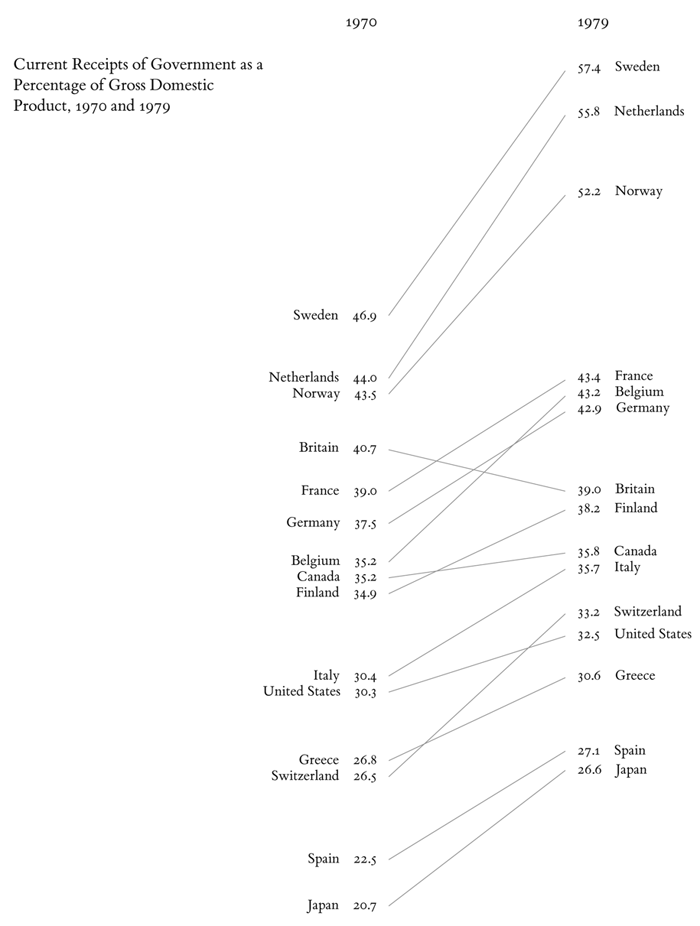
This table-graphic above organizes data for viewing in several directions. When read vertically, the chart ranks 15 countries by government tax collections in 1970 and again in 1979, with the names spaced in proportion to the percentages. Across the columns, the paired comparisons show how the numbers changed over the years. The slopes are also compared by reading down the collection of lines, and lines of unusual slope stand out from the overall upward pattern. The information shown is both integrated and separated: integrated through its connected content, separated in that the eye follows several different and uncluttered paths in looking over the data:
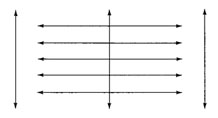
Such an analysis of the
viewing architecture of a graphic will help in creating and evaluating designs that organize complex information hierarchically.
Source: Edward Tufte,
The Visual Display of Quantitative Information, 158-159.
Below, a table showing cancer survival rates for 5, 10, 15, and 20 years.
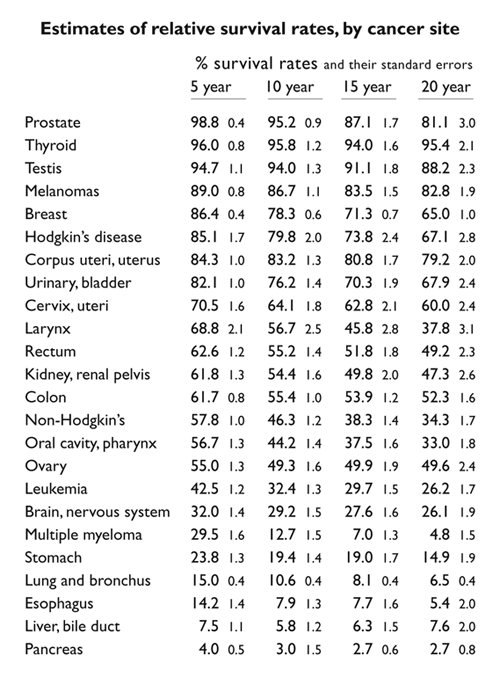
Below, this table-graphic, a slope graph, gives a rough
visual idea of time-gradients for survival for each cancer. Like the original table, every visual element in the graphic shows data.
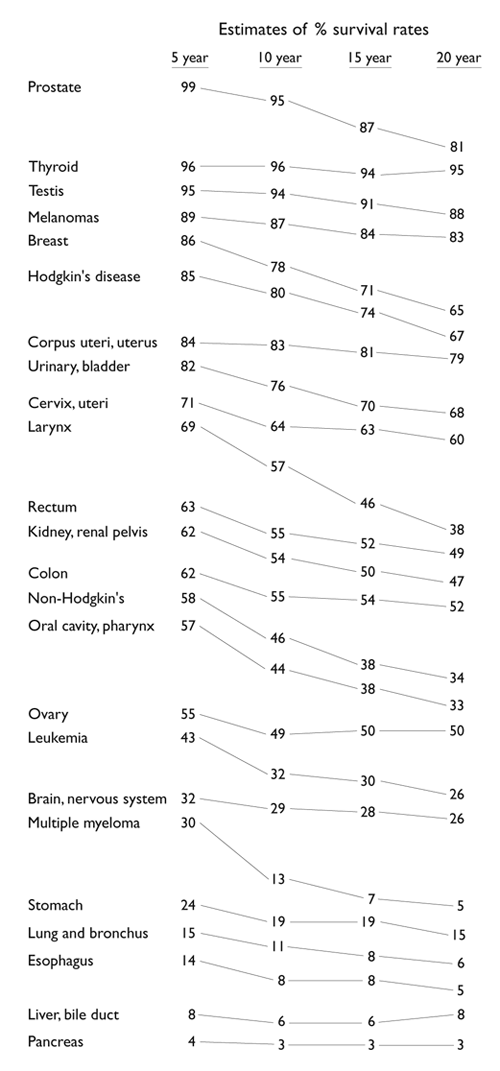
The slopes could also be sparklines showing how the detailed changes add up to the overall change.
Source: Edward Tufte,
Beautiful Evidence, 174, 176.
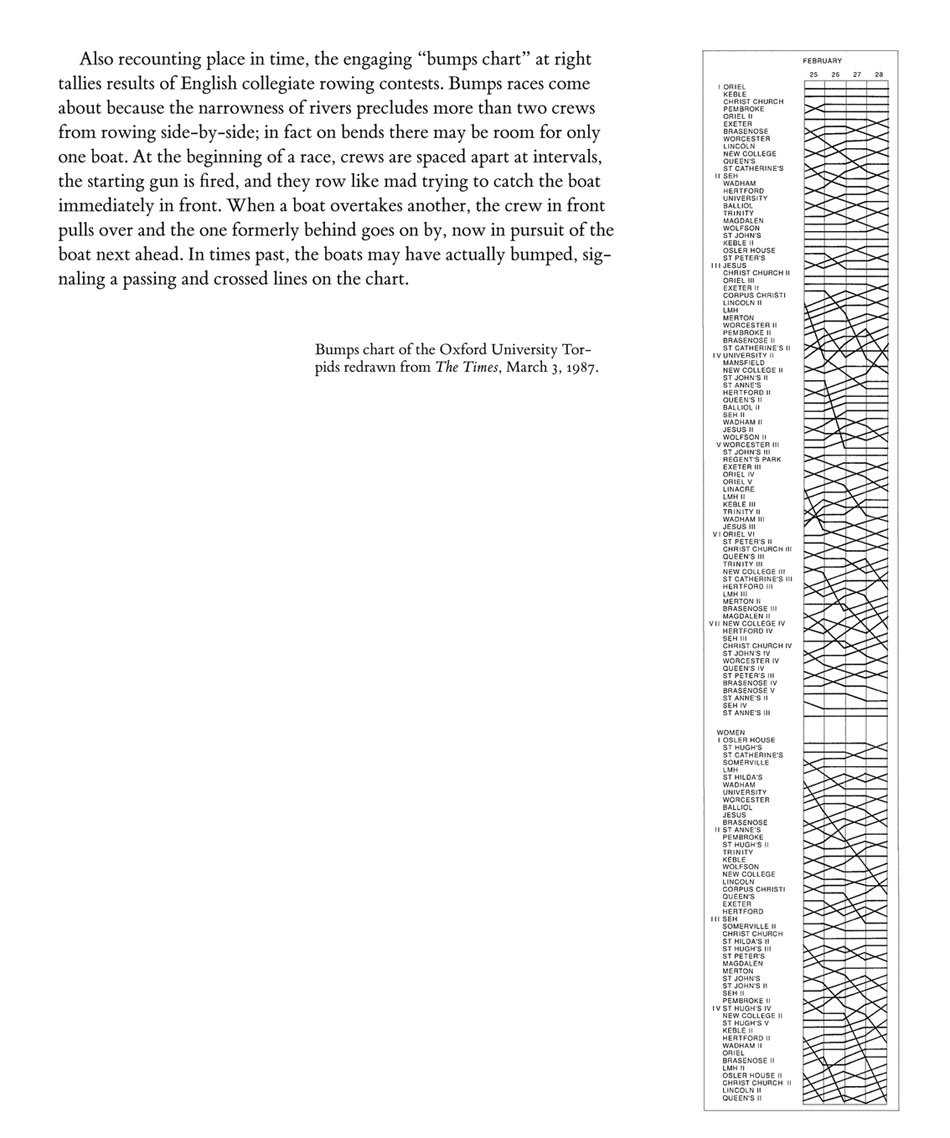
Bumps charts can also be considered slopegraphs. Here is a spectacular bumps chart from my
Beautiful Evidence (2006) pages 56-57.
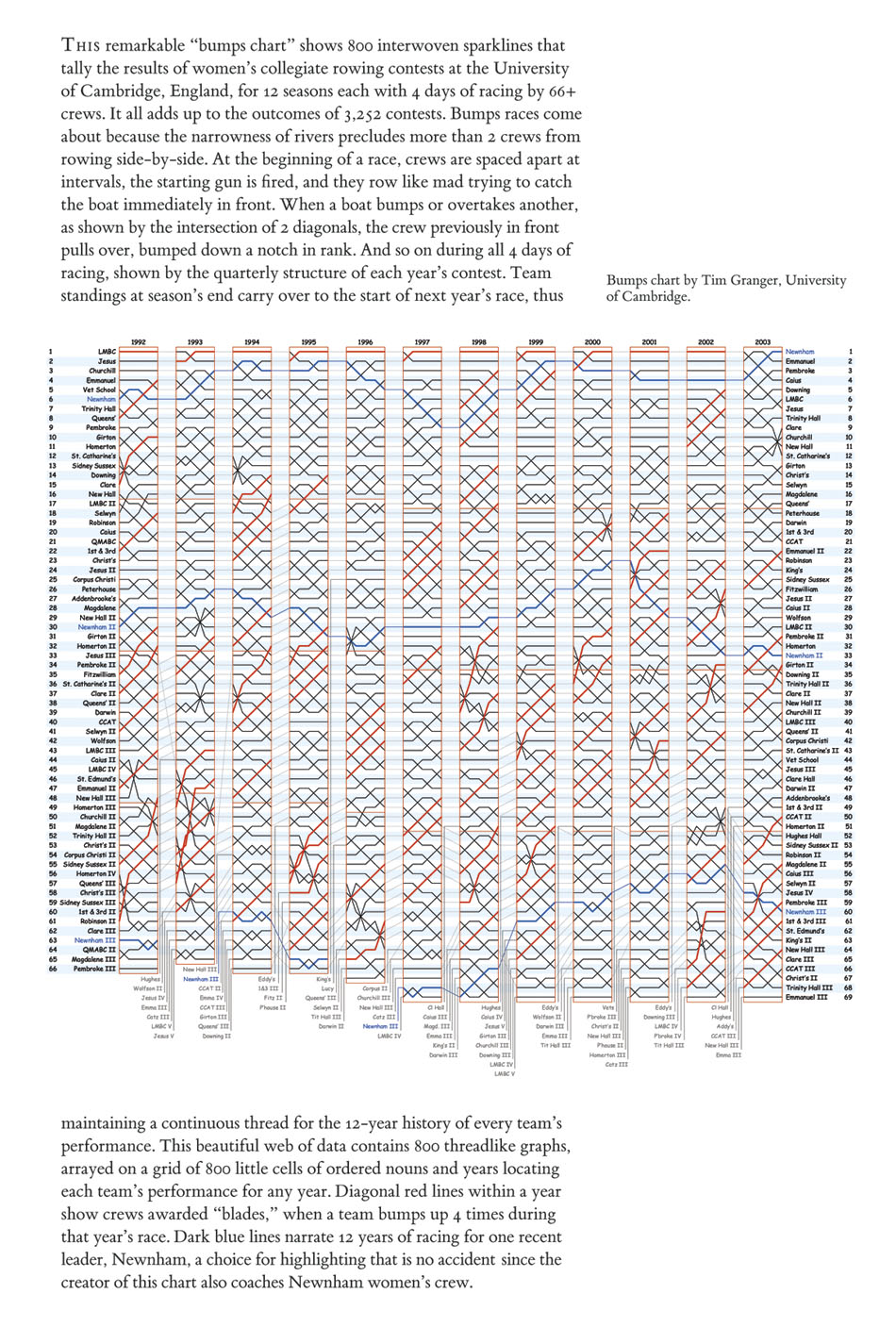
The 1987 bumps chart in my
Envisioning Information (1990), page 111, also qualifies as a slopegraph.
Although it would be better to include at the right a shuffled list of nouns.
Can our Kindly Contributors provide other examples?
An obvious candidate is the slopegraph of the average life span in 1980 and in 2010 for 50 or so countries.
January 13, 2014
Slopegraph contest:
Two winners of slopegraph contest, each receives $600 + a set of 4 books
Pascal Schetelat
https://github.com/pascal-schetelat/Slope
Excellent design and interface, good documentation of program, use of color
Ben Concutere
https://github.com/concutere/sg
http://concutere.com/sg/sg.html
Excellent design, good documentation, colors, SVG
Thanks you all! ET and the small commitee of happy judges.
The two winners should get in touch with me at etscuplture ]a t} goomail etc write a program posted on github or as a Chrome app whose output closely replicates the (1) GNP slopegraph and the (2) cancer survival slopegraph immediately below. Necessary subtleties include thin gray lines that don't crash into words/numbers, typeface Gill Sans or equally refined, tuned ordinal spacing of words at left with the line paths, probably best to make each line graph separately and then order and stack them appropriately to avoid too many line crashes. The idea is to compare slopes, with what are in effect a set of separate plots then ordered by first entry and then stacked with some optical care. User option: assign various clear but quiet colors to occasionally single out a few particular lines of interest. There should be a separate data-documentation box describing the source of the data, a link to the original data set, and the person directly responsible for the data and graph displayed. Much better if your code doesn't require a lot of extra stuff/apps to run; best if it runs in modern browsers Chrome, Safari, whatever, or as a Chrome app.
You might notify us of your entry by going down to the bottom of this thread to the "contribute" and provide a link to your entry. We will also search the web for good slopegraph programs All this is not easy. But a successful easy-to-use implementation would be a great contribution to open-source statistical graphics. Slopegraphs focus on slopes, deltas, changes; have lots of data; and have a straightforward reading even to the statistically innocent.
$1200 in prizes arbitrarily awarded. thanks, et
ET Reviews Some Books
 |
 |
William Loy, Stuart Allen, Aileen R. Buckley, and James E. Meacham
The Atlas of Oregon
The Atlas of Oregon (second edition) by William Loy, Stuart Allen, Aileen R. Buckley, and James E. Meacham is superb, ranking among the very best atlases ever. It has intense 3-dimensional resolution
in exquisitely detailed maps (in the elegant style of Stuart Allen's Raven maps). The statistical displays
are detailed, clear, often fascinating, and up-to-date. And the entire atlas is beautifully designed and
produced.
I include The Atlas of Oregon along with Atlas of Early American History by Lester J.Cappon,
Barbara Bartz Petchenik, and John Hamilton Long (Princeton 1976) among my very favorite atlases.
Anyone interested in the state of the art in information design should buy this book ($40 paperback
when discounted, $100 clothbound.) I bought The Atlas of Oregon from, of course, Powell's Books
http://www.powells.com |
|
 |
|
M. G. J. Minnaert
Light and Color in the Outdoors
This deeply perceptive book changes our own perceptions of all kinds of light and color events in the
outdoors. You will never see the same way again outdoors. Some examples involve elementary optics
(which explain the visual phenomena) but nearly all the 278 short chapters can be appreciated by the
visually alert reader. My favorite examples include dappled light, rainbows (there are always two),
and differences between reflected and transmitted light in seeing leaves and grass. The Dover edition
is fine; the Springer-Verlag edition is better with its excellent color photographs. |
|
 |
|
Probably by Francesco Colonna, translated by Joscelyn Godwin (1999)
Hypnerotomachia Poliphili: The Strife of Love in a Dream (1499)
This is a wonderful translation of an extraordinary book. Nearly 500 pages of sensual detailed
descriptions of fantasy architecture, gardens, and travels along with a short love story. Creates
a whole other world. Fun to read aloud. In my new book, Beautiful Evidence, I will have a chapter
on Hypnerotomachia Poliphili: The Strife of Love in a Dream. |
|
 |
|
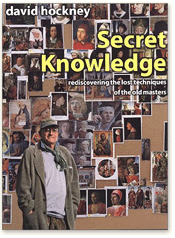
David Hockney
Secret Knowledge: Rediscovering the Lost Techniques of the Old Masters
This amazing, powerful, delightful, and beautiful book makes a strong case for the use of optical
projection methods by artists from about 1430 on. Hockney finds all sorts of telltale evidence of
lenses and mirrors (rather than only exquisite eye-brain-hand coordination) in painting and drawing
highly realistic flatland images of 3-space scenes. Hockney tells an often hilarious visual detective
story.
The book has such a wonderful intensity of seeing and thinking. The computer (presumably using
Adobe Photoshop) made it possible for Hockney to write with images and to construct a beautifully
designed and printed book.
This is one of my favorite works in art history, along with Meyer Schapiro's essay on the semiotics
of visual art (in Meyer Schapiro, Theory and Philosophy of Art: Style, Artist and Society), and
Martin Kemp's The Science of Art. Hockney, Schapiro, and Kemp provoke their readers into seeing
and thinking more deeply. |
|
 |
|
Robert Flynn Johnson and Donna Stein
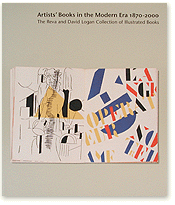
Artists' Books in the Modern Era 1870-2000: The Reva and David Logan Collection of Illustrated Books
One rainy Sunday afternoon in San Francisco last December, I went to an extraordinary show of artists'
books at the California Palace of the Legion of Honor. Artists' books are typically lavish large format
books, exquisitely printed in editions of about 50 to 200 copies, and illustrated with full-page or
double-page prints by great artists - Picasso, Matisse, Dufy, William Morris, Calder, Giacometti, Ernst,
Miró, Duchamp, Léger, Man Ray, El Lissitzky all did wonderful artists' books.
A copiously-illustrated catalog describes the 180 books in the show. The catalog is one of the finest
museum catalogs around; it was superbly designed by Jack Stauffacher and typeset in Cycles (designed
by Sumner Stone). This is a beautiful catalog about beautiful objects. There are hardcover and paper
editions of the catalog. I got my copies from William Stout Architectural Books in San Francisco,
http://www.stoutbooks.com which is a great bookstore (804 Montgomery St. 415 391-6757). |
|
 |
|
Ken Garland
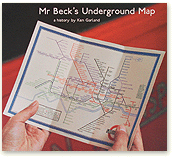
Mr Beck's Underground Map
Harry Beck's diagram of the 7+ lines of the London Underground, although geographically inaccurate,
provides a coherent overview of a complex system. With excellent color printing, classic British
railroad typography (by Edward Johnson), and, in the modern style, only horizontal, vertical, and 45
degree lines, the map became a beautiful organizing image of London. For apparently quite a number
of people, the map organized London (rather than London organizing the map). Despite 70 years of
revision due to extensions of the Underground and bureaucratic tinkering (the marketing department
wrecked the map for several years), the map nicely survives to this day.
Later European and American knock-offs did not succeed at all. The underground map and Minard's
famous Carte Figurative of the French Army's disaster in Russia in the war of 1812 are alike in
important respects: both are brilliant, and neither travels well. The underground map and Napoleon's
March are perfectly attuned to their particular data, so focused on their data sets. They do not serve,
then, as good practical generic architectures for design; indeed, revisions and knock-offs have
uniformly been corruptions or parodies of the originals. Both, however, exemplify the deep principles
of information design in operation, as well as the craft and passion behind great information displays.
There is a fine book on the map: Ken Garland, Mr Beck's Underground Map (Capital Transport
Publishing 1994). The book describes the enormous care, craft, thought, and hard work of Harry Beck
that went on for decades--exactly what it takes to do great information design and so in contrast to
the quick-and-dirty practices and thinking of commercial art. Garland's book is also a model for writing
histories of great information designs. |
|
 |
|
Eduard Imhof
Cartographic Relief Presentation
Eduard Imhof is the author of a deep and essential book, Cartographic Relief Presentation (English
translation 1982, from the original German published in 1965, Kartographische Gelandedarstellung).
Both the German and English editions were published by Walter de Gruyter, Berlin. The book is
about how to show mountains on maps (which means that it is about nearly everything, since the
book shows all sorts of methods for excaping the flatlands of paper and display screen). Topics
include contours, errors in contours, color, spot altitudes, shading, rock drawing, symbols, area
colors, interaction of design elements, and production of complex information displays.
Imhof is one of the people responsible for the great Swiss national maps, one of the best information
designs ever (see my Envisioning Information, p. 80 for a sample of the Swiss mountain maps). It is
one of the most technically sophisticated design books, so much deeper than the standard books on
graphic design.
The book is required reading for anyone serious about information and interface design. Imhof also
published many articles in cartographic journals which are also relevant to information and interface
design. Imhof's work was very helpful in my book Envisioning Information, which quotes several
long passages from Cartographic Relief Presentation. So read all the index entries under "Imhof"
in Envisioning Information to see some of his good ideas.
The book was first translated into English by various government agencies and then appeared
publicly in print in 1982. It was expensive; probably only a thousand or so copies were printed.
Many map libraries surely have the book; so search the electronic card catalogs to find the book in
a university library or map library (at, say, the US Geological Survey) near you. Perhaps the best
way to buy a copy is to place a want ad in a couple of the cartographic magazines in the US and
UK (and try cartographic discussion groups on the internet). There are also book dealers
specializing in cartography; they might not list on bookfinder.com. A used copy of the book will
probably cost $200-$500.
NOTE: A new edition was published in 2007. |
|
 |
|
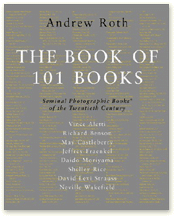
Andrew Roth
The Book of 101 Books: Seminal Photographic Books of the Twentieth Century
This is an extraordinary book, both for its content and design. The book provides a wonderful view
of 20th-century photography and photographic books, reproducing several double-page spreads (at
reduced size) from a well-chosen list of 101 great photographic books. There is so much to see and
think about here.
The catalog entries, luminously written by Vince Aletti and David Levi Strauss, provide a fairly
detailed description, history, and analysis of each of the photographic books. And there are several
essays on the history and techniques of photographic publishing; these essays are informative, smart,
learned.
This is one of the best-designed books in recent years. The typography, layout, and printing quality
are just perfect, at the very highest level of excellence. Andrew Roth and Jerry Kelly did the book
design; Sue Medlicott supervised the printing which was done superbly at the Stamperia Valdonega. |
Classic articles on statistical thinking
The Median Isn't the Message by Stephen Jay Gould
Prefatory Note by Steve Dunn
Stephen Jay Gould was influential evolutionary biologist who taught at Harvard University. He was the author of at least ten popular books on the evolution, and science, including, among others, The Flamingo's Smile, The Mismeasure of Man, Wonderful Life, and Full House.
As far as I'm concerned, Gould's The Median Isn't the Message is the wisest, most humane thing ever written about cancer and statistics. It is the antidote both to those who say that, "the statistics don't matter," and those who have the unfortunate habit of pronouncing death sentences on patients who face a difficult prognosis. Anyone who researches the medical literature will confront the statistics for their disease. Anyone who reads this will be armed with reason and with hope. The Median Isn't the Message is reproduced here by permission of the author.
My life has recently intersected, in a most personal way, two of Mark Twain's famous quips. One I shall defer to the end of this essay. The other (sometimes attributed to Disraeli), identifies three species of mendacity, each worse than the one before - lies, damned lies, and statistics.
Consider the standard example of stretching the truth with numbers - a case quite relevant to my story. Statistics recognizes different measures of an "average," or central tendency. The mean is our usual concept of an overall average - add up the items and divide them by the number of sharers (100 candy bars collected for five kids next Halloween will yield 20 for each in a just world). The median, a different measure of central tendency, is the half-way point. If I line up five kids by height, the median child is shorter than two and taller than the other two (who might have trouble getting their mean share of the candy). A politician in power might say with pride, "The mean income of our citizens is $15,000 per year." The leader of the opposition might retort, "But half our citizens make less than $10,000 per year." Both are right, but neither cites a statistic with impassive objectivity. The first invokes a mean, the second a median. (Means are higher than medians in such cases because one millionaire may outweigh hundreds of poor people in setting a mean; but he can balance only one mendicant in calculating a median).
The larger issue that creates a common distrust or contempt for statistics is more troubling. Many people make an unfortunate and invalid separation between heart and mind, or feeling and intellect. In some contemporary traditions, abetted by attitudes stereotypically centered on Southern California, feelings are exalted as more "real" and the only proper basis for action - if it feels good, do it - while intellect gets short shrift as a hang-up of outmoded elitism. Statistics, in this absurd dichotomy, often become the symbol of the enemy. As Hilaire Belloc wrote, "Statistics are the triumph of the quantitative method, and the quantitative method is the victory of sterility and death."
This is a personal story of statistics, properly interpreted, as profoundly nurturant and life-giving. It declares holy war on the downgrading of intellect by telling a small story about the utility of dry, academic knowledge about science. Heart and head are focal points of one body, one personality.
In July 1982, I learned that I was suffering from abdominal mesothelioma, a rare and serious cancer usually associated with exposure to asbestos. When I revived after surgery, I asked my first question of my doctor and chemotherapist: "What is the best technical literature about mesothelioma?" She replied, with a touch of diplomacy (the only departure she has ever made from direct frankness), that the medical literature contained nothing really worth reading.
Of course, trying to keep an intellectual away from literature works about as well as recommending chastity to Homo sapiens, the sexiest primate of all. As soon as I could walk, I made a beeline for Harvard's Countway medical library and punched mesothelioma into the computer's bibliographic search
program. An hour later, surrounded by the latest literature on abdominal mesothelioma, I realized with a gulp why my doctor had offered that humane advice. The literature couldn't have been more brutally clear: mesothelioma is incurable, with a median mortality of only eight months after discovery. I sat
stunned for about fifteen minutes, then smiled and said to myself: so that's why they didn't give me anything to read. Then my mind started to work again, thank goodness.
If a little learning could ever be a dangerous thing, I had encountered a classic example. Attitude clearly matters in fighting cancer. We don't know why (from my old-style materialistic perspective, I suspect that mental states feed back upon the immune system). But match people with the same cancer for age,
class, health, socioeconomic status, and, in general, those with positive attitudes, with a strong will and purpose for living, with commitment to struggle, with an active response to aiding their own treatment and not just a passive acceptance of anything doctors say, tend to live longer. A few months later I asked Sir Peter Medawar, my personal scientific guru and a Nobelist in immunology, what the best prescription for success against cancer might be. "A sanguine personality," he replied. Fortunately (since one can't reconstruct oneself at short notice and for a definite purpose), I am, if anything, even-tempered and confident in just this manner.
Hence the dilemma for humane doctors: since attitude matters so critically, should such a sombre conclusion be advertised, especially since few people have sufficient understanding of statistics to evaluate what the statements really mean? From years of experience with the small-scale evolution of Bahamian land snails treated quantitatively, I have developed this technical knowledge - and I am convinced that it played a major role in saving my life. Knowledge is indeed power, in Bacon's proverb.
The problem may be briefly stated: What does "median mortality of eight months" signify in our vernacular? I suspect that most people, without training in statistics, would read such a statement as "I will probably be dead in eight months" - the very conclusion that must be avoided, since it isn't so, and since attitude matters so much.
I was not, of course, overjoyed, but I didn't read the statement in this vernacular way either. My technical training enjoined a different perspective on "eight months median mortality." The point is a subtle one, but profound - for it embodies the distinctive way of thinking in my own field of evolutionary biology and natural history.
We still carry the historical baggage of a Platonic heritage that seeks sharp essences and definite boundaries. (Thus we hope to find an unambiguous "beginning of life" or "definition of death," although nature often comes to us as irreducible continua.) This Platonic heritage, with its emphasis in clear distinctions and separated immutable entities, leads us to view statistical measures of central tendency wrongly, indeed opposite to the appropriate interpretation in our actual world of variation, shadings, and continua. In short, we view means and medians as the hard "realities," and the variation that permits their calculation as a set of transient and imperfect measurements of this hidden essence. If the median is the reality and variation around the median just a device for its calculation, the "I will probably be dead in eight months" may pass as a reasonable interpretation.
But all evolutionary biologists know that variation itself is nature's only irreducible essence. Variation is the hard reality, not a set of imperfect measures for a central tendency. Means and medians are the abstractions. Therefore, I looked at the mesothelioma statistics quite differently - and not only because I am an optimist who tends to see the doughnut instead of the hole, but primarily because I know that variation itself is the reality. I had to place myself amidst the variation.
When I learned about the eight-month median, my first intellectual reaction was: fine, half the people will live longer; now what are my chances of being in that half. I read for a furious and nervous hour and concluded, with relief: damned good. I possessed every one of the characteristics conferring a probability of longer life: I was young; my disease had been recognized in a relatively early stage; I would receive the nation's best medical treatment; I had the world to live for; I knew how to read the data properly and not despair.
Another technical point then added even more solace. I immediately recognized that the distribution of variation about the eight-month median would almost surely be what statisticians call "right skewed." (In a symmetrical distribution, the profile of variation to the left of the central tendency is a mirror image of variation to the right. In skewed distributions, variation to one side of the central tendency is more stretched out - left skewed if extended to the left, right skewed if stretched out to the right.) The distribution of variation had to be right skewed, I reasoned. After all, the left of the distribution contains an irrevocable lower boundary of zero (since mesothelioma can only be identified at death or before). Thus, there isn't much room for the distribution's lower (or left) half - it must be scrunched up between zero and eight months. But the upper (or right) half can extend out for years and years, even if nobody ultimately survives. The distribution must be right skewed, and I needed to know how long the extended tail ran - for I had already concluded that my favorable profile made me a good candidate for that part of the curve.
The distribution was indeed, strongly right skewed, with a long tail (however small) that extended for several years above the eight month median. I saw no reason why I shouldn't be in that small tail, and I breathed a very long sigh of relief. My technical knowledge had helped. I had read the graph correctly. I had asked the right question and found the answers. I had obtained, in all probability, the most precious of all possible gifts in the circumstances - substantial time. I didn't have to stop and immediately follow Isaiah's injunction to Hezekiah - set thine house in order for thou shalt die, and not live. I would have time to think, to plan, and to fight.
One final point about statistical distributions. They apply only to a prescribed set of circumstances - in this case to survival with mesothelioma under conventional modes of treatment. If circumstances change, the distribution may alter. I was placed on an experimental protocol of treatment and, if fortune holds, will be in the first cohort of a new distribution with high median and a right tail extending to death by natural causes at advanced old age.
It has become, in my view, a bit too trendy to regard the acceptance of death as something tantamount to intrinsic dignity. Of course I agree with the preacher of Ecclesiastes that there is a time to love and a time to die - and when my skein runs out I hope to face the end calmly and in my own way. For most situations, however, I prefer the more martial view that death is the ultimate enemy - and I find nothing reproachable in those who rage mightily against the dying of the light.
The swords of battle are numerous, and none more effective than humor. My death was announced at a meeting of my colleagues in Scotland, and I almost experienced the delicious pleasure of reading my obituary penned by one of my best friends (the so-and-so got suspicious and checked; he too is a
statistician, and didn't expect to find me so far out on the right tail). Still, the incident provided my first good laugh after the diagnosis. Just think, I almost got to repeat Mark Twain's most famous line of all: the reports of my death are greatly exaggerated.
Postscript By Steve Dunn
Many people have written me to ask what became of Stephen Jay Gould. Sadly, Dr. Gould died in May of 2002 at the age of 60. Dr. Gould lived for 20 very productive years after his diagnosis, thus exceeding his 8 month median survival by a factor of thirty! Although he did die of cancer, it apparently wasn't mesothelioma, but a second and unrelated cancer.
In March 2002, Dr. Gould published his 1342 page "Magnum Opus", The Structure of Evolutionary Theory. It is fitting that Gould, one of the world's most prolific scientists and writers, was able to complete the definitive statement of his scientific work and philosophy just in time. That text is far too long and dense for almost any layman - but the works of Stephen Jay Gould will live on. Especially I hope, The Median Isn't The Message.
The work of Charles Joseph Minard
THE LIFE OF CHARLES JOSEPH MINARD (1781-1870)
A translation of Minard's obituary by Dawn Finley.
Source: V. Chevallier, "Notice nécrologique sur M. Minard, inspecteur général des ponts et chaussées, en retraite," Annales des ponts et chaussées, 2 (1871), 1-22.
Annals of Bridges and Roads. Memoirs and Documents Relating to the Art of Constructions and in the Service of the Engineer.
Number 15. Obituary of Mr. Minard, general inspector of bridges and roads, in retirement, by Mr. V. Chevallier, general inspector of bridges and roads. [Paris, 1871]
In the middle of our disasters, [it is sad] that the old men are not able to withstand the anguishes of the present and the threats of the future! Thus appears to have succumbed, after only several days of sickness and in the plentitude of his intellectual faculties, an eminent engineer who was about to reach ninety years and whom death seemed to have forgotten. Stationed in Paris for twenty-two years, Mr. Minard, dreading the bombardment that he foresaw, left for Bordeaux September 11, 1870, and at the end of six weeks was carried away by an attack of the fever.
In the course of his long career as an engineer, he had the good fortune to take part in almost all the great questions of public works which ushered in our century; and during his twenty years of retirement, always au courant of the technical and economic sciences, he endeavored to popularize the most salient results.
Mr. Charles Joseph Minard was born in Dijon March 27, 1781; he therefore witnessed the last days of the old regime, and he retained a profound memory of them. His father, clerk of the court and officer of the secondary school of Dijon, sought early to develop in him the taste for practical studies. He had made him learn at four years to read and to write, and at six years he took him to an elementary course in anatomy, taught by the doctor Chaussier and which keenly interested the child. Next the young Minard was sent to the secondary school at Dijon, where after having completed his fourth year early, feeling in himself little penchant for Latin and literature, he devoted himself with ardor to the study of the physical and mathematic sciences and especially their applications; and he loved to recount how at thirteen, in his totally patriotic zeal, he had wanted to extract the saltpeter from the earth of his cellar, and with what emotion he had perceived the first filaments of the crystallized salt.
At the secondary school at Dijon he began with two of his fellow students, Mr. Désormes and Mr. Clément, a very lively friendship which only increased with time. The three young students devoted themselves for hours of their free time to philosophical talks on human knowledge, and Mr. Minard certainly owed to this mutual teaching of his youth the full development of his eminently observant and practical spirit.
At fifteen and a half, he was received at the Polytechnic school, a still recent creation to which many of his compatriots had contributed, and he found his studies there in harmony with his tastes, and some professors, among others Lagrange and Fourrier, who made on him a profound impression. He left there in order to go to the School of Bridges and Roads.
This school still felt the effects of its first organization, where it had to train students who upon entering there knew only a little calculation and drawing.
The Corps of conductors, today so strongly constituted, only lent their very restrained support to the engineers; and the students, in their annual assignments, had practically exclusively to familiarize themselves with the operations of leveling, the drawing up of plans, and the practice of arithmetic.
It is in this way that Mr. Minard had first to cooperate in the leveling connected with the layout of the canal of Saint-Quentin.
Next he began studies of the canal of Charleroi in Brussels; and in order to gauge the streams which were needed to feed the canal, he embarked upon some experiments, which he published later, on the flow of the water by the openings of slender walls.
His intelligent studies had been so well appreciated that he was charged like an ordinary engineer, under the orders of the general inspector Gauthey, to finish in Paris the complete project of the canal of Charleroi, a project that the Council of Bridges and Roads had approved in 1804, but that was not carried out until 1827 by the Belgian government with very little changes.
It is during his stay in Paris that he knew Montgolfer the younger, friend of Désormes and Clément, even though much older than they; all four met together almost every Sunday, and Mr. Minard retained a great admiration for the original and inventive spirit of Montgolfer, for his eminently instructive conversation, and for his calculation in his head and his giving to all theoretical ideas practical forms.
Sent provisionally to Angers in 1805 for a service of the district, he was designated in November 1806 for the military port at Rochefort, where varied subjects of studies and applications served to supplement his technical education.
Already one of his old comrades at the Polytechnic school, Hubert, later appointed corresponding member of the Institute, resided in Rochefort as an officer of the naval engineers. Hubert practiced practical science. This was also the tendency of Mr. Minard; and the same tastes established between them a solid relationship.
Hardly having arrived, Mr. Minard, predicting the important role that iron would come to play in great public works, wished to know in depth the work of the forge [smithy], and he learned in the ateliers [workshops] of the port the trade of the blacksmith; and a long time afterwards, as superintendent of the School of Bridges and Roads, he demanded that the students at least be made to know practically the operations which iron undergoes, by carrying out under their eyes the principal handling of smelting, smithing and fitting.
Mr. Minard, in the port of Rochefort, was able to give free rein to his activity: he constructed there the busquées gates of new forms, the oil shop, the sculpture atelier, and the store with borders of iron and wooden carpentry; and each of his studies and his constructions carried the stamp of his observant and judicious spirit.
It is for the shop with the borders, in 1809, that he employed convicts as workers with as much success as economy, a fertile idea that much later in Toulon received from Mr. Bernard the happiest developments.
But his work was completed, his projects deferred: and Mr. Minard requested new occasions to deploy his activity.
In September 1810 he was sent, under the orders of the chief engineer Boitard, to Anvers first, next almost immediately to Flessingue. In this last port, the English had just destroyed the chamber walls of the lock and the wood linings of the wet dock; and it was a question of repairing the basin and of giving the lock more width and depth so that it could let the larger vessels of the time pass.
A coffer dam isolated work from the sea, but it failed to exhaust the lock and the basin. The Archimedes screw, even with the perfections it had received in Holland, had been too slow, too cumbersome, and too costly. Mr. Minard thought of using some pumps driven by a steam engine. A first application of this system had been made in the French empire at the works of Cherbourg, the second was going to be done in the far-away island of Walcheren, and it succeeded perfectly thanks to the clever provisions taken by Mr. Minard.
While rebuilding the quays of the basin, he actively occupied himself with the delicate and bold modifications that the lock was going to undergo.
The foundation raft had been originally formed, following the Dutch practice, of piling embedded on 2 meters thickness in brick masonry, and covered with a general netting with two floors. A floor was removed: a gutter was reserved in the middle of the high foundation raft to let pass the skittle of a ship of the line, and the doors rested against the busc only by one thrust of 0.15 meters; 1.19 meters depth was gained in this way. Finally the chamber walls rebuilt in recess of their first position gave to lock 17.54 meters of width on all the height; while previously this width was 14.51 meters at bottom, 16.15 meters at the top.
The lock thus remade was let open in 1812 to navigation and returned in 1815 to the Dutch government; after two strong repairs to the foundation raft in 1834 and 1841, it functioned until 1847. But at this later time it was perceived that the foundation raft was raised under the pressure of water, the hand-dredges used to unsilt the floor had pulled up the mailletage and permitted the invasion of some worms. The foundation raft was then rebuilt in masonry in the well-known shape of an inverted vault, but with a loss of more than 0.20 meters to the original depth.
The works carried out by Mr. Minard always so skillfully and so rapidly, in some very difficult circumstances, have largely contributed during thirty-five years to expand the role of the military port of Flessingue.
These works, however, Mr. Minard could not finish completely; violent attacks of the fever forced him to leave Flessingue; he left there the project of the large store which receives the tackles of the unarmed vessels.
At the beginning of 1813, after several months of rest, he was sent to Anvers, where he began a form intended for warships; at the same time he was promoted to the first class of his rank.
The foundation of this form put him in the grip of serious difficulties, and he has told in the Annales des ponts et chaussées how, despite a ceaseless surveillance, the excavations were one day unexpectedly overrun by a large irruption of sand and water. Nevertheless the principal difficulties had been happily surmounted; and the interior masonries elevated themselves up to the second bench. But after 1815 the government of the Netherlands, without doubt at the instigation of England, filled all the works, and it is on their site that one of the buildings of the warehouse rises.
Confined in the besieged town of Anvers, Mr. Minard always retained a sharp impression of some bloody episodes of the bombardment; and these are some memories which made him leave Paris last year at the approach of the Prussians.
When Anvers was evacuated, Mr. Minard was restored to service of the Bridges and Roads, and finding himself without destination, he used his forced leisure time for doing, with his friend Désormes, experiments on resistance to extension of wood, of iron, of smelting, of steel, of copper, of cannon metal, etc. The principal results of these have been recorded by Navier in his lessons on the resistance of materials (2nd ed.), and by Poncelet in his introduction to industrial mechanics.
As today, the war had destroyed many bridges: Mr. Minard was charged in January 1815 with reestablishing the communications at Trilport; and under the orders of the chief engineer Eustache, he briskly threw over the Marne a provisional bridge in framework, which was next replaced by a bridge in masonry.
Called to municipal service in Paris at the end of 1815, he applied himself there with zeal; he wanted notably to ameliorate the provisioning of pavement; and he drew up a complete project of the canal and of the railway in order to bring to Paris paving stones from the valley of Yvette and the waters of this little river. This remarkable project, the fruit of long research and of serious meditations, that Mr. Minard published in 1826, had been approved by the Council of Bridges and Roads on September 10, 1822; but the city's finances did not permit it to be completed.
It is during this stay in Paris, in 1821, that in a printed paper he refuted a theory published by a knowledgeable chief engineer, who believed to have found a new way to diminish the quantity of water that boats use in the passage of the locks, and further claimed that by a particular combination of the height of their fall with the draught of the ships, one could nullify this use and even make the water rise again in the space between two locks of the canal.
Mr. Minard, [because he was] attracted by the work and [because his] excellent services had captured the attention of the administration, was sent in September 1822 to Chalons-sur-A Sane as chief engineer of the canal of the Centre.
He had just married the second daughter of Mr. Désormes, whose elder daughter had married Mr. Clément, and to the ties of friendship were added the ties of family.
At the canal of the Centre, he made numerous and important checkings of the flow, several aqueducts and 59 pairs of lock gates.
The canal had lost a lot, especially at Vertempierre; he proposed, in order to stop it up, some masonry and some covers of hydraulic mortar which succeeded perfectly and have since been imitated in other canals. The seals especially, recovered with earth, have been generally adopted, because they are economical and durable and because they do not modify the section of the canal.
In the middle of these delicate operations a terrible blow came to strike him; a son who was entering into his second year was taken from him in a few hours by one of those pitiless illnesses that decimate children.
Thanks to the paternal benevolence of the administration, who wanted to divert him from his grief, Mr. Minard was sent on the canal of Saint-Quentin, where, as at the canal of the Centre, considerable losses rendered navigation intermittent; and the same procedures had the same successes.
The canal of Saint-Quentin received other significant improvements; Mr. Minard put up there numerous works of art, and he completed the channel of Noirieux which has an underground [depth] of 10 kilometers, archways at 5 kilometers, and which had to be sealed at 2 kilometers.
All the works of perfection were carried out on behalf of the agents of the canal, the Honoré brothers, who had naturally addressed themselves to complete the work with the engineer who had so skillfully begun it: and the administration, after having named Mr. Minard chief engineer of the first class, had authorized him in June 1827 to take a leave.
This mission brilliantly accomplished, he demanded to return to the service of the State and on November 1, 1830 he was named superintendent of the School of Bridges and Roads of which Prony had for a long time been the director; not long afterward, he received the cross of the Legion of Honor.
The old courses were insufficient, and had been rejuvenated by some skillful professors, Brisson, Navier, Coriolis, Duleau, Dufrenoy, etc.; and, in 1832, Duleau who taught all the courses of construction having been carried away by cholera, Bernard was charged with the roads and bridges and the maritime works, and Minard with inland navigation.
Additionally, Mr. Minard, in order to fill in a lack in their education, had to give the students some notion of railways.
As for the canals and rivers, he had gathered, be it in the lessons of his predecessors, be it in the memories of his own experience, all the elements of a very interesting and essentially practical course.
As for the railways, he found in France only very imperfect documents, and the roads outlined to some extent of Saint-Etienne, of Roanne and some others: he went to England, at his own expense, to research information he lacked. He visited all the railways that were in activity or under construction, not only those which for a long time served the coal mines, but especially those which would come to be devoted to travelers and merchandise, and particularly the route from Liverpool to Manchester where Robert Stephenson, in a famous contest, had so brilliantly inaugurated the reign of the locomotive.
All these documents methodically classified and analyzed, he made the subject of very substantial lessons, where nearly twenty years later one of his successors in teaching, Mr. Maniel, declared to have found an invaluable copy. The rest of his lessons, first written down by his students, have been printed, then almost immediately translated into German, after having had in Belgium, at the same moment as their appearance, the honor of [being] forged.
Besides this trip to England, Mr. Minard accomplished still five others, likewise at his own expense, in France and in foreign parts, during successive vacations from the school, gathering documents not only for the course on railways, but also for the course in inland navigation that he continued to teach, and for the course in maritime works that he would teach later.
These two important classes would be printed in 1841 and 1846; and, like the course in railways, they appeared almost simultaneously in Belgium as counterfeit.
If this last writing, which dates from the very beginning of the railways, can only be considered as a rough outline, the two others on the contrary expose the principles clearly established, so that the examples which, though sometimes few in numbers, are not the less perfectly analyzed and discussed; and more than one chapter still retains its topical interest.
But the double functions of professor and superintendent of the school became too heavy for Mr. Minard, and from 1835 he demanded to abandon these last ones and to devote himself exclusively to the courses on navigation and on railways, which constantly demanded laborious research in order to embrace all of the new works.
It is not until 1836 that the administration granted his request, by giving to him in addition the class on maritime works that Bernard had been obliged to give up.
In 1839 the administration wanted to use more completely his detailed studies and his broad experience; and it named him inspector of a division. But it had him continue his lessons so well appreciated; and only on his insistent requests did he finally prevail in 1842 to resign from his exhausting functions as a teacher, which he had exercised with so much success for ten years.
Almost at the same time that he was named inspector, he received the cross of officer of the Legion of Honor.
At the general Council of Bridges and Roads a new career opened up before him.
The time had come when it was necessary to determine in France the grand arteries of the railways. Limits of inclines, limits of the radii of the curves, technical and commercial conditions of the routes--all were to be fixed.
Thanks to the successive perfections of locomotives, we have been able to increase the superior limits of the inclines, to diminish the inferior limits of the radii of the curves.
But the true conditions of general interest that should preside over a layout have remained the same, and if they have been at first strongly controversial, one can say that they affirm themselves more and more.
In two very remarkable memoirs published in 1842 and 1843, Mr. Minard shows how much it mattered for the fruitful exploitation of the large lines to contemplate less the extreme stations than the intermediate populations.
He stated in principle that the travelers of great distances would not generally suffer to cover the expenses, that it was necessary to think especially of small distances where the far more numerous travelers were finally more productive; and that as a consequence the sketches should aim to serve as best possible the intermediate locales, even at the cost of a certain lengthening of the route. He supported by all the known examples therefore the very great importance of that which he called the partial route; in 1846, he arrived at the same conclusions when comparing the international traffic between Belgium and Prussia to the local traffic in each country; and all the subsequent facts have only confirmed the accuracy of his appraisals.
I heard him many times regret not having been able to win acceptance for his opinion of certain plans which among the others had only been adopted by a weak majority; and as one from Dijon he especially complained that the railway of Bourgogne did not better serve the rich vineyards of the translation Cté d'Or.
He was charged at first during two and a half years with the ninth inspection, which contained the Haute-Garonne, five neighboring departments, the canal of Midi, and some Mediterranean ports.
Mr. Minard had since his most tender youth frail and delicate health, which was only supported by a sober and regular life, and which resisted in this way the attacks of the weather. In 1822 he had an injured muscle on the right leg, in 1826 a sprain to the same leg; these accidents, complicated by more and more intense rheumatism, prevented him from long walks, and the trips that he was able to make by foot were always diminishing.
The remote rounds of midday, especially at this period, were too tiring for him; also despite the interest that certain works of the ninth inspection presented him, he accepted with eagerness in May 1841 the fifteenth inspection, much less distant from Paris, of a route less tiresome, and which contained only five departments, the Loire de Roanne to Orléans, the Allier and the canals of the Berri, of the Nivernais and of the Centre: however, in 1844 and 1845, he prevailed by reason of his more broken and impaired health to be excused from making his rounds. But if he lacked the bodily forces, his intellectual faculties, developed and matured by age, retained all their rigor; and in 1846, the minister of public works, Mr. Dumon, and the under-secretary of the State, Mr. Legrand, who had been able to appreciate Mr. Minard, proposed that King Louis-Philippe bring from six to seven the number of inspectors general, forming the permanent part of the Council of Bridges and Roads, and that he take as a new member an engineer versed at the same time in the two big questions of the day (maritime ports and railways), declaring that the choice should therefore bring itself naturally to Mr. Minard.
The terms of the report to the king are too flattering [to be omitted from] the text.
"Mr. Minard," the report said, "is without contest the member of the Council who has the most deepened, be it as an engineer, be it as a professor at the School of Bridges and Roads, the theory and the practice of works at sea. No member has occupied himself with more interest with the problems of railways from the point of view of political economy. His writings on these two branches of knowledge enjoy a deserved reputation."
It is in these so honorable conditions that Mr. Minard became a permanent member of the Council of Bridges and Roads where, as an inspector of a division, he only stayed one part of each year; and he went from then on to take part in the discussion of all the important questions.
Vast projects had already passed under his eyes, and others would still come to occupy the deliberations of the Council.
It is thus that as a temporary or permanent member he had to examine and discuss all of the great plans of railways, all of the projects of our principal ports of the ocean and of the Mediterranean, and all the improvements proposed for our maritime rivers; and to all of these such serious questions, he provided the tribute of his experience and his knowledge.
In most of the grand technical discussions, Mr. Minard had seen how important it was to a good solution to bring to bear the sound notions of political economy. In 1831, during his stay at the School of Bridges and Roads, he had proposed the creation of a chair for the teaching of this science, and he asked himself thus how the one who would be charged with this course should make it apply to public works. For a long time he had meditated and discussed these matters, he had read the principal economists, and in 1831 he compiled the ideas which seemed to him indispensable to engineers. He therefore submitted his memoir to the famous Jean-Baptiste Say, who wrote him a flattering letter; but Say did not publish it, limiting Minard to creating the opportunity for the application of his ideas. Finally in 1850, more and more devoted to the principles which guided him, he decided to insert in the Annales des ponts et chaussées his elementary notions of political economy applied to public works; and this memoir at once concise and substantial earned him numerous congratulations.
If one considers the difficult works carried out by Mr. Minard in the military ports and on the canals, the important services that he rendered as a professor and as a member of the Council of Bridges and Roads, his advancement may appear a little slow for the time in which he lived. The truth is that Mr. Minard did not know how to value himself, and it is only around the end of his career, when numerous and brilliant services were highly demanded of him, that just rewards came to reach him. I speak of how in 1846 a new place of general inspector had been created for him; and in 1849 he received in the Legion of Honor the cord of commander.
But a decree of 1848 had fixed at seventy years, for the general inspectors, the limit of their active career, and on March 27, 1851, Mr. Minard, while he was dining with his family, received without emotion the decree that put him in retirement dated that very day.
However, he was retained as a member of the commission of Annales des ponts et chaussées, the commission of which he had been a part since the foundation of this collection in 1831.
Those who knew him and appreciated him will certainly regret his departure at the moment when, in all the maturity of his experience and of his judgment, he could still bring to the discussion of important affairs an assistance so active and so clear. His colleagues remember that three days before his retirement, he combatted, with a perfect lucidity and grand authority, the immediate extension of the dikes of the lower Seine downstream from Quillebeuf.
The rule of the age limit, blind and merciless as death, came suddenly to take away from the Corps of Bridges and Roads one of its most eminent members.
Nevertheless, for Mr. Minard, retirement, far from resembling death, became like a second existence, and this last period of his life has not been the less busy or fulfilling.
Happy for his liberty, he came to be able henceforth to devote himself exclusively to certain studies projected or begun over a long period, and always interrupted or thwarted by the obligations of his service.
One time, however, giving in to some friends he had at the Academy of the sciences, he abandoned his life so tranquil and so well occupied in order to go to solicit anew the title of free academic; because he had already failed in 1850, and although written down as the first on the list of presentation, he had only twelve votes.
In 1852, he presented himself again and sustained a new failure. He gave up therefore all other attempts, regretting the strains of the process, but satisfied to have seen up close the savants of our time; and from then on he did not leave his independent life and the studies of his choice.
However, he did not content himself to enjoy sparingly the varied acquaintances that he had made and that he continued to acquire.
Before his retirement, he had published his treatises on construction, his notable memoirs on the partial route, and some technical notices inserted in our Annales. After his retirement, he put out a long series of research as interesting as it was varied, which only death interrupted.
Among his favorite studies, I will cite especially his figurative maps and his graphic tables, the use of which he popularized and to which he attached a well merited importance; because for the dry and complicated columns of statistical data, of which the analysis and the discussion always require a great sustained mental effort, he had substituted images mathematically proportioned, that the first glance takes in and knows without fatigue, and which manifest immediately the natural consequences or the comparisons unforeseen.
Fully convinced of the utility of these applications, he claimed their original conception with a certain pride in two booklets, one in 1865 on the graphic tables and the figurative maps, the other in 1861 on statistics.
Since his first graphic table in 1844 and his first figurative map in 1845, the subjects he treated were as follows:
Passenger traffic on the roads and railways.--- Traffic of general merchandise, and in particular of coal, cereal and wines on the water ways and railways.--- Tonnage of the sea ports of France, of Europe and of the globe.--- Consumption of meats of the butchers of Paris.--- Merchandise passing in transit by way of France.--- Importation of raw cotton in Europe, before, during, and after the war of secession in the United States.
For ten years, the public could see in an exhibition of painting the full-length portrait of the minister of public works in his office, and next to him were represented the figurative maps of Mr. Minard relating to the trade of France.
Thanks in effect to diverse ministers of public works, just as to Mr. de Franqueville, general director of bridges and roads and railways, Mr. Minard had always received from the administration powerful encouragement for his eminently useful maps.
He was able to apply this graphic mode of representation to questions entirely different, which present themselves under a totally original point of view, for example:
Research of the best placement for central administration of the post offices of Paris.--- Density of the populations in the diverse provinces of Spain (each province is covered with parallel hatchings whose spacing is proportional to the population).--- Diffusion of the primitive languages in the ancient world, after Mr. Alfred Maury.--- Comparison of the two campaigns, one of Charlemagne in 791, the other of Napoleon 1st in 1805, after Mr. Amédée Thierry.
Finally, in one of his last maps, at the end of 1869, as by a premonition of the appalling catastrophes which were going to shatter France, he emphasized the losses of men which had been caused by two great captains, Hannibal and Napoleon 1st, the one in his expedition across Spain, Gaul and Italy, the other in the fatal Russian campaign. The armies in their march are represented as flows which, broad initially, become successively thinner. The army of Hannibal was reduced in this way from 96,000 men to 26,000, and our great army from 422,000 combatants to only 10,000. The image is gripping; and, especially today, it inspires bitter reflections on the cost to humanity of the madnesses of conquerors and the merciless thirst of military glory.
Some maps were accompanied by separate explanatory texts: such are his maps, 1) of the movement of cereals in 1853 and 1857, 2) of the production of coal in Europe and the exportation of English coal, 3) of the passenger traffic on the railways of Europe.
Likewise, in August 1867, he discussed in a pamphlet the graphic tables where he had represented the principal results of free trade between France and England, and, a supporter of free trade himself, he was happy to show the advantages reaped by the two countries.
Mr. Minard has again sought in special memoirs to deepen several technical questions the importance of which he sensed.
The decomposition of certain hydraulic mortars by sea water was the object of several articles published separately or in the Annales des ponts et chaussées. Mr. Minard fights the laboratory tests proposed by Vicat, while insisting on the impossibility of condensing the action of time and of the joining together in one tank all the natural circumstances; he allows sanction of new products only [after] long experiments in free water and it is still today the only unquestionable way.
In 1856, two notes in the chronicle of the Annales called attention of the engineers to erosions which were produced by the recent rises in water levels upstream from the bridges and which had brought about the ruin of them. Mr. Minard, in a memoir published at the same time, recalled that he had announced this fact in 1841 in his Course of interior navigation; he cited, as having clearly professed the same doctrine before him, Smeaton in 1778, Mercadier in 1788. Then, by numerous examples which confirm the new facts, he asserts that the next and immediate collapse of the bridges during the rise in water level is due to erosion which then brings upstream piles and sometimes abutments.
The bay of the Seine was also the subject of several memoirs. He examined in February 1856 the nautical future of Le Havre, and in April 1859 the influence which the damming up of the Seine up to Honfleur could have on this port. Finally, in November 1864, in treating the question of the mouths of the navigable rivers, he joined to the new studies on the Seine the history of the work done to the mouths of the Rhone and the Adour.
In December 1869, he published his research on the great constructions of some ancient peoples, research where he developed as much patience as erudition. After having described these great works from a technical point of view, he considers them from a philosophic point of view, seeing in the pyramids of Egypt and of Mexico, or in the immense walls of Babylon, only the lavish pride and inhuman selfishness of their founders, but admiring the long roads constructed in Peru under the paternal administration of the Incas, and especially, by reason of its public utility, the gigantic high wall of China which has for such a long time protected this vast empire against the invasion of the Tartars.
Finally, he leaves two memoirs to which he put the closing touch.
The one, relating to the current studies of the young, contains some ideas for reform that our latest misfortunes fully justify.
The other exposes the very interesting and very instructive history of the canal of Saint-Quentin, where he made his first and his last works.
During his retirement, putting to profit the flexibility of his spirit and the extent of his knowledge, he knew how to delight by varied occupations the leisure which he gave himself.
As much as his strength permitted him, he exploited the riches of our libraries, and he followed with as much assiduity as interest certain public classes, notably those of paleontology and physiology.
He read ardently or made himself read the most important publications relating to our contemporary history, annotating certain passages in order to rectify or modify them. He could do this because since the first republic he had successively found himself in relation with several important personages, and his powerful memory recalled a crowd of interesting anecdotes which he recounted with as much spirit as discretion.
This is not all: sometimes he wrote the memories of his youth, sometimes he occupied himself with metaphysics and philosophy, sometimes finally he wrote his ideas on the music and the musicians of his time, consoling himself thus, he who had always cultivated music with passion, to be forced by the infirmities of age to give up this pleasure.
Mr. Minard wrote without pretension, thinking only to join concision and clarity, and caring little for some negligences of style provided that his thought be clearly expressed.
As a professor, he had the same qualities and knew how to seize the attention of his listeners. The students that he trained during his ten years in teaching certainly will recall his excellent and substantial lessons and his incessant efforts to maintain his classes at the level of science.
Mr. Minard, with a very upright understanding, with an insurmountable tenacity for each opinion which appeared to him just, never compromised with his convictions, seeking in the important discussions, notably for the plans of our great rail lines, only that which he believed to be [in] the general interest, without preoccupying himself with [fear of] offending some particular interests.
If this rigidity of principles and this inflexibility of character have excited against him some animosity by which he could only be honored, he knew, by his solid qualities, how to make for himself and to preserve for himself real friends; several dated from his childhood and his youth, and he had the pain of seeing them successively disappear.
In his later years, the bodily infirmities grew; he moved with more and more difficulty, but he worked always with the same ardor. He received freely those who came to see him, and he held them by the delight of his conversation. His surprising memory, his intelligence as alive as always, his regular habits, his sober life, the care with which his family surrounded him, all put at a distance the idea of a coming end. But faced with the progress of the Prussian army his imagination carried him away; and after some hesitation he decided all of a sudden, Sunday September 11, 1870, to leave Paris, his books, his papers, his intellectual riches and the office which he occupied for twenty-five years. Leaning on crutches, in the middle of this throng of women, of children and of old people who fled as he did, he left for Bordeaux with one part of his family, carrying only one light bag and some studies already begun. He endured very well the fatigues of a night journey, and barely installed at Bordeaux, without other resources than his memory, he reapplied himself to work; but six weeks after his arrival, as strongly frightened of the present as of the future, he was taken for three days by an irresistible fever, and on October 24 he returned [his] soul, full with gratitude towards God, according to his expressions, for the portion of happiness which had been given to him on this earth.
His devoted companion, one of his sons-in-law and his youngest daughter had the sad consolation of softening the bitterness of his last moments. His other daughter and his other son-in-law (the author of this notice), confined in Paris during the siege, only knew after the armistice the cruel loss they had suffered three months before.
Not having been able to pay to Mr. Minard the last respects, I wanted at least to be the faithful and impartial historian of a life so exemplary and so well filled. Would that I could have fully made known the right and just man who leaves indelible regrets with his family and his friends, the untiring savant who devoted his long existence to making himself useful, and the eminent engineer who contributed to rendering illustrious the Corps of Bridges and Roads!
Translation by Dawn Finley